
We use cookies on our website to give you an improved browser experience. View our Privacy Policy for more information. Please make your selection to opt in or out of ALL cookies here: Accept or Decline
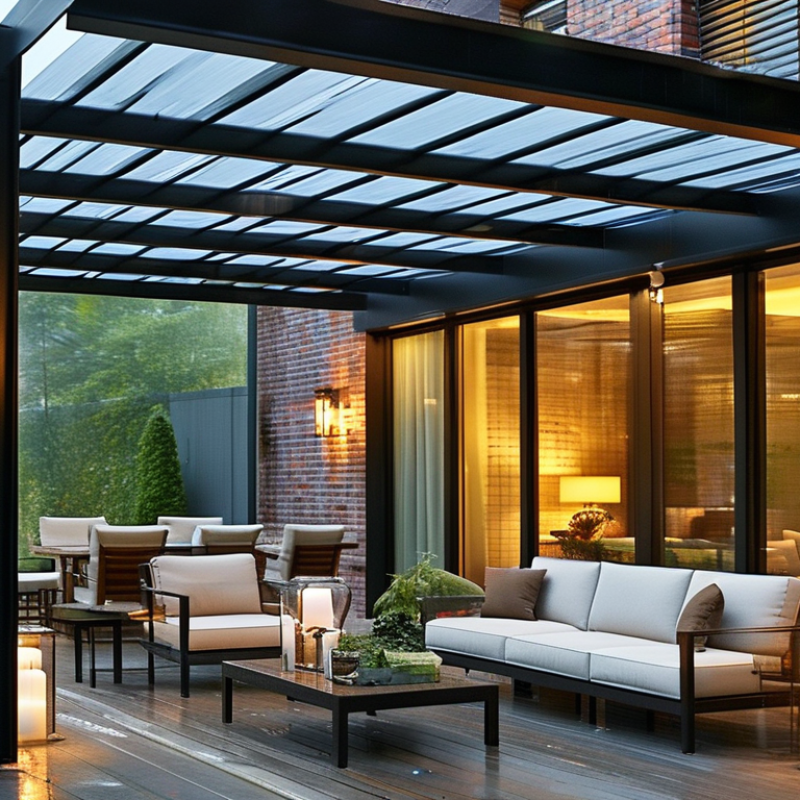
Outdoor spaces are becoming year-round extensions of the home. Louvered Roof Panels help manage sunlight, rain, airflow, and privacy with adjustable blades. Their value is practical. Open the roof for daylight. Close it during a sudden shower. Add integrated lighting, screens, or heaters for evening comfort.
The International Energy Agency reports that buildings consume about 30% of global final energy. Cooling demand continues to rise as temperatures increase. The U.S. Department of Energy also explains that exterior shading can reduce solar heat gain before sunlight reaches glass. These findings support responsive outdoor shading, although a roof system cannot replace proper insulation, ventilation, or climate-specific design. It is one layer, not a complete solution.
Building-science expert Joseph Lstiburek is widely known for the warning, “Water always wins.” That short sentence matters here. Effective Louvered Roof Panels need reliable drainage, corrosion-resistant materials, secure fasteners, and installation suited to local wind and snow conditions. Product ratings should be checked carefully. Marketing language often sounds stronger than testing evidence.
The best choice depends on more than appearance. Consider blade orientation, motor performance, gutter capacity, maintenance access, and warranty coverage. A patio in coastal Florida faces different demands than one in Toronto. Even beautiful systems can disappoint when drainage is ignored. This guide examines why Louvered Roof Panels are increasingly selected for outdoor spaces, while recognizing their limits, costs, and installation risks. The goal is not blind enthusiasm. It is a more realistic decision.
Why Choose Louvered Roof Panels for Outdoor Spaces?
Louvered roof panels use adjustable slats to control sunlight, airflow, and rain. Each blade rotates through a motorized or manual mechanism. Open slats create a bright, ventilated patio. Closed slats form a sheltered overhead surface. The roof is adjustable, not permanently sealed. That distinction matters.
ASHRAE’s 2021 Handbook—Fundamentals explains that exterior shading can block solar radiation before it reaches occupied areas. The U.S. Energy Information Administration’s 2020 Residential Energy Consumption Survey reports that about 90% of U.S. homes use air conditioning. Controlling direct sun may reduce heat entering nearby rooms, although results depend on orientation, glass area, and local weather. It is not magic.
A practical installation needs more than attractive blades. Rain channels should direct water toward visible downspouts, not across furniture. Wind-rated frames require suitable anchoring and regular fastener checks. A rain sensor can close the panels automatically, but sensors sometimes react slowly during sudden storms. The International Energy Agency’s 2023 cooling report warns that global cooling demand could more than triple by 2050 without efficiency improvements. Louvered panels may improve outdoor comfort, yet they cannot replace insulation or mechanical cooling. Perfect comfort is unlikely.
| Data Dimension | What It Is | How It Works | Practical Value |
|---|---|---|---|
| Basic Structure | A roof system made of multiple horizontal slats, commonly called louvers, supported by a surrounding frame. | The louvers rotate around pivot points to change the angle of the roof surface. | Provides adjustable shade, daylight, and airflow in one roof system. |
| Louver Material | Aluminum is widely used because it is lightweight, corrosion-resistant, and suitable for outdoor exposure. | Coated or anodized surfaces help protect the metal from moisture and ultraviolet exposure. | Reduces structural weight and can support long-term outdoor use with routine care. |
| Adjustable Opening | The roof can typically be positioned from nearly closed to open, depending on the system design. | A manual crank or motorized actuator changes the louver angle. | Allows users to respond to sun, rain, temperature, and ventilation needs. |
| Sun Control | Closed or partially closed louvers block direct sunlight and reduce glare below the roof. | Changing the louver angle controls the amount of direct solar radiation entering the space. | Improves outdoor comfort and helps protect furniture and finishes from strong sunlight. |
| Natural Ventilation | Open louvers create a path for warm air and humidity to escape. | Air moves through the roof opening while the sides of the outdoor space remain partially or fully open. | Supports a cooler, less stagnant environment without fully enclosing the area. |
| Rain Management | Many systems use interlocking louver edges and integrated gutters to manage rainfall. | When closed, overlapping slats direct water toward perimeter channels and downspouts. | Helps keep patios, decks, and outdoor seating areas usable during light to moderate rain. |
| Weather Position | A fully closed position is generally used during rain, while an open position is used during dry and mild conditions. | Users adjust the panels according to weather conditions and the manufacturer’s operating guidance. | Offers more flexibility than a permanently fixed roof. |
| Motorized Control | Motorized systems use electric actuators controlled by a wall switch, remote, or compatible control system. | The actuator rotates the louvers through a controlled range of positions. | Makes roof adjustment convenient, especially for larger installations or hard-to-reach areas. |
| Manual Control | Smaller or simpler installations may use a hand-operated crank or lever. | Mechanical force from the user changes the angle of the louvers. | Can reduce system complexity and does not require electrical power for adjustment. |
| Structural Span | The maximum unsupported span depends on louver size, frame design, wind exposure, snow load, and local building requirements. | Engineers size the posts, beams, louvers, and connections for the site-specific loads. | Proper sizing improves stability and helps the roof perform safely in its intended environment. |
| Drainage Design | Common drainage components include hollow beams, internal channels, outlets, and downspouts. | Water collected at the roof perimeter is directed through the frame and discharged at designated outlets. | Reduces uncontrolled dripping around the edges of the covered space. |
| Energy and Comfort | The roof itself does not provide the same thermal insulation as an insulated solid roof. | Comfort is improved mainly through adjustable shade, airflow, and control of direct solar exposure. | Provides passive outdoor comfort while preserving an open-air atmosphere. |
| Maintenance | Routine care usually includes removing leaves and debris, cleaning drainage paths, and checking moving parts. | Periodic inspection helps identify blocked gutters, loose fasteners, coating damage, or actuator issues. | Regular maintenance supports reliable operation and helps prevent water-management problems. |
| Best Applications | Suitable for patios, terraces, decks, courtyards, outdoor dining areas, poolside spaces, and garden seating. | The adjustable roof adapts to changing sunlight and weather throughout the day. | Extends the practical use of outdoor spaces across more seasons and conditions. |
| Important Limitation | Performance varies by design, installation quality, local climate, wind exposure, and applicable building codes. | The system should be selected, installed, and operated according to site-specific engineering and product instructions. | Helps ensure realistic expectations regarding weather protection, safety, and durability. |
Note: Actual load ratings, dimensions, drainage capacity, operating range, and weather resistance differ by system and should be confirmed through project-specific technical documentation and local building requirements.
Outdoor comfort depends on more than shade. Louvered roof panels let users adjust sunlight, airflow, and weather protection throughout the day. Rotating louvers can soften harsh midday glare while preserving gentle daylight. On warm afternoons, open gaps release trapped heat near the ceiling. Small changes matter.
Design quality begins with control. Motorized systems offer precise adjustments, while manual options remain simple and dependable. Some systems include rain sensors that close the louvers when drops reach the surface. However, sensors need regular testing. No system is perfect. A delayed response can still leave furniture damp.
Material selection shapes long-term performance. Powder-coated aluminum resists moisture and reduces structural weight when properly engineered. Concealed drainage channels guide water toward downspouts instead of letting it spill at the edges. Installers should check local wind, snow, and drainage requirements before fixing the frame. A slight roof pitch can improve runoff, although it may affect the visual balance.
Careful spacing also protects airflow without creating unwanted glare. In real projects, small detailing errors often cause larger comfort problems. Loose fasteners, poor sealing, or undersized posts can create noise and movement. Regular cleaning keeps channels clear and helps the panels operate smoothly.
Louvered roof panels give outdoor spaces adjustable shade, airflow, and greater daily usability. Unlike fixed covers, their blades can open for sunlight or close during harsh glare and light rain. This flexibility matters on patios, restaurants, and shared terraces where conditions change hourly.
The 2023 Global Status Report for Buildings and Construction reports that buildings consume about 30% of global final energy. It also attributes roughly 26% of energy-related emissions to the sector. Louvered panels cannot solve this challenge alone. However, controlled shading can reduce direct solar exposure around glazed walls and occupied areas. The U.S. Department of Energy identifies exterior shading as an effective way to limit unwanted solar heat before it reaches windows.
Comfort is more than air temperature. ASHRAE Standard 55 evaluates air speed, radiant temperature, humidity, and clothing. Open louvers can preserve breezes, while closed louvers reduce radiant heat from a bright sky. In practice, blade direction and drainage design matter greatly. Poor alignment may create hot strips of sunlight beneath the roof. Wind sensors and manual controls also require maintenance. Small details matter. A site inspection should consider sun angles, prevailing winds, rainfall, and nearby trees. These panels work best when their operation matches real outdoor habits, not just showroom demonstrations.
Louvered roof panels allow outdoor areas to adapt to changing sunlight and ventilation needs. The chart shows the idealized projected openness and shading effect at different louver angles, calculated from basic sine and cosine relationships.
As the louvers open, projected openness increases, supporting daylight and airflow. As they close, projected shading increases, helping create a more protected and comfortable outdoor space. Actual performance depends on panel geometry, installation, weather, and site orientation.
Choosing louvered roof panels begins with the material, not the color. Aluminum offers low weight, corrosion resistance, and easier handling during installation. Powder-coated finishes can protect surfaces, but scratches still require prompt attention. Steel provides strength, yet its weight demands stronger framing and careful corrosion protection. In coastal areas, ask for suitable coatings and stainless-steel fasteners. Small details matter. I have seen attractive panels fail early because dissimilar metals touched without separation. Timber may complement a garden, but it needs regular sealing and precise moisture control. Material choice should match wind exposure, rainfall, cleaning habits, and local structural requirements.
Control systems determine how comfortably the roof works each day. Manual handles are simple and dependable for smaller openings. Motorized controls allow smoother adjustment when panels are high or numerous. Sensors can respond to rain, wind, or heat, but they need correct calibration and maintenance. Keep an accessible manual override. Power interruptions happen. A wall switch, remote, or smart controller should not replace basic judgment. I prefer testing controls while standing beneath the roof, where glare, noise, and movement become obvious. This practical check often reveals problems drawings miss.
Installation begins with verified dimensions, sound foundations, and planned drainage. The frame must be level before panels and motors are fitted. Water should flow toward gutters, not pool near joints. Leave service access for wiring, lubrication, and future repairs. Installers should check fasteners, seals, movement limits, and emergency operation before handover. I once underestimated cleaning access; blocked gutters became a recurring nuisance. That mistake changed my checklist. Good installation is not only neat. It remains understandable and serviceable years later.
Louvered roof panels can make a patio more usable during bright sun or light rain. However, their value depends on your site, not appearance alone. Measure the patio’s width, height, and orientation before choosing a system. South- or west-facing areas may need stronger sun control. A nearby wall can also change wind pressure and airflow.
Check the structure carefully. Existing beams may not support the added weight, moving parts, or water loads. Ask a qualified installer to review connections, drainage, and local building requirements. Consider how the roof opens during winter, storms, and long periods of heat. Maintenance access matters too. Leaves often collect near gutters. That detail is easy to miss. Think about noise as well, especially when rain hits metal surfaces. I would also question whether adjustable shade is necessary every day. A simpler fixed cover may sometimes perform better and cost less.
Tips: Sketch the sun’s path across your patio at different times. Note where water flows after heavy rain. Compare manual and motorized controls, including repair access. Leave clearance for lights, fans, doors, and tree branches. Request written details about materials, drainage, wind resistance, and maintenance intervals. If the space feels cramped on paper, it may feel worse after installation.
We use cookies on our website to give you an improved browser experience. View our Privacy Policy for more information. Please make your selection to opt in or out of ALL cookies here: Accept or Decline
Do you consent to the use of ALL cookies?
901 2nd Court West
Birmingham, AL 35204
Sales: 866.481.4036
Logistics/Ops: 866.481.4036
2101 Dralle Road
University Park, IL 60466
Sales: 708.813.9070
Logistics/Ops: 708.235.4200
400 E. 13th Street
Little Rock, AR 72114
Sales: 866.760.5344
Logistics/Ops: 866.760.5344
225 Collins Road
Elkhart, IN 46515
Sales: 574.295.0214
Logistics/Ops: 574.607.4611
601 Berryman Pike
Tipton, IN 46072
Sales: 800.897.7591
Logistics/Ops: 800.897.7591
3900 Uvalda Street
Denver, CO 80239
Sales: 303.706.8000
Ops/Logistics: 303.576.8398
510 3rd Street E
Milan, IL 61264
Sales: 800.322.1052
Logistics/Ops: 800.322.1052
1660 E. Aurora
Des Moines, IA 50313
Sales: 800.671.1660
Logistics: 800.671.1660
86554 Gene Lasserre Blvd.
Yulee, FL 32097
Sales: 904.253.3060
Logistics/Ops: 904.225.3000
694 S.E. County Road 245
Lake City, FL 32025
Sales: 800.727.6706
Logistics/Ops: 386.752.7412
210 Neptune Road
Auburndale, FL 33823
Sales: 863.967.1131
Logistics/Ops: 863.777.9814
4601 McCoy Drive
Pensacola, FL 32503
Sales: 850.308.7030
Logistics/Ops: 850.434.5502
815 South 56th Street
Tampa, FL 33619
Sales: 813.302.1940
Logistics/Ops: 813.621.1352
200 Hosea Road
Lawrenceville, GA 30046
Sales: 770.953.7575
Logistics/Ops: 770.513.6000
Branch Product Guide
Branch Line Card
Moulding Offering
Cedar Offering
Column Offering
8173 Hwy. 165 North
Monroe, LA 71211
Sales: 800.256.4165
Logistics/Ops: 800.256.4165
508 Warren Avenue
Portland, ME 04103
Sales: 207.888.2331
Logistics/Ops: 207.797.6565
4300 Georgia Pacific Blvd.
Frederick, MD 21704
Sales: 301.798.7474
Logistics/Ops: 301.874.8000
419 Maple Street
Bellingham, MA 02019
Sales: 508.449.0535
Logistics/Ops: 508.966.5500
825 Buchanan Ave SW
Grand Rapids, MI 49507
Sales: 877.800.1180
Logistics/Ops: 616.278.0909
995 Pacific St. NW
Aitkin, MN 56431
Sales: 800.432.3727
Logistics/Ops: 218.212.7770
1102 Port Terminal Drive
Duluth, MN 55802
Sales: 800.951.9899
Logistics/Ops: 800.851.9899
9110 83rd Ave. North
Brooklyn Park, MN 55445
Sales: 763.425.0204
Logistics/Ops: 763.425.0204
910 E. Railroad Street
Long Beach, MS 39560
Sales: 866.535.4135
Logistics/Ops: 228.205.2400
1727 Warren Street
North Kansas City, MO 64116
Sales: 800.621.2611
Logistics/Ops: 800.621.2611
2123 North Golden
Springfield, MO 65803
Sales: 800.375.7891
Logistics/Ops: 800.375.7891
13860 Corp. Woods Trail
Bridgeton, MO 63044
Sales: 314.209.0800
Logistics/Ops: 314.209.0800
1109 South 19th Street
Omaha, NE 68108
Sales: 800.489.6637
Logistics/Ops: 800.489.6637
1 Luger Road
Denville, NJ 07834
Sales: 973-339-3539
Logistics/Ops: 973.625.1461
3720 Jeffrey Blvd.
Blasdell, NY 14219
Sales: 716.235.5989
Logistics/Ops: 716.825.6557
319 Yaphank Ave.
Yaphank, NY 11980
Sales: 631.358.5714
Logistics/Ops: 631.924.7401
3300 Parkside Drive
Charlotte, NC 28208
Sales: 800.839.2588
Logistics/Ops: 704.394.3172
1712 East D Street
Butner, NC 27509
Sales: 984.389.8200
Logistics/Ops: 919.575.3700
128 Foothills Drive
Statesville, NC 28687
Sales: 800.222.1414
Logistics/Ops: 704.394.3172
550 Munroe Falls Rd.
Tallmadge, OH 44278
Sales: 330.357.4506
Logistics/Ops: 330.794.1141
10347 Toebben Dr.
Independence, KY 41051
Sales: 859.298.3926
Logistics/Ops: 859.746.2250
450 N. MacArthur
Oklahoma City, OK 73127
Sales: 800.375.6025
Logistics/Ops: 800.375.6025
1680 North Aspen
Broken Arrow, OK 74012
Sales: 918.272.2212
Logistics/Ops: 918.272.2212
522 Bridge Street
Hunker, PA 15639
Sales: 878.217.2001
Logistics/Ops: 724.925.7285
4290 Atlanta Street
Charleston, SC 29418
Sales: 843.371.1420
Logistics/Ops: 843.554.8192
1040 S. Industrial Dr.
Erwin, TN 37650
Sales: 423.641.1005
Logistics/Ops: 423.742.5911
4287 Pilot Drive
Memphis, TN 38118
Sales: 901.365.2101
Logistics/Ops: 901.365.2101
700 Myatt Drive
Madison, TN 37115
Sales: 615.327.9547
Logistics/Ops: 629.777.4949
4747 Mark IV Parkway
Fort Worth, TX 76106
Sales: 866.323.5117
Logistics/Ops: 817.625.9091
6990 Market Avenue
El Paso, TX 79915
Sales: 915.778.6356
Logistics/Ops: 915.265.7200
2502 Wilson Road
Harlingen, TX 78552
Sales: 800.580.6711
Logistics/Ops: 800.580.6711
10,000 North Loop East
Houston, TX 77029
Sales: 713.921.1977
Logistics/Ops: 713.675.3544
702 East 44th St.
Lubbock, TX 79404
Sales: 866.454.6010
Logistics/Ops: 866.454.6010
535 N. WW White Road
San Antonio, TX 78219
Sales: 800.284.0488
Logistics/Ops: 210.333.8112
142 Pine Haven Shores Rd.
Shelburne, VT 05482
Sales: 802.800.2540
Logistics/Ops: 802.985.2512
4700 Bethlehem Road,
Richmond, VA 23230
Sales: 804.201.2400
Logistics/Ops: 804.342.1161
4516 N Barker Road
Spokane Valley, WA 99027
Phone: 509.892.9420
Toll free: 800.728.6157
8365 N. 76th Street
Milwaukee, WI 53223
Sales: 800.356.9245
Logistics/Ops: 800.356.9245
312 S. Chester Street
Sparta, WI 54656
Sales: 800.362.5864
Logistics/Ops: 800.362.5864
899 Grossman Drive
Schofield, WI 54476
Sales: 800.472.0017
Logistics/Ops: 800.472.0017
