
We use cookies on our website to give you an improved browser experience. View our Privacy Policy for more information. Please make your selection to opt in or out of ALL cookies here: Accept or Decline
Aluminium casement door & windows can provide clear sightlines, useful ventilation, and a clean finish in homes and commercial spaces. “Casement” describes how a sash is hinged, but the design can take many forms. This guide introduces ten common types, from single-opening windows to French casement configurations and outward-opening doors. Each option suits different room layouts, opening needs, and views.
The differences are practical. A narrow frame can admit more daylight, while a multi-panel arrangement may create a wider opening. Some styles use fixed panes beside operable sashes; others prioritize easy access to a patio or garden. Details matter. Handle position, hinge direction, glazing, drainage, and frame dimensions all affect everyday use. A kitchen window above a counter, for example, needs a different opening arrangement from a bedroom window facing a sheltered yard.
We compare each type by its layout, typical advantages, and points to check before choosing. Performance depends on more than the frame material: glazing, weather seals, installation quality, and local climate also matter. A slim profile alone does not guarantee better insulation. Not every home needs the largest opening, either. Review measurements and product specifications carefully, and consider how the sash will move around furniture, walkways, and outdoor space. Some trade-offs are easy to miss in a showroom. The right choice is the one that fits the building and how people actually use it.
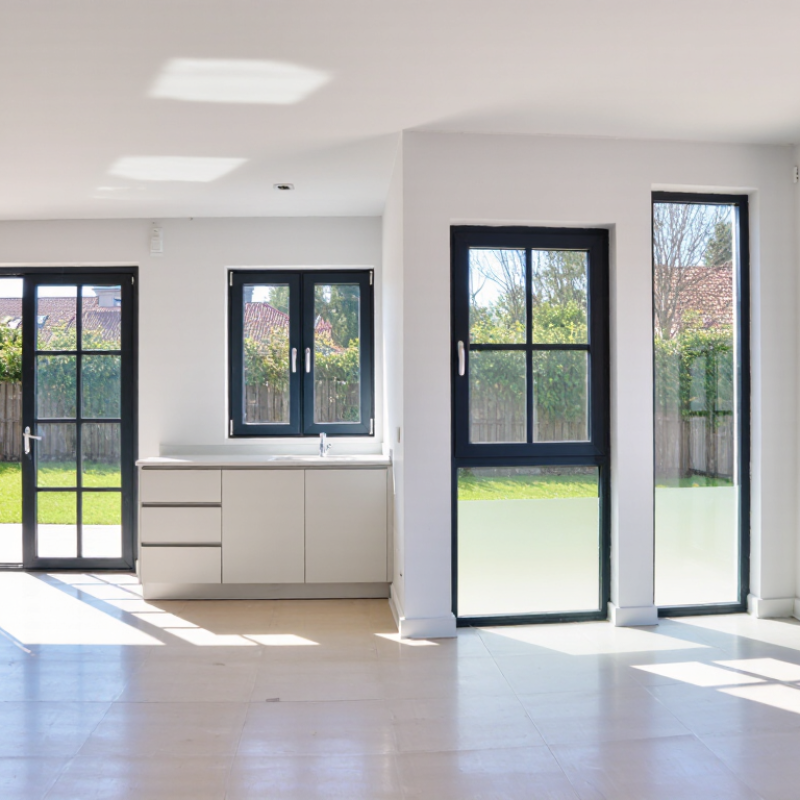
Aluminium casement doors and windows have sashes attached to their frames by side hinges. They open like doors, either inward or outward, depending on the design. A handle or locking mechanism draws the sash against weather seals when closed. Simple in principle.
Their frames are made from aluminium, a rigid, relatively light metal that can support large glass areas with slim sightlines. Many systems include thermal breaks, insulating barriers that reduce heat transfer through the frame. Glazing, seals, and careful installation also affect indoor comfort; the frame alone cannot prevent drafts or condensation. That matters. This detail is sometimes overlooked.
Casement styles suit rooms where clear views and ventilation matter. An open sash can direct a breeze indoors, though outward-opening units need clearance from paths, plants, or nearby walls. A well-fitted window should close evenly, without rubbing or visible gaps. In practice, even a good design can disappoint if the opening is measured poorly. Check hinge position, opening direction, and hardware access before choosing a configuration. Aluminium needs relatively little upkeep, but tracks and hinges still collect dust. Wipe them occasionally and inspect the seals as they age. No window is perfect; local weather and installation quality make a real difference.
Each bar shows the number of operable leaves in an example configuration. These are illustrative layouts, not industry rankings; actual designs can vary.
Aluminium casement doors and windows are defined less by their frames than by how their sashes move. A side-hung sash turns on hinges along one vertical edge, opening inward or outward like a narrow door. It gives a clear opening for fresh air, but an outward-opening sash may catch strong wind. Check the available space before choosing.
French casement designs use two side-hung sashes that meet at the centre. With no fixed post between them, the opening feels broad and works well for garden access.
A single-leaf casement is simpler: one sash opens while the rest of the frame stays fixed. Top-hung, or awning-style, casements pivot at the upper edge and can admit air while offering some shelter from light rain. Not perfect in every shower.
Some designs combine opening actions. Tilt-and-turn units tilt inward at the top for controlled ventilation, then swing inward for cleaning and access. The hardware is more complex, so smooth operation depends on accurate fitting and occasional adjustment.
Narrow-profile frames can help preserve the view, yet the sash still needs enough room to open without hitting furniture, curtains, or a walkway. For doors, consider the threshold and handle position too; a beautiful opening is less useful if everyday traffic feels awkward.
Aluminium casement designs vary by opening pattern and room use. Common window types include single-leaf casements for narrow openings, paired casements with a central mullion, and French casements that open from the middle without a fixed central post. Top-hung awning windows shed light rain when slightly open; bottom-hung units tilt inward, often for controlled ventilation. Tilt-and-turn models offer two opening modes. Small details matter.
Other common choices include a fixed-light window paired with an opening casement, corner casements that meet around a building edge, and bay-window combinations that project outward. Casement patio doors use larger hinged leaves for garden access. In practice, labels can overlap between manufacturers, so check hinge position, opening direction, and clear passage width rather than relying on names alone. That detail is easy to miss.
Performance depends on more than the aluminium frame. The U.S. Department of Energy’s Energy Saver guidance estimates that windows account for about 25–30% of residential heating and cooling energy use. That figure describes homes broadly, not every project. Glazing, seals, installation, and local climate all affect results. A slim frame may look neat, but poor fitting can still cause drafts.
Side-hung casement windows swing outward from a vertical hinge, giving rooms a wide opening for fresh air. They suit kitchens and living rooms, though nearby paths need clearance. Top-hung awning windows pivot along the upper edge, helping shed light rain while ventilating bathrooms. Bottom-hung hopper windows tilt inward from the bottom and work well in compact spaces, but their opening is modest. Fixed casements do not open; they frame views and bring daylight beside operable windows. Simple, but useful.
French casement windows use two side-hung sashes that meet without a central post, creating a broad opening for garden-facing rooms. Flush casements sit nearly level with the frame, offering a restrained look on contemporary façades. Stormproof designs overlap the outer frame when closed, which can improve weather resistance; careful installation still matters. Cottage-style casements divide the glass with narrow bars, adding a traditional pattern to smaller homes. The bars may reduce clear views.
Tilt-and-turn units combine inward tilting for controlled ventilation with a wider inward swing for cleaning. They can suit upper floors, but need interior clearance. Aluminium casement doors apply side-hung operation to a full-height opening, while French casement doors use paired leaves for a wider passage. Both are common choices for patios and balconies. Check threshold height, hardware, and opening direction before specifying any type; a beautiful opening can be awkward beside furniture.
Choosing an aluminium casement design starts with the room, not the catalogue. Note which way the window faces, how much wall space is available, and whether an open sash could block a walkway. A wide opening can bring in a welcome breeze. It can also clash with a narrow balcony. Small details matter.
Thermal performance deserves equal attention. U.S. Department of Energy Energy Saver guidance estimates that windows account for 25–30% of residential heating and cooling energy use. Ask for the unit’s U-factor and solar heat gain coefficient, then compare values suited to your climate and exposure. Lower U-factors generally indicate better insulation; a suitable solar heat gain coefficient depends on local conditions. For cold, windy sites, consider thermally broken frames, quality weather seals, and double glazing. Check the actual ratings, not just the glass description.
Think about daily use, too. Casement windows open outward, so confirm there is clearance for screens, planting, and nearby paths. Choose durable hinges and multi-point locks, and test the handle before ordering if possible. For doors, check threshold height and how the panel will swing when furniture is nearby. I’ve seen attractive plans feel awkward once a chair or plant occupies the “empty” space. That part is easy to miss. A larger glazed area may improve daylight, but frame strength, hardware, and installation still matter; the best-looking option is not always the most comfortable one.
| Design Type | How It Opens | Typical Applications | Main Benefits | Points to Consider | Choosing Tip |
|---|---|---|---|---|---|
| Side-Hung Casement Window | Hinges on one vertical side; the sash swings outward or inward. | Bedrooms, living rooms, and other rooms where a wide opening is useful. | Opens broadly for ventilation and gives access to the outside face for cleaning when safely reachable. | Allow clearance for the sash, nearby paths, plants, and exterior fittings. Wind exposure can affect operation. | Choose the hinge side to suit room layout, prevailing weather, and any nearby walls or obstructions. |
| Top-Hung Awning Window | Hinges along the top edge and opens outward from the bottom. | Kitchens, bathrooms, and locations where ventilation is wanted higher on a wall. | The outward-opening sash can help deflect some light rain while the window is partly open. | Rain protection depends on wind, sash size, and opening angle; it is not a substitute for weather protection. | Consider it where a projecting sash will not obstruct a walkway or conflict with exterior features. |
| French Casement Window | Two side-hung sashes meet in the middle and open without a fixed central mullion. | Wide window openings, garden-facing rooms, and spaces needing a broad clear opening. | Provides a wide opening when both sashes are open and creates a balanced, symmetrical appearance. | Both sashes need operating space; hardware, meeting-stile seals, and locking points require careful specification. | Check the clear opening and handle arrangement, especially if the window is intended for access or escape. |
| Flush Casement Window | A side- or top-hung sash closes level with the outer frame face. | Contemporary homes and renovation projects seeking a clean, aligned exterior look. | Creates a simple, low-profile appearance and can be specified in different opening configurations. | “Flush” describes the sash-to-frame appearance; performance depends on the complete frame, seals, glazing, and installation. | Review a full-size sample or elevation drawing to confirm sightlines and the relationship between sash and frame. |
| Fixed and Opening Casement Combination | One or more fixed panes are combined with side-hung or top-hung opening sashes. | Large window walls, living areas, and openings where ventilation is needed in selected sections. | Combines daylight and uninterrupted fixed glazing with controllable ventilation. | Fixed panes do not provide ventilation or an opening route. Large glazed areas need appropriate glass and structural design. | Place opening sashes where they are easy to reach and useful for airflow; confirm safe cleaning access for fixed panes. |
| Bay or Bow Casement Window | Multiple window units project outward from the building; individual casements may open within the arrangement. | Living rooms and other spaces where a projecting window arrangement suits the building design. | Can increase the sense of space and bring daylight from more than one direction. | Requires careful structural support, weather detailing, and coordination with interior sills and exterior drainage. | Confirm projection, support, and installation details with the project designer before selecting opening sections. |
| Corner Casement Configuration | Glazing meets at a building corner, with one or more opening casements positioned in the adjoining walls. | Rooms designed to capture views or daylight from two directions. | Creates a distinctive corner view and can increase the amount of daylight entering the room. | Corner posts, structural support, weather sealing, and the location of opening sashes need project-specific design. | Ask how the corner is supported and sealed, and make sure opening sashes have adequate clearance. |
| Egress Casement Window | A casement sash opens to provide a clear opening intended to support emergency escape where required. | Rooms where local building regulations require an emergency escape opening. | A side-hung sash can provide a substantial clear opening compared with some restricted-opening styles. | Required clear dimensions, sill height, operation, and accessibility depend on local regulations and the building. | Verify the finished clear opening with the local building authority or a qualified professional; do not rely on frame size alone. |
| Single-Leaf Casement Door | One hinged door leaf swings inward or outward from a vertical frame jamb. | Balcony, patio, side, or garden access where a single-door opening is suitable. | Provides a straightforward access route and can be glazed to connect indoor and outdoor spaces. | Needs swing clearance; threshold, weather seals, drainage, security hardware, and accessibility should be specified for the site. | Choose the swing direction and threshold detail based on traffic flow, exposure to rain, and any accessibility requirements. |
| French Casement Doors | Two hinged door leaves meet at the centre and can open separately or together. | Patio and garden openings where a wider passage is occasionally useful. | Offers a broad opening when both leaves are open and a symmetrical glazed-door appearance. | Both leaves need clearance; the inactive leaf typically uses additional locking hardware. Threshold and meeting-stile sealing matter. | Check the clear passage with both leaves open and confirm how the secondary leaf is secured during everyday use. |
We use cookies on our website to give you an improved browser experience. View our Privacy Policy for more information. Please make your selection to opt in or out of ALL cookies here: Accept or Decline
Do you consent to the use of ALL cookies?
901 2nd Court West
Birmingham, AL 35204
Sales: 866.481.4036
Logistics/Ops: 866.481.4036
2101 Dralle Road
University Park, IL 60466
Sales: 708.813.9070
Logistics/Ops: 708.235.4200
400 E. 13th Street
Little Rock, AR 72114
Sales: 866.760.5344
Logistics/Ops: 866.760.5344
225 Collins Road
Elkhart, IN 46515
Sales: 574.295.0214
Logistics/Ops: 574.607.4611
601 Berryman Pike
Tipton, IN 46072
Sales: 800.897.7591
Logistics/Ops: 800.897.7591
3900 Uvalda Street
Denver, CO 80239
Sales: 303.706.8000
Ops/Logistics: 303.576.8398
510 3rd Street E
Milan, IL 61264
Sales: 800.322.1052
Logistics/Ops: 800.322.1052
1660 E. Aurora
Des Moines, IA 50313
Sales: 800.671.1660
Logistics: 800.671.1660
86554 Gene Lasserre Blvd.
Yulee, FL 32097
Sales: 904.253.3060
Logistics/Ops: 904.225.3000
694 S.E. County Road 245
Lake City, FL 32025
Sales: 800.727.6706
Logistics/Ops: 386.752.7412
210 Neptune Road
Auburndale, FL 33823
Sales: 863.967.1131
Logistics/Ops: 863.777.9814
4601 McCoy Drive
Pensacola, FL 32503
Sales: 850.308.7030
Logistics/Ops: 850.434.5502
815 South 56th Street
Tampa, FL 33619
Sales: 813.302.1940
Logistics/Ops: 813.621.1352
200 Hosea Road
Lawrenceville, GA 30046
Sales: 770.953.7575
Logistics/Ops: 770.513.6000
Branch Product Guide
Branch Line Card
Moulding Offering
Cedar Offering
Column Offering
8173 Hwy. 165 North
Monroe, LA 71211
Sales: 800.256.4165
Logistics/Ops: 800.256.4165
508 Warren Avenue
Portland, ME 04103
Sales: 207.888.2331
Logistics/Ops: 207.797.6565
4300 Georgia Pacific Blvd.
Frederick, MD 21704
Sales: 301.798.7474
Logistics/Ops: 301.874.8000
419 Maple Street
Bellingham, MA 02019
Sales: 508.449.0535
Logistics/Ops: 508.966.5500
825 Buchanan Ave SW
Grand Rapids, MI 49507
Sales: 877.800.1180
Logistics/Ops: 616.278.0909
995 Pacific St. NW
Aitkin, MN 56431
Sales: 800.432.3727
Logistics/Ops: 218.212.7770
1102 Port Terminal Drive
Duluth, MN 55802
Sales: 800.951.9899
Logistics/Ops: 800.851.9899
9110 83rd Ave. North
Brooklyn Park, MN 55445
Sales: 763.425.0204
Logistics/Ops: 763.425.0204
910 E. Railroad Street
Long Beach, MS 39560
Sales: 866.535.4135
Logistics/Ops: 228.205.2400
1727 Warren Street
North Kansas City, MO 64116
Sales: 800.621.2611
Logistics/Ops: 800.621.2611
2123 North Golden
Springfield, MO 65803
Sales: 800.375.7891
Logistics/Ops: 800.375.7891
13860 Corp. Woods Trail
Bridgeton, MO 63044
Sales: 314.209.0800
Logistics/Ops: 314.209.0800
1109 South 19th Street
Omaha, NE 68108
Sales: 800.489.6637
Logistics/Ops: 800.489.6637
1 Luger Road
Denville, NJ 07834
Sales: 973-339-3539
Logistics/Ops: 973.625.1461
3720 Jeffrey Blvd.
Blasdell, NY 14219
Sales: 716.235.5989
Logistics/Ops: 716.825.6557
319 Yaphank Ave.
Yaphank, NY 11980
Sales: 631.358.5714
Logistics/Ops: 631.924.7401
3300 Parkside Drive
Charlotte, NC 28208
Sales: 800.839.2588
Logistics/Ops: 704.394.3172
1712 East D Street
Butner, NC 27509
Sales: 984.389.8200
Logistics/Ops: 919.575.3700
128 Foothills Drive
Statesville, NC 28687
Sales: 800.222.1414
Logistics/Ops: 704.394.3172
550 Munroe Falls Rd.
Tallmadge, OH 44278
Sales: 330.357.4506
Logistics/Ops: 330.794.1141
10347 Toebben Dr.
Independence, KY 41051
Sales: 859.298.3926
Logistics/Ops: 859.746.2250
450 N. MacArthur
Oklahoma City, OK 73127
Sales: 800.375.6025
Logistics/Ops: 800.375.6025
1680 North Aspen
Broken Arrow, OK 74012
Sales: 918.272.2212
Logistics/Ops: 918.272.2212
522 Bridge Street
Hunker, PA 15639
Sales: 878.217.2001
Logistics/Ops: 724.925.7285
4290 Atlanta Street
Charleston, SC 29418
Sales: 843.371.1420
Logistics/Ops: 843.554.8192
1040 S. Industrial Dr.
Erwin, TN 37650
Sales: 423.641.1005
Logistics/Ops: 423.742.5911
4287 Pilot Drive
Memphis, TN 38118
Sales: 901.365.2101
Logistics/Ops: 901.365.2101
700 Myatt Drive
Madison, TN 37115
Sales: 615.327.9547
Logistics/Ops: 629.777.4949
4747 Mark IV Parkway
Fort Worth, TX 76106
Sales: 866.323.5117
Logistics/Ops: 817.625.9091
6990 Market Avenue
El Paso, TX 79915
Sales: 915.778.6356
Logistics/Ops: 915.265.7200
2502 Wilson Road
Harlingen, TX 78552
Sales: 800.580.6711
Logistics/Ops: 800.580.6711
10,000 North Loop East
Houston, TX 77029
Sales: 713.921.1977
Logistics/Ops: 713.675.3544
702 East 44th St.
Lubbock, TX 79404
Sales: 866.454.6010
Logistics/Ops: 866.454.6010
535 N. WW White Road
San Antonio, TX 78219
Sales: 800.284.0488
Logistics/Ops: 210.333.8112
142 Pine Haven Shores Rd.
Shelburne, VT 05482
Sales: 802.800.2540
Logistics/Ops: 802.985.2512
4700 Bethlehem Road,
Richmond, VA 23230
Sales: 804.201.2400
Logistics/Ops: 804.342.1161
4516 N Barker Road
Spokane Valley, WA 99027
Phone: 509.892.9420
Toll free: 800.728.6157
8365 N. 76th Street
Milwaukee, WI 53223
Sales: 800.356.9245
Logistics/Ops: 800.356.9245
312 S. Chester Street
Sparta, WI 54656
Sales: 800.362.5864
Logistics/Ops: 800.362.5864
899 Grossman Drive
Schofield, WI 54476
Sales: 800.472.0017
Logistics/Ops: 800.472.0017
