
We use cookies on our website to give you an improved browser experience. View our Privacy Policy for more information. Please make your selection to opt in or out of ALL cookies here: Accept or Decline
A square manhole cover is more than a flat plate over an underground opening. It is a load-bearing access component. Trucks, bicycles, rainwater, and repeated braking all test its performance.
The global manhole covers market was valued at about USD 3.8 billion in 2023, according to Fortune Business Insights. The report expects continued growth through 2030. That forecast sounds encouraging. Yet market value does not prove field reliability. Installation quality still matters. The U.S. Environmental Protection Agency’s 2023 Clean Watersheds Needs Survey identified roughly USD 630 billion in national wastewater infrastructure needs over twenty years. Access points form a small visible part of that system, but their failures create noise, ponding, damage, and public complaints.
Engineer John M. Tobiasson, known for research on utility-cover design, emphasized a practical principle: “A manhole cover is a structural component, not merely a lid.” That idea explains why square manhole covers require careful attention to frame support, load class, drainage, locking features, and corrosion resistance. ASTM A48 cast iron specifications and EN 124 load classifications provide useful reference points, although local requirements must be checked.
A strong cover can still fail.
A poorly seated frame may rock beneath a vehicle tire. A blocked channel can trap water around the opening. Designers should also question whether a square shape suits the traffic pattern, maintenance method, and surrounding pavement. This guide examines those decisions with evidence, not assumptions.
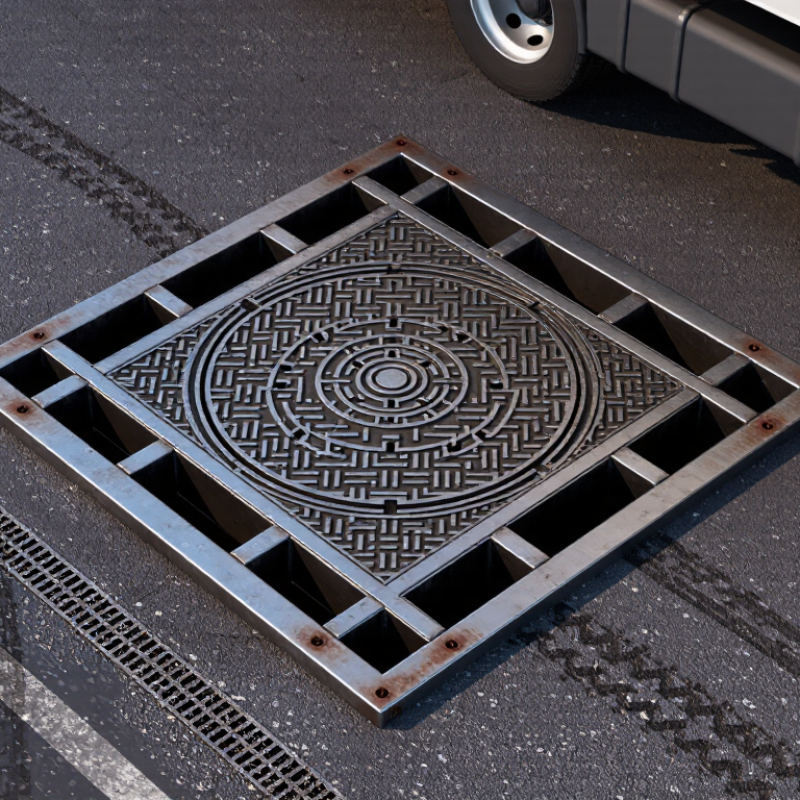
A square manhole cover is a removable access panel used to protect openings above underground spaces. These spaces may contain drainage lines, electrical conduits, communication cables, or service chambers. Unlike a round cover, its four straight sides create a clear, practical outline for paved areas and indoor utility rooms.
Its basic characteristics include a rigid frame, a fitted cover, and a textured surface that helps reduce slipping. Common materials include ductile iron, steel, and reinforced composite materials. The selected material should match the expected load, weather exposure, and maintenance conditions. A cover beside a roadway needs different strength from one inside a pedestrian courtyard.
The frame supports the surrounding pavement and keeps the cover positioned correctly. Small drainage gaps may prevent water from collecting around the edge. Many square covers include lifting slots, but these openings should not weaken the panel. They should also allow safe handling with suitable tools. Heavy covers are not casual lifting objects. Installation requires a level seat, accurate measurements, and proper load classification. A square shape does not automatically make a cover safer or stronger. I have seen poor fitting cause rocking, noise, and damaged edges. That detail is easy to overlook. Local construction standards should guide dimensions, testing, and installation, because requirements vary by location and application.
What Is a Square Manhole Cover?
Key Materials and Structural Components
A square manhole cover consists of a removable lid and a supporting frame. The frame transfers traffic loads into the surrounding pavement. The lid closes the access opening and protects workers, soil, and drainage channels from falling debris.
Ductile iron remains common because it combines high strength with useful impact resistance. Steel can provide reliable structural performance, but it needs effective corrosion protection. Polymer-composite covers are lighter and resist rust, although their long-term behavior depends on resin quality, reinforcement, temperature, and repeated loading. No material wins everywhere. A lighter cover is easier to lift, but lighter is not automatically safer.
The structural details matter as much as the material. A wide seating lip spreads pressure across the frame. A textured surface improves tire and foot traction during rain. Hinges reduce misplaced lids, while locking devices limit unauthorized access. Drainage channels prevent water from remaining around the frame. The fit should be stable, without rocking or sharp edge contact.
EN 124-2:2015 defines load classes from A15, rated at 15 kN, to F900, rated at 900 kN. A D400 cover, rated at 400 kN, is commonly selected for carriageways, but site conditions still require engineering judgment. The American Society of Civil Engineers gave U.S. wastewater infrastructure a D+ in its 2021 Infrastructure Report Card. That rating reflects broader system pressure, not only covers, yet it highlights why inspection and maintenance cannot be treated as minor tasks. Even a well-designed cover can fail early when its frame is poorly installed.
| Category | Component or Material | Typical Data | Structural Function | Important Considerations |
|---|---|---|---|---|
| Basic Form | Square cover and frame | Common nominal clear openings include approximately 450 × 450 mm, 600 × 600 mm, and 900 × 900 mm. | Provides access to underground drainage, utility, inspection, and service chambers. | Actual external dimensions, clear opening, and depth vary according to the chamber design and applicable local requirements. |
| Primary Material | Ductile iron | High-strength iron containing graphite in a nodular form; commonly selected for vehicular and utility access covers. | Resists bending, impact, wear, and repeated wheel loading while allowing relatively compact sections. | Corrosion protection may include coating, painting, or other specified treatments. Material grade and casting quality should be verified from the product specification. |
| Primary Material | Grey cast iron | Iron with flake graphite; generally more brittle and less impact-resistant than ductile iron. | Provides compressive strength and mass for light-duty access applications. | Not normally the first choice where heavy traffic, impact, or significant deformation resistance is required. |
| Primary Material | Carbon or stainless steel | Steel plates and fabricated sections can be produced in various thicknesses and profiles. | Offers high tensile strength and can be adapted for reinforced covers, hinged assemblies, or special access requirements. | Carbon steel requires corrosion protection; stainless steel improves corrosion resistance but generally increases material cost. |
| Alternative Material | Polymer concrete or fibre-reinforced composite | Non-metallic construction with lower density than iron-based covers. | Reduces lifting weight and can provide resistance to moisture, salts, and some chemical environments. | Load capacity, ultraviolet resistance, fire performance, and long-term creep behavior must be checked for the intended installation. |
| Load Classification | EN 124 load classes | A15: 15 kN; B125: 125 kN; C250: 250 kN; D400: 400 kN; E600: 600 kN; F900: 900 kN test load. | Indicates the tested load category for a cover and frame assembly under the relevant standard. | The correct class depends on the installation location, traffic exposure, support conditions, and the standard adopted for the project. |
| Load-Bearing Part | Cover plate or lid | May be solid, recessed, perforated, or fitted with a non-slip surface; thickness and rib layout depend on the required load class. | Transfers pedestrian, wheel, and impact loads to the supporting frame. | A square lid should be designed to prevent rocking, excessive deflection, and accidental displacement during service. |
| Stiffening System | Underside ribs or reinforcing bars | Ribs are commonly arranged as transverse, longitudinal, diagonal, or grid-like supports. | Increases bending stiffness and distributes concentrated loads across the cover. | Rib geometry must leave sufficient clearance for the frame, lifting tools, drainage, and maintenance access. |
| Support Component | Frame and bearing flange | The frame surrounds the clear opening and provides a continuous seating surface for the lid. | Transfers loads from the cover into the chamber surround, concrete collar, or supporting structure. | Correct leveling, full bearing contact, and adequate surrounding concrete support are essential to reduce rocking and edge failure. |
| Seating Detail | Machined or fitted bearing surfaces | Contact surfaces may be flat, tapered, or fitted with an elastomeric noise-reduction insert. | Improves stability and can reduce vibration, rattling, and impact between the lid and frame. | Debris, poor alignment, and worn inserts can prevent full contact and may create unsafe movement under traffic. |
| Security Feature | Locking mechanism | Options include captive bolts, key-operated locks, spring latches, or tamper-resistant fasteners. | Helps prevent unauthorized opening, theft, and accidental displacement. | The mechanism should remain accessible for authorized maintenance and resist corrosion in the installation environment. |
| Access Feature | Lifting keyholes or access slots | Openings are positioned to accept compatible lifting tools and may be recessed or protected. | Allows safe removal of the cover without damaging the lid or frame. | Opening dimensions and spacing should match the specified lifting tool and should not create a trip hazard when the lid is installed. |
| Optional Feature | Hinges and captive retention | A hinged lid remains connected to the frame and may include a locking or opening-limiting device. | Reduces the risk of lid loss and improves handling during inspection and maintenance. | Hinge pins, stops, and retainers must be designed for repeated operation and protected against blockage by dirt or corrosion. |
| Surface Treatment | Protective coating or finish | Common approaches include bituminous coatings, paint systems, powder coatings, galvanizing, or corrosion-resistant alloys. | Helps protect the cover and frame from moisture, de-icing salts, wastewater exposure, and soil contact. | Coating selection should account for abrasion, chemical exposure, surface preparation, and the expected service environment. |
| Installation | Concrete surround and bedding | A stable, level surround is required to support the frame continuously around the opening. | Distributes applied loads into the surrounding pavement or chamber structure. | Insufficient support, uneven bedding, or premature loading can cause settlement, cracking, frame distortion, and cover rocking. |
| The dimensions and material choices shown are typical engineering options rather than universal requirements. Final selection should follow the applicable local standard, site loading, chamber design, environmental exposure, and manufacturer-certified test data. | ||||
What Is a Square Manhole Cover?
A square manhole cover is a removable access panel fitted over an underground chamber. It usually serves utility vaults, drainage pits, cable chambers, and service trenches. Unlike circular covers, square covers align naturally with tiled paths, concrete grids, and building service rooms. Their straight edges can simplify paving work and reduce awkward cutting around the opening.
Common Applications and Installation Settings
Square covers are often installed on sidewalks, courtyards, parking areas, and indoor mechanical rooms. In utility zones, they provide access to electrical, communication, water, or drainage equipment. Light-duty versions suit pedestrian areas, while reinforced covers support vehicles and warehouse traffic. The correct load class matters more than appearance.
Installation begins with a stable frame set into sound concrete. The frame must remain level with the finished surface. A slight height error can collect water or create a trip hazard. Installers should check the clear opening, frame dimensions, cover thickness, and lifting access before ordering. Drainage around the frame also deserves attention, especially in regions with heavy rain or frost.
A practical detail is often missed. Covers need firm, even support on every bearing edge. Debris, uneven bedding, or damaged frames can cause rocking and noise. I have seen small alignment mistakes become expensive repairs. Still, site conditions vary, and a standard detail may not fit every project. Local structural requirements and an engineer’s review should guide final selection for heavily loaded areas.
square manhole covers are commonly selected according to the expected traffic and installation environment. The EN 124 load classes range from A15 for pedestrian areas to F900 for locations exposed to exceptionally high wheel loads. Typical applications include sidewalks, parking areas, roadways, industrial yards, airports, and ports.
A square manhole cover is a removable, load-bearing lid fitted over an underground access chamber. Its shape can simplify paving layouts and provide stable seating when the frame is correctly installed. However, a square cover is not automatically safer. The frame, hinges, locking system, and surrounding pavement must work together.
Safety begins with the correct load class. EN 124-1:2015 and EN 124-2:2015 classify covers from A15 to F900. A15 supports 1.5 tonnes for pedestrian areas, while B125 supports 12.5 tonnes on footways and similar spaces. C250 reaches 25 tonnes near kerbs, and D400 supports 40 tonnes on carriageways. E600 and F900 are intended for heavy industrial or exceptional traffic zones. These figures describe test loads, not a promise of unlimited service life.
A rating alone can mislead. Site engineers should check traffic frequency, impact loads, drainage, corrosion, and installation quality. A delivery truck turning over a poorly seated cover can create sharp movement and noise. Small details matter. The frame should sit level with the pavement, with full bedding support beneath it. Anti-rocking features, secure lifting points, and controlled access reduce maintenance risks. In practice, conditions rarely behave so neatly. That assumption deserves doubt. Periodic inspection should look for cracked concrete, displaced frames, worn hinges, and damaged bearing surfaces before failure becomes visible to pedestrians.
A square manhole cover protects an underground access point from traffic, water, and debris. Its four-sided design can simplify alignment, but it still demands careful maintenance. A loose cover can rock under a vehicle and damage the surrounding pavement.
Routine maintenance starts with a visual check around the frame. Remove sediment, leaves, and standing water before opening the access point.
Inspect the cover for cracks, corrosion, bent edges, and missing lifting holes. Check the frame for movement or broken concrete. If the cover rocks, treat it as a safety concern. Do not ignore unusual noise.
Inspection records should include the location, date, surface condition, and observed defects. A clear photo can support repair decisions. Measure the opening before ordering a replacement. In practice, records are rarely perfect. A forgotten measurement can delay the work.
Replacement requires matching the opening, frame depth, load rating, and surface level. Confirm local requirements before selecting materials. The new cover should sit evenly, without rocking or gaps. Never lift heavy covers alone. Use suitable lifting tools and keep the work area controlled. After installation, check that the cover remains stable under normal site conditions. Traffic, drainage, and repeated freezing can expose weaknesses later. A “finished” repair may still need follow-up inspection.
We use cookies on our website to give you an improved browser experience. View our Privacy Policy for more information. Please make your selection to opt in or out of ALL cookies here: Accept or Decline
Do you consent to the use of ALL cookies?
901 2nd Court West
Birmingham, AL 35204
Sales: 866.481.4036
Logistics/Ops: 866.481.4036
2101 Dralle Road
University Park, IL 60466
Sales: 708.813.9070
Logistics/Ops: 708.235.4200
400 E. 13th Street
Little Rock, AR 72114
Sales: 866.760.5344
Logistics/Ops: 866.760.5344
225 Collins Road
Elkhart, IN 46515
Sales: 574.295.0214
Logistics/Ops: 574.607.4611
601 Berryman Pike
Tipton, IN 46072
Sales: 800.897.7591
Logistics/Ops: 800.897.7591
3900 Uvalda Street
Denver, CO 80239
Sales: 303.706.8000
Ops/Logistics: 303.576.8398
510 3rd Street E
Milan, IL 61264
Sales: 800.322.1052
Logistics/Ops: 800.322.1052
1660 E. Aurora
Des Moines, IA 50313
Sales: 800.671.1660
Logistics: 800.671.1660
86554 Gene Lasserre Blvd.
Yulee, FL 32097
Sales: 904.253.3060
Logistics/Ops: 904.225.3000
694 S.E. County Road 245
Lake City, FL 32025
Sales: 800.727.6706
Logistics/Ops: 386.752.7412
210 Neptune Road
Auburndale, FL 33823
Sales: 863.967.1131
Logistics/Ops: 863.777.9814
4601 McCoy Drive
Pensacola, FL 32503
Sales: 850.308.7030
Logistics/Ops: 850.434.5502
815 South 56th Street
Tampa, FL 33619
Sales: 813.302.1940
Logistics/Ops: 813.621.1352
200 Hosea Road
Lawrenceville, GA 30046
Sales: 770.953.7575
Logistics/Ops: 770.513.6000
Branch Product Guide
Branch Line Card
Moulding Offering
Cedar Offering
Column Offering
8173 Hwy. 165 North
Monroe, LA 71211
Sales: 800.256.4165
Logistics/Ops: 800.256.4165
508 Warren Avenue
Portland, ME 04103
Sales: 207.888.2331
Logistics/Ops: 207.797.6565
4300 Georgia Pacific Blvd.
Frederick, MD 21704
Sales: 301.798.7474
Logistics/Ops: 301.874.8000
419 Maple Street
Bellingham, MA 02019
Sales: 508.449.0535
Logistics/Ops: 508.966.5500
825 Buchanan Ave SW
Grand Rapids, MI 49507
Sales: 877.800.1180
Logistics/Ops: 616.278.0909
995 Pacific St. NW
Aitkin, MN 56431
Sales: 800.432.3727
Logistics/Ops: 218.212.7770
1102 Port Terminal Drive
Duluth, MN 55802
Sales: 800.951.9899
Logistics/Ops: 800.851.9899
9110 83rd Ave. North
Brooklyn Park, MN 55445
Sales: 763.425.0204
Logistics/Ops: 763.425.0204
910 E. Railroad Street
Long Beach, MS 39560
Sales: 866.535.4135
Logistics/Ops: 228.205.2400
1727 Warren Street
North Kansas City, MO 64116
Sales: 800.621.2611
Logistics/Ops: 800.621.2611
2123 North Golden
Springfield, MO 65803
Sales: 800.375.7891
Logistics/Ops: 800.375.7891
13860 Corp. Woods Trail
Bridgeton, MO 63044
Sales: 314.209.0800
Logistics/Ops: 314.209.0800
1109 South 19th Street
Omaha, NE 68108
Sales: 800.489.6637
Logistics/Ops: 800.489.6637
1 Luger Road
Denville, NJ 07834
Sales: 973-339-3539
Logistics/Ops: 973.625.1461
3720 Jeffrey Blvd.
Blasdell, NY 14219
Sales: 716.235.5989
Logistics/Ops: 716.825.6557
319 Yaphank Ave.
Yaphank, NY 11980
Sales: 631.358.5714
Logistics/Ops: 631.924.7401
3300 Parkside Drive
Charlotte, NC 28208
Sales: 800.839.2588
Logistics/Ops: 704.394.3172
1712 East D Street
Butner, NC 27509
Sales: 984.389.8200
Logistics/Ops: 919.575.3700
128 Foothills Drive
Statesville, NC 28687
Sales: 800.222.1414
Logistics/Ops: 704.394.3172
550 Munroe Falls Rd.
Tallmadge, OH 44278
Sales: 330.357.4506
Logistics/Ops: 330.794.1141
10347 Toebben Dr.
Independence, KY 41051
Sales: 859.298.3926
Logistics/Ops: 859.746.2250
450 N. MacArthur
Oklahoma City, OK 73127
Sales: 800.375.6025
Logistics/Ops: 800.375.6025
1680 North Aspen
Broken Arrow, OK 74012
Sales: 918.272.2212
Logistics/Ops: 918.272.2212
522 Bridge Street
Hunker, PA 15639
Sales: 878.217.2001
Logistics/Ops: 724.925.7285
4290 Atlanta Street
Charleston, SC 29418
Sales: 843.371.1420
Logistics/Ops: 843.554.8192
1040 S. Industrial Dr.
Erwin, TN 37650
Sales: 423.641.1005
Logistics/Ops: 423.742.5911
4287 Pilot Drive
Memphis, TN 38118
Sales: 901.365.2101
Logistics/Ops: 901.365.2101
700 Myatt Drive
Madison, TN 37115
Sales: 615.327.9547
Logistics/Ops: 629.777.4949
4747 Mark IV Parkway
Fort Worth, TX 76106
Sales: 866.323.5117
Logistics/Ops: 817.625.9091
6990 Market Avenue
El Paso, TX 79915
Sales: 915.778.6356
Logistics/Ops: 915.265.7200
2502 Wilson Road
Harlingen, TX 78552
Sales: 800.580.6711
Logistics/Ops: 800.580.6711
10,000 North Loop East
Houston, TX 77029
Sales: 713.921.1977
Logistics/Ops: 713.675.3544
702 East 44th St.
Lubbock, TX 79404
Sales: 866.454.6010
Logistics/Ops: 866.454.6010
535 N. WW White Road
San Antonio, TX 78219
Sales: 800.284.0488
Logistics/Ops: 210.333.8112
142 Pine Haven Shores Rd.
Shelburne, VT 05482
Sales: 802.800.2540
Logistics/Ops: 802.985.2512
4700 Bethlehem Road,
Richmond, VA 23230
Sales: 804.201.2400
Logistics/Ops: 804.342.1161
4516 N Barker Road
Spokane Valley, WA 99027
Phone: 509.892.9420
Toll free: 800.728.6157
8365 N. 76th Street
Milwaukee, WI 53223
Sales: 800.356.9245
Logistics/Ops: 800.356.9245
312 S. Chester Street
Sparta, WI 54656
Sales: 800.362.5864
Logistics/Ops: 800.362.5864
899 Grossman Drive
Schofield, WI 54476
Sales: 800.472.0017
Logistics/Ops: 800.472.0017
