
We use cookies on our website to give you an improved browser experience. View our Privacy Policy for more information. Please make your selection to opt in or out of ALL cookies here: Accept or Decline
Sourcing u100 dried cherry 85g dried fruit in 2026 requires more than comparing online prices. The product name combines size, fruit quality, pack weight, and commercial expectations. “U100” is not always defined identically by suppliers. Some use it as fewer than 100 cherries per pound, while others apply an internal size grade. Confirm the count method in writing.
Market evidence supports a careful sourcing process. The International Nut and Dried Fruit Council’s annual statistical reports track global dried-fruit production, trade, and consumption trends. USDA Foreign Agricultural Service reports provide useful information on crop conditions, exports, and supply risks. CBI market studies also emphasize traceability, consistent quality, and transparent European buyer specifications. These sources do not replace supplier audits. They improve purchasing judgment.
Ask for a recent sample. Inspect the cherries under bright light. Check color, softness, stem fragments, sugar crystallization, and uneven pieces. Request moisture, microbiological, allergen, and pesticide-residue documentation. Confirm whether the 85g pack uses a resealable pouch, nitrogen flushing, or ordinary air packaging. Small details matter.
The difficult part is consistency. A low price may hide smaller fruit, excess syrup, or weak packaging. That deserves reflection. Do not trust impressive photographs alone. Compare at least three suppliers, review certificates, and verify the factory’s packing records. A reliable 2026 sourcing plan should connect the u100 dried cherry 85g dried fruit specification with documented food safety controls, practical shelf-life testing, and clear delivery terms. Suppliers may still disagree. Your specification must not.
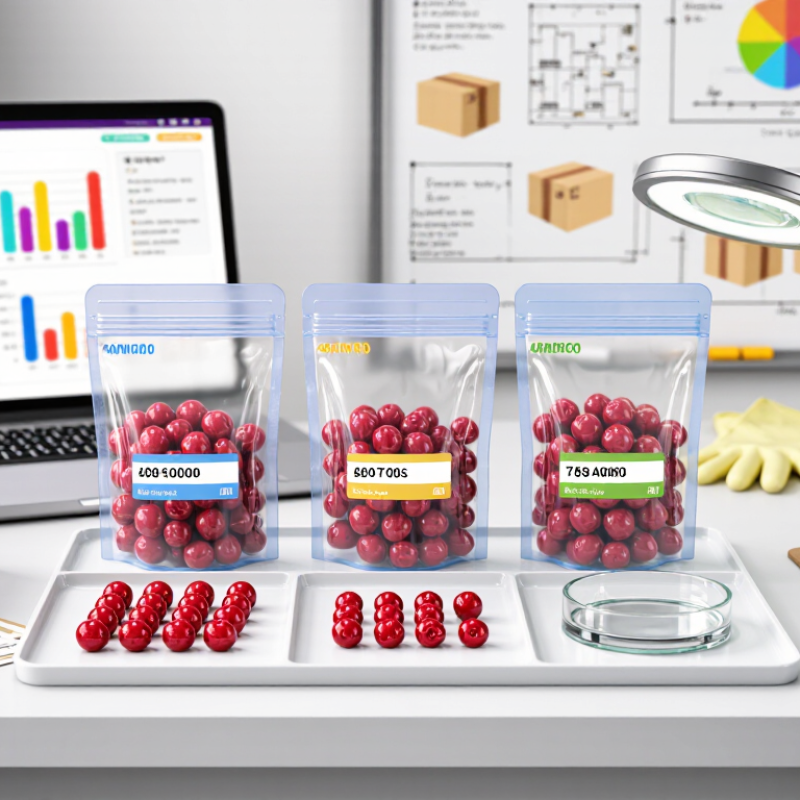
For sourcing U100 dried cherry 85g packs in 2026, define the grade before requesting quotations. U100 usually suggests fewer than 100 pieces per pound, but sizing systems vary by supplier. Write the requirement clearly: whole or halved fruit, target piece count, 85g net weight, and acceptable weight tolerance. The pack should show origin, harvest year, ingredient statement, and lot code.
USDA FoodData Central lists sweetened dried cherries at about 333 calories and 63.5g sugar per 100g, so buyers must distinguish sweetened fruit from unsweetened fruit.
Quality specifications need measurable limits. Set moisture targets, such as 18–25%, according to texture and shelf-life testing. Require checks for foreign material, insects, mold, damaged fruit, and excessive stems. Laboratory verification should cover water activity, pesticide residues, microbiological safety, and sulfite declaration where applicable.
The International Nut and Dried Fruit Council’s Statistical Yearbook tracks dried-fruit production and trade, showing why seasonal supply and origin can affect pricing. Yet market reports cannot replace a retained sample. I have seen attractive samples fail after heat exposure; packaging assumptions were wrong.
Tips:
Request three samples from different lots. Weigh ten pieces individually. Record softness after seven days at room temperature. Confirm whether “U100” means count per pound or another internal grade. A 2% fill-weight tolerance may look minor, but it changes retail consistency. Ask for corrective-action records, not only certificates.
Reliable sourcing starts with a precise U100 definition. Cherry grading can vary between suppliers. Request the count range, average piece weight, diameter, moisture level, and allowable defects in writing. A sample should match the production lot, not a prettier showroom sample. Check the supplier’s HACCP plan, third-party audit, traceability records, and recent certificate of analysis. A lot code should lead back to harvest, processing, and packing records.
Quality testing needs measurable limits. Request water activity, moisture, yeast and mold, Salmonella, E. coli, pesticide residues, heavy metals, and sulfite results. Codex CXS 193-1995 offers international contaminant guidance, but destination-country rules still control acceptance. USDA FoodData Central entries show dried cherries commonly provide about 325–350 kcal and 60–70g sugar per 100g. An 85g pouch may therefore contain roughly 276–298 kcal and 51–60g sugar, depending on added ingredients. The nutrition panel must reflect the actual recipe.
Packaging deserves equal attention. Confirm net weight tolerance, seal strength, oxygen protection, and storage conditions. Ask for accelerated shelf-life evidence, not only a printed expiry date. In practical audits, visual checks miss hidden moisture pockets. I once underestimated that risk. The better approach is testing several cartons across different pallet positions, then comparing results with the supplier’s stated specification. Suppliers who resist lot-level evidence deserve caution.
Sourcing U100 dried cherry in an 85g pouch requires more than comparing the lowest quotation. Confirm what “U100” means in the supplier’s grading sheet, including cherry count, moisture, added sugar, and defect tolerance. These details can change the price sharply. The International Nut and Dried Fruit Council’s Statistical Yearbook 2024 identifies crop size and export availability as major dried-fruit price drivers. A short harvest window may create higher prices, even when the pouch is small.
For a practical comparison, request three quotes using identical specifications. Recent supplier benchmarks often place standard 85g dried-fruit pouches around USD 0.55–1.10 each before freight, while premium fruit can exceed USD 1.30. Minimum orders commonly range from 3,000 to 20,000 pouches. Ask for tooling, printed-film, carton, and inspection charges separately. A low unit price may hide expensive packaging setup fees. I have seen this mistake delay otherwise workable launches.
Shipping terms need equal attention. Request both FOB and DDP prices, then compare the landed cost per pouch. UNCTAD’s Review of Maritime Transport 2024 reports that maritime shipping carries over 80% of global merchandise trade by volume, so port congestion and schedule changes remain meaningful risks. Air freight may suit samples, but it can destroy margins. Confirm carton dimensions, pallet count, transit time, insurance, and temperature protection. Terms can look clear, yet still leave gaps. A written quotation with delivery windows is safer than a polished spreadsheet.
Sourcing U100 dried cherry in an 85g pack starts with a precise product file. “U100” is not a universal grade, so request its size, moisture target, added-sugar status, and defect tolerance in writing. Compare the specification with laboratory results, not photographs. FAO and WHO estimate that nearly 600 million people become ill from contaminated food each year, making preventive controls essential. A supplier should provide HACCP records, recent microbiological tests, pesticide screening, and full lot traceability.
Certification claims require careful checking. Verify the certificate number, audit scope, site address, and expiry date through the issuing body. Food safety schemes such as BRCGS, IFS, and FSSC 22000 support supplier evaluation, but they do not replace importer verification. For United States shipments, confirm FDA facility registration, prior notice procedures, compliant labeling, and a documented Foreign Supplier Verification Program. The FDA’s FSMA framework places responsibility on the importer. Rules can change.
For European Union entry, review Regulation (EU) No 1169/2011 for ingredient, nutrition, origin, and net-quantity information. Test against pesticide maximum residue limits under Regulation (EC) No 396/2005. Packaging must suit direct food contact and protect the cherries from moisture, oxygen, and crushing. An 85g pouch should show a readable lot code, best-before date, storage advice, and country of origin where required. Use food-grade inner film and validate seal strength. I would also request transit samples. A perfect factory sample can hide damage after three weeks at sea.
Before placing an order for U100 dried cherries, confirm what U100 means in the supplier’s grading system. It commonly indicates fewer than 100 pieces per pound, but definitions can differ. Request a current specification sheet, a 500-gram sample, and photos of the sealed 85g pouch. Check moisture, added sugar, preservatives, color, breakage, and net weight. The 2024 Grand View Research report estimates the global dried fruit market at about USD 7.5 billion in 2023, with continued growth expected through 2030. That growth can attract inconsistent suppliers. Do not rely on attractive pricing alone.
Write every requirement into the purchase order. Include pack count, tolerance, carton dimensions, pallet pattern, production date, shelf life, and inspection rights. A pre-shipment check should verify weight from randomly selected cartons. Small errors multiply quickly. For delivery, choose sea freight for planned replenishment and air freight only for urgent, high-value orders. UNCTAD’s Review of Maritime Transport 2024 states that over 80% of world merchandise trade by volume moves by sea. Ask the forwarder for booking confirmation, temperature records where available, and carton-level tracking. Dried fruit still absorbs moisture, especially near ports. Use moisture barriers and desiccants when the route is humid. I would also keep a 10% time buffer for customs or port delays. It feels excessive, but one late promotion can cost more than the buffer. My weak point is assuming the first approved sample represents every production lot; it does not. Keep retention samples and review complaints after delivery.
| Phase | Data Dimension | Specification or Benchmark | Order-Control Data | Required Checkpoint |
|---|---|---|---|---|
| 1. Product Definition | Product format | U100 dried cherries, 85g net weight per retail pouch | Net contents tolerance: verify the applicable legal market requirement; use calibrated checkweighing | Approve the written product specification before requesting a quotation |
| 1. Product Definition | U100 grade meaning | Define whether U100 refers to size, appearance, ingredient purity, or an internal grade code | Attach a measurable grade sheet with size range, defect limits, color, texture, and broken-fruit percentage | Do not rely on the term “U100” without a supplier-signed definition |
| 1. Product Definition | Ingredients | Confirm cherries, sweetener, oil, preservatives, and allergen statement separately | Require a current ingredient declaration and nutrition panel for the destination market | Match the approved formula to the final printed packaging |
| 2. Supplier Qualification | Food-safety documentation | Valid food-safety certification, traceability procedure, allergen controls, and recall procedure | Review documents before sample approval and again before shipment | Check certificate scope, validity dates, and manufacturing-site address |
| 2. Supplier Qualification | Pre-shipment testing | Microbiological, pesticide-residue, foreign-material, moisture, and water-activity testing as required by the market | Use an independent laboratory when the risk level or customer requirement justifies it | Release the shipment only after reviewing results against agreed limits |
| 3. Order Planning | Planned order quantity | 10,080 pouches at 85g each | Total finished product weight: 856.8kg, excluding packaging materials and pallets | Reconcile purchase quantity with forecast, launch date, and minimum shelf-life requirement |
| 3. Order Planning | Carton configuration | 24 pouches per export carton | 420 cartons; 2.04kg net product per carton before secondary packaging | Confirm carton dimensions, gross weight, pallet pattern, and carton-marking requirements |
| 3. Order Planning | Shelf life | Target 12 months from production, subject to formulation, packaging, and validated stability data | Set a receiving requirement of at least 9 months remaining shelf life | Print lot code, production date, best-before date, and storage instruction |
| 4. Purchase Order | Commercial terms | Specify currency, unit price, payment milestones, Incoterm 2020, destination, and quotation validity | Use a signed purchase order and pro forma invoice before production begins | Ensure the invoice, packing list, and purchase order show identical quantities and descriptions |
| 4. Purchase Order | Artwork and packaging | Food-contact pouch with approved barcode, nutrition information, allergen declaration, lot coding, and recycling marks where applicable | Approve digital proof and physical pre-production sample before mass printing | Verify barcode readability and mandatory labeling in the destination country |
| 5. Production Control | Indicative production lead time | 15–25 business days after artwork, deposit, and raw-material confirmation | Add 2–3 business days for final quality review and document preparation | Request weekly progress updates and production photographs where appropriate |
| 5. Production Control | Quality acceptance | Check net weight, seal integrity, appearance, odor, texture, label accuracy, carton count, and lot traceability | Document nonconformities with photographs and corrective-action deadlines | Use an agreed inspection plan rather than accepting goods by visual judgment alone |
| 6. Delivery Management | Transit planning | International ocean transit commonly requires approximately 25–35 days, excluding port congestion and customs delays | Airfreight is faster but normally has a higher transport cost; compare total landed cost | Book transport after cargo readiness and document accuracy are confirmed |
| 6. Delivery Management | Required shipping documents | Commercial invoice, packing list, transport document, certificate of origin where required, health or phytosanitary documents where applicable, and test reports | Send scanned documents before arrival to support customs pre-clearance | Check product description, tariff classification, origin, quantity, and gross weight for consistency |
| 6. Delivery Management | Storage and receiving | Keep sealed cartons in a clean, dry, pest-controlled area away from direct sunlight and strong odors | Record arrival date, lot number, carton count, damaged units, and remaining shelf life | Use FIFO or FEFO inventory rotation and quarantine damaged or undocumented cartons |
| 7. Final Reconciliation | Landed-cost review | Include product price, packaging, inspection, freight, insurance, duties, taxes, customs clearance, warehousing, and inland delivery | Calculate landed cost per 85g pouch and per export carton | Close the order only after quantity, quality, documents, and invoice totals are reconciled |
We use cookies on our website to give you an improved browser experience. View our Privacy Policy for more information. Please make your selection to opt in or out of ALL cookies here: Accept or Decline
Do you consent to the use of ALL cookies?
901 2nd Court West
Birmingham, AL 35204
Sales: 866.481.4036
Logistics/Ops: 866.481.4036
2101 Dralle Road
University Park, IL 60466
Sales: 708.813.9070
Logistics/Ops: 708.235.4200
400 E. 13th Street
Little Rock, AR 72114
Sales: 866.760.5344
Logistics/Ops: 866.760.5344
225 Collins Road
Elkhart, IN 46515
Sales: 574.295.0214
Logistics/Ops: 574.607.4611
601 Berryman Pike
Tipton, IN 46072
Sales: 800.897.7591
Logistics/Ops: 800.897.7591
3900 Uvalda Street
Denver, CO 80239
Sales: 303.706.8000
Ops/Logistics: 303.576.8398
510 3rd Street E
Milan, IL 61264
Sales: 800.322.1052
Logistics/Ops: 800.322.1052
1660 E. Aurora
Des Moines, IA 50313
Sales: 800.671.1660
Logistics: 800.671.1660
86554 Gene Lasserre Blvd.
Yulee, FL 32097
Sales: 904.253.3060
Logistics/Ops: 904.225.3000
694 S.E. County Road 245
Lake City, FL 32025
Sales: 800.727.6706
Logistics/Ops: 386.752.7412
210 Neptune Road
Auburndale, FL 33823
Sales: 863.967.1131
Logistics/Ops: 863.777.9814
4601 McCoy Drive
Pensacola, FL 32503
Sales: 850.308.7030
Logistics/Ops: 850.434.5502
815 South 56th Street
Tampa, FL 33619
Sales: 813.302.1940
Logistics/Ops: 813.621.1352
200 Hosea Road
Lawrenceville, GA 30046
Sales: 770.953.7575
Logistics/Ops: 770.513.6000
Branch Product Guide
Branch Line Card
Moulding Offering
Cedar Offering
Column Offering
8173 Hwy. 165 North
Monroe, LA 71211
Sales: 800.256.4165
Logistics/Ops: 800.256.4165
508 Warren Avenue
Portland, ME 04103
Sales: 207.888.2331
Logistics/Ops: 207.797.6565
4300 Georgia Pacific Blvd.
Frederick, MD 21704
Sales: 301.798.7474
Logistics/Ops: 301.874.8000
419 Maple Street
Bellingham, MA 02019
Sales: 508.449.0535
Logistics/Ops: 508.966.5500
825 Buchanan Ave SW
Grand Rapids, MI 49507
Sales: 877.800.1180
Logistics/Ops: 616.278.0909
995 Pacific St. NW
Aitkin, MN 56431
Sales: 800.432.3727
Logistics/Ops: 218.212.7770
1102 Port Terminal Drive
Duluth, MN 55802
Sales: 800.951.9899
Logistics/Ops: 800.851.9899
9110 83rd Ave. North
Brooklyn Park, MN 55445
Sales: 763.425.0204
Logistics/Ops: 763.425.0204
910 E. Railroad Street
Long Beach, MS 39560
Sales: 866.535.4135
Logistics/Ops: 228.205.2400
1727 Warren Street
North Kansas City, MO 64116
Sales: 800.621.2611
Logistics/Ops: 800.621.2611
2123 North Golden
Springfield, MO 65803
Sales: 800.375.7891
Logistics/Ops: 800.375.7891
13860 Corp. Woods Trail
Bridgeton, MO 63044
Sales: 314.209.0800
Logistics/Ops: 314.209.0800
1109 South 19th Street
Omaha, NE 68108
Sales: 800.489.6637
Logistics/Ops: 800.489.6637
1 Luger Road
Denville, NJ 07834
Sales: 973-339-3539
Logistics/Ops: 973.625.1461
3720 Jeffrey Blvd.
Blasdell, NY 14219
Sales: 716.235.5989
Logistics/Ops: 716.825.6557
319 Yaphank Ave.
Yaphank, NY 11980
Sales: 631.358.5714
Logistics/Ops: 631.924.7401
3300 Parkside Drive
Charlotte, NC 28208
Sales: 800.839.2588
Logistics/Ops: 704.394.3172
1712 East D Street
Butner, NC 27509
Sales: 984.389.8200
Logistics/Ops: 919.575.3700
128 Foothills Drive
Statesville, NC 28687
Sales: 800.222.1414
Logistics/Ops: 704.394.3172
550 Munroe Falls Rd.
Tallmadge, OH 44278
Sales: 330.357.4506
Logistics/Ops: 330.794.1141
10347 Toebben Dr.
Independence, KY 41051
Sales: 859.298.3926
Logistics/Ops: 859.746.2250
450 N. MacArthur
Oklahoma City, OK 73127
Sales: 800.375.6025
Logistics/Ops: 800.375.6025
1680 North Aspen
Broken Arrow, OK 74012
Sales: 918.272.2212
Logistics/Ops: 918.272.2212
522 Bridge Street
Hunker, PA 15639
Sales: 878.217.2001
Logistics/Ops: 724.925.7285
4290 Atlanta Street
Charleston, SC 29418
Sales: 843.371.1420
Logistics/Ops: 843.554.8192
1040 S. Industrial Dr.
Erwin, TN 37650
Sales: 423.641.1005
Logistics/Ops: 423.742.5911
4287 Pilot Drive
Memphis, TN 38118
Sales: 901.365.2101
Logistics/Ops: 901.365.2101
700 Myatt Drive
Madison, TN 37115
Sales: 615.327.9547
Logistics/Ops: 629.777.4949
4747 Mark IV Parkway
Fort Worth, TX 76106
Sales: 866.323.5117
Logistics/Ops: 817.625.9091
6990 Market Avenue
El Paso, TX 79915
Sales: 915.778.6356
Logistics/Ops: 915.265.7200
2502 Wilson Road
Harlingen, TX 78552
Sales: 800.580.6711
Logistics/Ops: 800.580.6711
10,000 North Loop East
Houston, TX 77029
Sales: 713.921.1977
Logistics/Ops: 713.675.3544
702 East 44th St.
Lubbock, TX 79404
Sales: 866.454.6010
Logistics/Ops: 866.454.6010
535 N. WW White Road
San Antonio, TX 78219
Sales: 800.284.0488
Logistics/Ops: 210.333.8112
142 Pine Haven Shores Rd.
Shelburne, VT 05482
Sales: 802.800.2540
Logistics/Ops: 802.985.2512
4700 Bethlehem Road,
Richmond, VA 23230
Sales: 804.201.2400
Logistics/Ops: 804.342.1161
4516 N Barker Road
Spokane Valley, WA 99027
Phone: 509.892.9420
Toll free: 800.728.6157
8365 N. 76th Street
Milwaukee, WI 53223
Sales: 800.356.9245
Logistics/Ops: 800.356.9245
312 S. Chester Street
Sparta, WI 54656
Sales: 800.362.5864
Logistics/Ops: 800.362.5864
899 Grossman Drive
Schofield, WI 54476
Sales: 800.472.0017
Logistics/Ops: 800.472.0017
