
We use cookies on our website to give you an improved browser experience. View our Privacy Policy for more information. Please make your selection to opt in or out of ALL cookies here: Accept or Decline
Shower Glass is more than a clear panel separating water from the rest of your bathroom. It affects safety, privacy, cleaning, light, and the room’s visual balance. A bright, frameless enclosure can make a compact bathroom feel larger. However, the wrong glass may reveal water spots, fingerprints, or an awkward door swing every day.
In practical bathroom planning, the best choice depends on several details. Tempered glass is widely used because it is processed for increased strength and safer breakage. Laminated options may provide additional protection, depending on local requirements and the installation design. Clear, low-iron, frosted, rain-textured, and patterned glass each create different experiences. Clear glass shows more buildup. Textured glass hides some marks. It can also reduce natural light.
Thickness alone does not determine quality. Hardware, edge treatment, panel support, accurate measurements, and professional installation matter just as much. A qualified installer should check wall conditions, floor level, door clearance, and applicable building standards before ordering the glass. Small errors can cause leaks or stressful adjustments later.
Details matter most.
Cleaning habits should guide the finish. If you rarely squeegee the enclosure, heavily textured surfaces may become difficult to maintain. If privacy matters, partially frosted glass may offer a better compromise than fully transparent panels. There is no universal winner. Even careful planning can miss personal preferences, especially after installation. This guide explains the main Shower Glass types and the practical questions that help you choose with greater confidence.
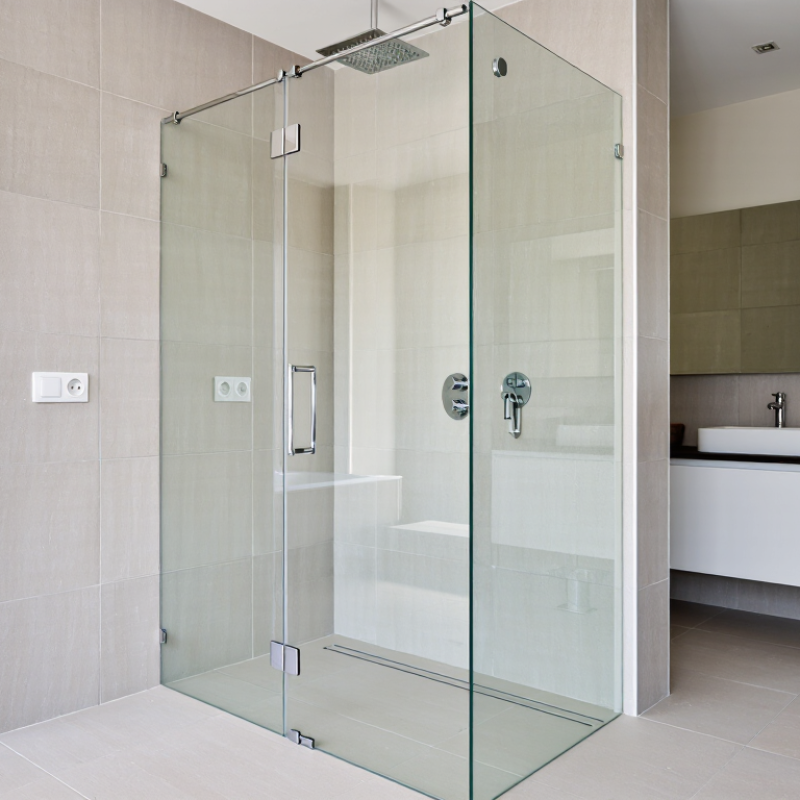
Shower glass is a safety-glazing panel used to contain water while keeping the bathroom visually open. It usually works as a fixed screen, hinged door, or sliding enclosure. The glass blocks splashes, while seals, channels, and hinges control movement and leakage. Small gaps are intentional. They allow expansion and prevent pressure on the panel.
Most shower panels use tempered glass. U.S. Consumer Product Safety Commission guidance states that tempered glass is about four times stronger than ordinary annealed glass. When damaged, it breaks into small granular pieces instead of long, sharp shards. The National Glass Association also identifies heat-treated safety glass as suitable for areas where human impact is possible. However, “safer” does not mean unbreakable. A hard strike near an edge can still cause failure.
Thickness affects stiffness, not just appearance. Six-millimeter glass may suit some framed systems, while eight- or ten-millimeter panels often feel more stable in frameless installations. The final choice depends on panel size, hardware, wall strength, and local safety requirements. Clear glass provides the most open look, but textured glass offers more privacy and hides water marks. Protective coatings can slow mineral buildup. They cannot cancel cleaning. In real bathrooms, poor alignment often causes more trouble than the glass itself. A qualified installer should verify measurements, edge protection, door swing, and support before installation.
| Glass Type | How It Works | Typical Thickness | Safety Characteristics | Privacy Level | Light Transmission | Maintenance | Best Use |
|---|---|---|---|---|---|---|---|
| Clear Tempered Glass | Uses a transparent, heat-treated panel to separate the shower area while allowing unobstructed views. | 6–10 mm | Tempered glass is stronger than ordinary annealed glass and breaks into smaller, less sharp pieces when shattered. | Low | Approximately 80–90% | Easy to clean, although water spots and soap residue are highly visible. | Bright bathrooms, frameless enclosures, and spaces that benefit from a visually open design. |
| Low-Iron Clear Glass | Reduces the green tint normally visible in standard clear glass, producing a cleaner and more neutral appearance. | 6–10 mm | Usually manufactured as safety-tempered glass for shower applications. | Low | Approximately 90% or higher, depending on thickness and surface treatment | Similar to clear glass; mineral deposits may be more noticeable because of its very clear appearance. | Minimalist bathrooms where accurate tile and hardware colors are important. |
| Frosted Glass | Uses a chemically etched, sandblasted, or permanently textured surface to scatter light and obscure outlines. | 6–10 mm | Can be safety-tempered; the frosting itself does not determine impact strength. | Medium to high | Approximately 55–75% | Textured areas can hold residue and may require gentle, regular cleaning. | Bathrooms where privacy is more important than a fully transparent enclosure. |
| Patterned or Textured Glass | Uses a raised or patterned surface to distort visibility while admitting natural or artificial light. | 6–8 mm | Safety performance depends on whether the panel is tempered or laminated and on local building requirements. | Medium to high | Approximately 50–80%, depending on the pattern | More difficult to clean than smooth glass because texture can collect soap and mineral deposits. | Decorative shower screens and designs requiring visual separation. |
| Tinted Glass | Uses color throughout the glass to reduce glare and create a darker, more private visual effect. | 6–10 mm | Must be specified as safety glass for shower use; color alone does not make glass safer. | Medium | Approximately 35–75%, depending on tint color and depth | Generally smooth and easy to clean; water marks may contrast with darker colors. | Contemporary bathrooms, glare reduction, and coordinated interior color schemes. |
| Laminated Glass | Combines two glass layers with a plastic interlayer that helps hold fragments together if the glass breaks. | Typically 6–10 mm total, depending on construction | Provides post-breakage fragment retention; the exact safety classification should be confirmed for the intended installation. | Low to high, depending on the interlayer and surface design | Approximately 70–90%, depending on glass and interlayer selection | Requires care around exposed edges and seals; smooth surfaces are relatively easy to maintain. | Projects prioritizing fragment retention, acoustic control, or specialized privacy effects. |
| Rain or Water-Effect Glass | Uses vertical or irregular texture to diffuse shapes and create a flowing visual effect while allowing light through. | 6–8 mm | Should be safety-tempered or otherwise approved for shower use according to local requirements. | Medium to high | Approximately 60–80% | Texture can make wiping more demanding, especially in hard-water areas. | Privacy-focused shower doors and decorative bathroom partitions. |
Selection tip: For most shower enclosures, choose safety glass that complies with applicable local building codes. Consider privacy, available light, glass thickness, hardware compatibility, cleaning effort, and the enclosure size before making a final decision.
Shower glass usually refers to safety glass designed for wet bathroom enclosures. The main choice is tempered glass. It is heated and rapidly cooled, making it stronger than ordinary glass. If broken, it usually falls into small, blunt pieces. It cannot be cut after tempering, so accurate measurements matter.
Very important. Accurate measurements matter.
Clear glass is the most common type. It allows light to pass through and can make a small bathroom feel larger. However, water spots and soap residue are easy to see.
Low-iron clear glass offers a cleaner appearance, especially beside white tile. Frosted glass provides more privacy, while still admitting soft light. Its surface can be etched across the entire panel or used in a limited pattern.
Textured and patterned glass can hide fingerprints and mineral marks better. They also create a stronger visual feature, which may not suit every bathroom.
Tinted glass adds a gray, bronze, or blue tone. It can reduce glare, but it may change how tile colors appear. Laminated glass has a plastic layer between two panes. If cracked, the pieces tend to remain attached to that layer. It offers added security, though it is heavier and often costs more.
In practical installations, 6 mm glass suits many standard doors, while 8 mm or thicker glass feels more substantial.
A professional should check wall alignment, hardware loads, ventilation, and door clearance.
I once underestimated how visible hard-water stains become on clear glass. That small detail changed the recommendation.
Availability, cleaning habits, privacy needs, and bathroom size should guide the final choice.
Shower glass affects safety long before you step inside. I used to think thicker glass always meant better protection. That assumption is incomplete. Properly manufactured tempered glass is commonly chosen because it breaks into smaller pieces under severe impact. However, it can still cause cuts, especially after poor installation or damage around the edges. Ask for safety-rated glass, clear product markings, and an installer experienced with bathroom enclosures.
Thickness matters, but it is not the only factor. Strong hinges, correctly fitted channels, stable wall support, and smooth, protected edges reduce everyday risks. A door should open without striking a toilet, vanity, or another person. Small chips deserve attention. They can spread unexpectedly, even when the panel appears usable. Laminated glass may offer another safety option because its layers can remain attached after cracking, but the framing system must support it properly.
Privacy depends on surface texture, lighting, and bathroom layout. Frosted glass softens outlines, while heavily textured patterns hide movement more effectively. Clear glass provides the brightest, most open appearance, yet it reveals shadows easily at night. I once underestimated this detail in a bathroom with strong ceiling lights. The glass looked private during the day, but not after dark. Curtains or partial frosting can improve privacy without making the room feel closed in. Cleaning also matters: mineral deposits can create uneven cloudy patches and reduce visibility. Schedule regular checks for loose hardware, edge damage, and door alignment.
Choosing shower glass starts with safety, not appearance. For most enclosures, certified tempered glass is the practical standard. It is heat-treated and designed to break into smaller, less sharp pieces if shattered. Local building requirements still matter. Check them before ordering.
Measure the opening at several points. Walls are rarely perfectly straight. A difference of a few millimeters can affect the door swing and seals. Glass thickness also matters. Around 8 to 10 millimeters often feels solid, but the enclosure design determines the best option. Ask an experienced installer to verify the hardware, clearances, and wall support.
Clear glass keeps a small bathroom visually open. Frosted or textured glass offers more privacy, but patterns can collect soap residue. Think about your cleaning routine. Hard-water areas may benefit from an easier-to-maintain surface, although no coating removes cleaning completely. I would not choose from a sample alone. Bathroom lighting can change the glass color and transparency. Try a water test. Review the measurements carefully. Good glass is only part of the result. Poor alignment can cause leaks, noise, and a door that never closes properly.
Shower glass should be installed by a qualified glazier, not improvised on site. The National Glass Association’s Glass and Glazing Manual notes that tempered glass is about four times stronger than ordinary annealed glass. However, strength does not excuse poor fitting. Measure the opening after walls and tiles are complete. Check that every surface is plumb, because small errors can stress hinges and seals. Tempered panels must not be drilled, cut, or reshaped after treatment. One detail is easy to miss. Anchors must suit the wall structure, not merely the tile surface. Safety glazing should comply with ANSI Z97.1 and CPSC 16 CFR 1201 requirements.
Maintenance begins after installation. I have seen beautiful enclosures fail early because water remained around the bottom track. Wipe the glass with a soft squeegee after each shower. Use a pH-neutral cleaner weekly, then dry the edges and hardware. Avoid abrasive pads, razor blades, and chlorine-heavy products. The U.S. Environmental Protection Agency’s WaterSense criteria limit showerheads to 2.0 gallons per minute, yet efficient water use still leaves mineral deposits. Hard-water spots may need a manufacturer-approved descaler. Inspect hinges, handles, seals, and corners monthly. A chip, crack, loose fitting, or sudden door movement requires professional attention. Do not keep using damaged glass. My own caution is simple: cleaning feels routine, but inspection is where safety is often overlooked.
Common residential shower enclosures use tempered safety glass in nominal thicknesses of approximately 6, 8, 10, or 12 mm. Framed systems commonly use thinner panels, while frameless and heavy frameless designs often use thicker glass for rigidity. The final thickness should be selected according to panel size, hardware, local safety requirements, and professional installation guidance.
Shower glass should be installed by a qualified professional with properly supported edges and compatible hardware. For maintenance, use a squeegee after each shower, clean regularly with a non-abrasive product, and inspect seals and fittings for wear or leaks.
We use cookies on our website to give you an improved browser experience. View our Privacy Policy for more information. Please make your selection to opt in or out of ALL cookies here: Accept or Decline
Do you consent to the use of ALL cookies?
901 2nd Court West
Birmingham, AL 35204
Sales: 866.481.4036
Logistics/Ops: 866.481.4036
2101 Dralle Road
University Park, IL 60466
Sales: 708.813.9070
Logistics/Ops: 708.235.4200
400 E. 13th Street
Little Rock, AR 72114
Sales: 866.760.5344
Logistics/Ops: 866.760.5344
225 Collins Road
Elkhart, IN 46515
Sales: 574.295.0214
Logistics/Ops: 574.607.4611
601 Berryman Pike
Tipton, IN 46072
Sales: 800.897.7591
Logistics/Ops: 800.897.7591
3900 Uvalda Street
Denver, CO 80239
Sales: 303.706.8000
Ops/Logistics: 303.576.8398
510 3rd Street E
Milan, IL 61264
Sales: 800.322.1052
Logistics/Ops: 800.322.1052
1660 E. Aurora
Des Moines, IA 50313
Sales: 800.671.1660
Logistics: 800.671.1660
86554 Gene Lasserre Blvd.
Yulee, FL 32097
Sales: 904.253.3060
Logistics/Ops: 904.225.3000
694 S.E. County Road 245
Lake City, FL 32025
Sales: 800.727.6706
Logistics/Ops: 386.752.7412
210 Neptune Road
Auburndale, FL 33823
Sales: 863.967.1131
Logistics/Ops: 863.777.9814
4601 McCoy Drive
Pensacola, FL 32503
Sales: 850.308.7030
Logistics/Ops: 850.434.5502
815 South 56th Street
Tampa, FL 33619
Sales: 813.302.1940
Logistics/Ops: 813.621.1352
200 Hosea Road
Lawrenceville, GA 30046
Sales: 770.953.7575
Logistics/Ops: 770.513.6000
Branch Product Guide
Branch Line Card
Moulding Offering
Cedar Offering
Column Offering
8173 Hwy. 165 North
Monroe, LA 71211
Sales: 800.256.4165
Logistics/Ops: 800.256.4165
508 Warren Avenue
Portland, ME 04103
Sales: 207.888.2331
Logistics/Ops: 207.797.6565
4300 Georgia Pacific Blvd.
Frederick, MD 21704
Sales: 301.798.7474
Logistics/Ops: 301.874.8000
419 Maple Street
Bellingham, MA 02019
Sales: 508.449.0535
Logistics/Ops: 508.966.5500
825 Buchanan Ave SW
Grand Rapids, MI 49507
Sales: 877.800.1180
Logistics/Ops: 616.278.0909
995 Pacific St. NW
Aitkin, MN 56431
Sales: 800.432.3727
Logistics/Ops: 218.212.7770
1102 Port Terminal Drive
Duluth, MN 55802
Sales: 800.951.9899
Logistics/Ops: 800.851.9899
9110 83rd Ave. North
Brooklyn Park, MN 55445
Sales: 763.425.0204
Logistics/Ops: 763.425.0204
910 E. Railroad Street
Long Beach, MS 39560
Sales: 866.535.4135
Logistics/Ops: 228.205.2400
1727 Warren Street
North Kansas City, MO 64116
Sales: 800.621.2611
Logistics/Ops: 800.621.2611
2123 North Golden
Springfield, MO 65803
Sales: 800.375.7891
Logistics/Ops: 800.375.7891
13860 Corp. Woods Trail
Bridgeton, MO 63044
Sales: 314.209.0800
Logistics/Ops: 314.209.0800
1109 South 19th Street
Omaha, NE 68108
Sales: 800.489.6637
Logistics/Ops: 800.489.6637
1 Luger Road
Denville, NJ 07834
Sales: 973-339-3539
Logistics/Ops: 973.625.1461
3720 Jeffrey Blvd.
Blasdell, NY 14219
Sales: 716.235.5989
Logistics/Ops: 716.825.6557
319 Yaphank Ave.
Yaphank, NY 11980
Sales: 631.358.5714
Logistics/Ops: 631.924.7401
3300 Parkside Drive
Charlotte, NC 28208
Sales: 800.839.2588
Logistics/Ops: 704.394.3172
1712 East D Street
Butner, NC 27509
Sales: 984.389.8200
Logistics/Ops: 919.575.3700
128 Foothills Drive
Statesville, NC 28687
Sales: 800.222.1414
Logistics/Ops: 704.394.3172
550 Munroe Falls Rd.
Tallmadge, OH 44278
Sales: 330.357.4506
Logistics/Ops: 330.794.1141
10347 Toebben Dr.
Independence, KY 41051
Sales: 859.298.3926
Logistics/Ops: 859.746.2250
450 N. MacArthur
Oklahoma City, OK 73127
Sales: 800.375.6025
Logistics/Ops: 800.375.6025
1680 North Aspen
Broken Arrow, OK 74012
Sales: 918.272.2212
Logistics/Ops: 918.272.2212
522 Bridge Street
Hunker, PA 15639
Sales: 878.217.2001
Logistics/Ops: 724.925.7285
4290 Atlanta Street
Charleston, SC 29418
Sales: 843.371.1420
Logistics/Ops: 843.554.8192
1040 S. Industrial Dr.
Erwin, TN 37650
Sales: 423.641.1005
Logistics/Ops: 423.742.5911
4287 Pilot Drive
Memphis, TN 38118
Sales: 901.365.2101
Logistics/Ops: 901.365.2101
700 Myatt Drive
Madison, TN 37115
Sales: 615.327.9547
Logistics/Ops: 629.777.4949
4747 Mark IV Parkway
Fort Worth, TX 76106
Sales: 866.323.5117
Logistics/Ops: 817.625.9091
6990 Market Avenue
El Paso, TX 79915
Sales: 915.778.6356
Logistics/Ops: 915.265.7200
2502 Wilson Road
Harlingen, TX 78552
Sales: 800.580.6711
Logistics/Ops: 800.580.6711
10,000 North Loop East
Houston, TX 77029
Sales: 713.921.1977
Logistics/Ops: 713.675.3544
702 East 44th St.
Lubbock, TX 79404
Sales: 866.454.6010
Logistics/Ops: 866.454.6010
535 N. WW White Road
San Antonio, TX 78219
Sales: 800.284.0488
Logistics/Ops: 210.333.8112
142 Pine Haven Shores Rd.
Shelburne, VT 05482
Sales: 802.800.2540
Logistics/Ops: 802.985.2512
4700 Bethlehem Road,
Richmond, VA 23230
Sales: 804.201.2400
Logistics/Ops: 804.342.1161
4516 N Barker Road
Spokane Valley, WA 99027
Phone: 509.892.9420
Toll free: 800.728.6157
8365 N. 76th Street
Milwaukee, WI 53223
Sales: 800.356.9245
Logistics/Ops: 800.356.9245
312 S. Chester Street
Sparta, WI 54656
Sales: 800.362.5864
Logistics/Ops: 800.362.5864
899 Grossman Drive
Schofield, WI 54476
Sales: 800.472.0017
Logistics/Ops: 800.472.0017
