
We use cookies on our website to give you an improved browser experience. View our Privacy Policy for more information. Please make your selection to opt in or out of ALL cookies here: Accept or Decline
Choosing Steel Grating in 2026 requires more than comparing prices per square metre. The World Steel Association reported global crude steel production of approximately 1.84 billion tonnes in 2024. That scale reflects steel’s continuing importance, but it does not make every grating suitable for every site. A loading dock, wastewater plant, offshore platform, and public walkway face different forces, moisture levels, and maintenance demands.
A reliable selection starts with verified data. Check the span, bearing-bar size, panel depth, load class, deflection limit, and support details. Consider serrated surfaces where oil, rain, or ice may create slip risks. Galvanized coatings often support outdoor service, while painted or stainless options may suit specific chemical environments. EN ISO 14122 provides guidance for permanent access systems, and OSHA 29 CFR 1910.22 addresses safe walking-working surfaces in the United States. These references help, but project drawings and local requirements still control the final decision.
Details matter on site. A 1,000-millimetre panel may look rigid, yet inadequate supports can produce visible vibration under a loaded trolley. Small openings may improve safety around tools, while larger openings can improve drainage and reduce weight. No guide is perfect. Experienced teams can still overlook corrosion at cut edges, fastener compatibility, or future cleaning access. Before ordering, compare supplier test certificates, coating specifications, fabrication tolerances, and installation records. The strongest choice balances structural performance, worker safety, lifecycle cost, and realistic maintenance conditions.
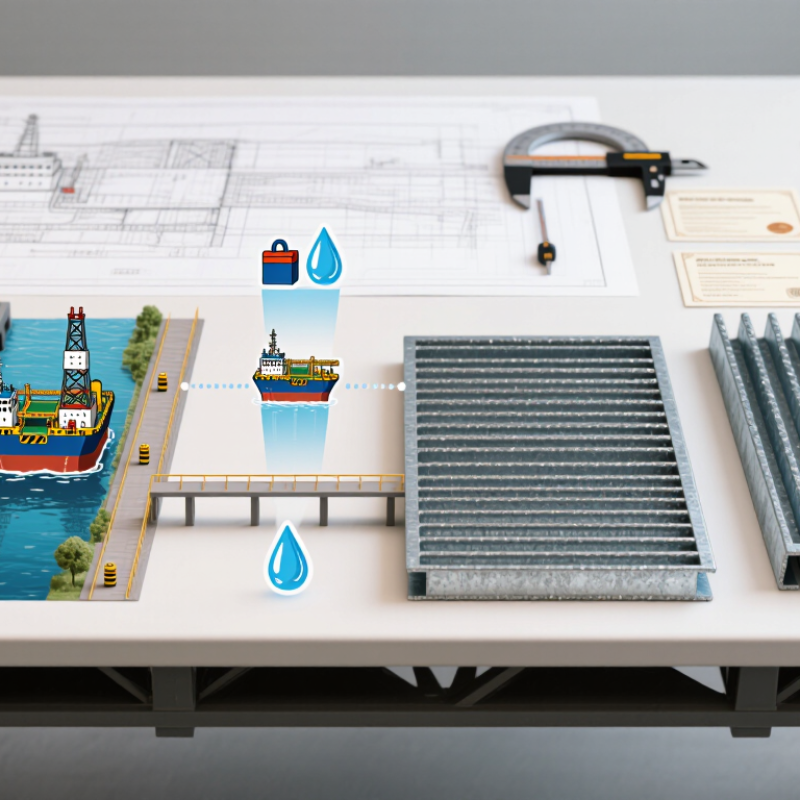
Choosing steel grating in 2026 starts with its structure, not its appearance. Welded grating uses cross bars fused to bearing bars, while press-locked grating relies on deep pressure connections. Bearing bars carry the main load. Their depth, spacing, and span affect deflection under foot traffic, carts, or equipment. Serrated bars can improve traction in oily or wet areas, although they may collect more debris. Carbon steel suits many industrial floors. Hot-dip galvanized steel adds stronger corrosion resistance. Stainless steel is better for aggressive moisture and hygiene-sensitive spaces. Aluminum reduces weight but usually offers lower stiffness. World Steel Association reported 1.89 billion tonnes of crude steel production in 2023, showing the material’s huge supply base, but not every grade fits every service condition.
Tips: Measure twice. Check the span first. Match the opening size to safety needs. Ask for verified load tables, material certificates, and coating information. ISO 14122-2 and relevant national standards provide useful guidance for permanent access platforms, but project requirements still need engineering review. I have seen installations fail because buyers compared price per square meter instead of total load capacity. A neat calculation can still miss vibration, drainage, or unusual wheel loads. Recheck those details.
For exposed platforms, compare galvanized coating thickness and drainage design. For removable panels, confirm lifting weight and bearing-seat details. Weld quality matters, especially around heavy-duty load bars. The wrong choice may look acceptable on delivery day. It may not remain safe after years of wear. Industry market analyses continue to forecast steady demand for steel grating through this decade, yet published forecasts differ by region and definition. Treat them as planning signals, not proof of product performance.
How to Choose Steel Grating in 2026? Load capacity, span, and traffic requirements should guide the specification. A grating panel is not simply “heavy duty” or “light duty.” Its bearing bars, span direction, support width, and connection method all affect performance. OSHA 1910.22(b) requires walking surfaces to support their maximum intended load and, in general, four times that load. For public or assembly areas, ASCE/SEI 7-22 lists live loads that can reach 100 psf, depending on occupancy. These figures are starting points, not final product ratings.
Span changes everything. A 1.2-meter span may perform well, while doubling it can sharply increase deflection. Measure the clear opening, then confirm whether bearing bars run across or along the traffic path. A facility with pallet trucks, forklifts, or maintenance carts needs wheel-load analysis, not only uniform-load analysis. AASHTO LRFD Bridge Design Specifications should guide roadway and bridge applications, while EN 1991-2 provides traffic-load models for European designs. I have seen neat calculations fail because a wheel landed near an unsupported edge. That detail matters.
Tips: Record the heaviest wheel load, axle spacing, speed, and turning pattern. Check deflection, slip resistance, drainage, and corrosion exposure. Ask for tested load tables and connection details. Do not rely on a generic span chart. It may hide assumptions. A qualified structural engineer should verify unusual traffic, impact, fatigue, or public-access conditions.
| Application | Traffic Requirement | Indicative Design Load | Typical Clear Span | Representative Bearing Bar | Common Bar Pitch | Recommended Surface | Key Selection Check |
|---|---|---|---|---|---|---|---|
| Pedestrian walkway | Foot traffic, hand carts, and routine maintenance access | 4.8 kPa uniformly distributed load | 600–1,200 mm | 25 × 3 mm or 30 × 3 mm steel bar | 30 or 40 mm center-to-center | Plain or serrated top surface | Check pedestrian comfort, heel safety, and slip resistance |
| Industrial platform | Personnel, tools, and light service equipment | 7.5 kPa uniformly distributed load | 900–1,500 mm | 30 × 3 mm or 40 × 3 mm steel bar | 30 or 40 mm center-to-center | Serrated galvanized surface in wet areas | Verify support spacing and deflection under service load |
| Maintenance trolley route | Small wheeled carts or maintenance trolleys | 10 kPa distributed load plus local wheel loads | 1,000–1,500 mm | 40 × 5 mm steel bar | 30 mm center-to-center | Serrated surface with close mesh | Check wheel contact area, local bending, and openings |
| Occasional forklift access | Low-speed forklift crossing with defined wheel paths | 15 kPa equivalent load; confirm actual wheel loads | 1,000–1,500 mm | 50 × 5 mm or 60 × 5 mm steel bar | 30 mm center-to-center | Heavy-duty serrated surface | Design for concentrated wheel loads, impact, and braking effects |
| Light vehicle crossing | Passenger vehicles or service vehicles over a trench | 20 kPa equivalent load; use project vehicle loads | 1,500–2,000 mm | 60 × 5 mm or 75 × 5 mm steel bar | 30 mm center-to-center | Heavy-duty serrated or anti-skid surface | Check axle loads, wheel spacing, impact, and support bearing |
| Drainage trench cover | Pedestrian or vehicle traffic, depending on location | Must be based on the governing wheel or point load | 300–1,500 mm | Selected by structural calculation | 30 or 40 mm center-to-center | Close mesh with load-rated edge frame | Confirm opening size, frame anchorage, and removable-panel weight |
| Chemical or marine area | Pedestrian or maintenance traffic with corrosion exposure | Use the applicable load from the traffic class | 600–1,200 mm | Steel size selected for load and corrosion allowance | 30 or 40 mm center-to-center | Hot-dip galvanized or stainless steel, subject to exposure | Match material and coating to chlorides, chemicals, and drainage |
| Security or access panel | Occasional personnel access; restricted traffic | 4.8–7.5 kPa, subject to site requirements | Up to 900 mm | 25 × 3 mm or 30 × 3 mm steel bar | 30 mm center-to-center | Close mesh with bolted or hinged restraints | Prevent uplift, rattling, unauthorized removal, and trip hazards |
How to Choose Steel Grating in 2026?
Comparing Surface Treatments and Environmental Resistance
Steel grating selection should begin with exposure, not price. Indoor dry areas may need basic mill finish or paint. Coastal walkways face chloride, windblown sand, and constant wetting. ISO 9223 classifies atmospheric corrosivity from C1 to CX, helping engineers describe that risk consistently. The NACE IMPACT study estimated global corrosion costs at $2.5 trillion annually, about 3.4% of global GDP. That figure is broad, but it explains why a cheap coating can become expensive maintenance.
Hot-dip galvanizing forms a zinc layer that protects exposed steel sacrificially. ISO 1461 specifies an average coating thickness of 85 micrometres for fabricated steel over six millimetres thick. Electrogalvanizing provides a smoother, thinner finish, but usually suits milder exposure. Powder coating adds color and barrier protection. It can chip at loading edges, though. A duplex system, combining galvanizing and powder coating, can improve redundancy when appearance and salt resistance both matter. This is not automatic. Pretreatment and drainage decide much of the result. During inspection, check welds, cut ends, trapped water, and damaged areas—not only the shiny top surface. The overlooked underside may fail first. Specification writers should request coating records, thickness tests, and a defined repair method. I would still question any “maintenance-free” claim, because real sites are rarely clean, dry, or predictable.
The index is a practical selection scale from 1 to 5 based on commonly accepted material behavior: 1 indicates limited resistance and 5 indicates strong resistance. Hot-dip galvanizing is widely selected for outdoor steel grating, while stainless steel is generally more suitable for persistent moisture, coastal salt, and chemical exposure. Actual service life depends on coating thickness, drainage, pollutants, temperature, and maintenance.
Choosing steel grating begins with the load, span, and working environment. Measure the opening accurately, then specify panel length, width, bearing bar depth, and thickness.
A walkway carrying workers needs different capacity from a platform holding stored equipment. Use current load tables and have a qualified engineer verify unusual conditions. Guesswork becomes expensive quickly.
The opening pattern also matters. Smaller openings help prevent shoes, tools, and debris from passing through. Larger openings improve drainage and ventilation, but may create hazards near stairs or occupied areas.
Check the applicable local safety requirements before ordering.
Supports must provide adequate bearing at every end, with spacing suited to the grating’s rated span. Uneven steelwork can cause rocking, even when the panel appears strong.
Specify secure clips or fasteners, and inspect them after installation. For wet or oily areas, serrated surfaces can improve traction.
Consider toe plates, handrails, edge banding, and warning markings where falling objects or people are possible. Keep drainage paths clear.
One detail is easy to miss: corrosion protection should match moisture, chemicals, temperature, and maintenance access.
I would recheck that choice before fabrication. Safety features should support real use, not merely satisfy a checklist.
Start with the duty, not the appearance. Confirm span, pedestrian or vehicle loading, opening size, deflection limits, and slip resistance. Check the current standard required by your project authority, such as EN ISO 14122 or applicable ASTM specifications. The adopted edition matters. A familiar specification may no longer match local requirements. Ask for load tables, material certificates, welding details, and coating records before approving production.
Cost comparisons often miss the supporting steel, delivery, cutting, fasteners, and installation labor. A low unit price can become expensive after field modifications. Compare complete installed costs instead. Galvanized grating usually costs more initially, but it can reduce repainting in damp or industrial areas. Stainless steel may suit corrosive conditions, though it is not automatically the best choice. Measure twice.
Installation quality affects safety and service life. Bearing bars should follow the designed span direction and rest securely on supports. Use properly sized clips or welds approved for the application. Protect cut edges with suitable treatment, especially after galvanizing. Keep drainage paths clear, and avoid trapped water beneath panels. A small alignment error can create movement, noise, and premature wear.
Plan inspections at practical intervals. Look for bent bars, loose fasteners, coating damage, blocked drains, and corrosion around joints. Record photographs and locations, not just general observations. My earlier assumption that thicker grating always offered better value was incomplete. Correct load selection, sound support, and maintenance often matter more than extra steel. Recheck conditions after unusual loads, flooding, or process changes.
We use cookies on our website to give you an improved browser experience. View our Privacy Policy for more information. Please make your selection to opt in or out of ALL cookies here: Accept or Decline
Do you consent to the use of ALL cookies?
901 2nd Court West
Birmingham, AL 35204
Sales: 866.481.4036
Logistics/Ops: 866.481.4036
2101 Dralle Road
University Park, IL 60466
Sales: 708.813.9070
Logistics/Ops: 708.235.4200
400 E. 13th Street
Little Rock, AR 72114
Sales: 866.760.5344
Logistics/Ops: 866.760.5344
225 Collins Road
Elkhart, IN 46515
Sales: 574.295.0214
Logistics/Ops: 574.607.4611
601 Berryman Pike
Tipton, IN 46072
Sales: 800.897.7591
Logistics/Ops: 800.897.7591
3900 Uvalda Street
Denver, CO 80239
Sales: 303.706.8000
Ops/Logistics: 303.576.8398
510 3rd Street E
Milan, IL 61264
Sales: 800.322.1052
Logistics/Ops: 800.322.1052
1660 E. Aurora
Des Moines, IA 50313
Sales: 800.671.1660
Logistics: 800.671.1660
86554 Gene Lasserre Blvd.
Yulee, FL 32097
Sales: 904.253.3060
Logistics/Ops: 904.225.3000
694 S.E. County Road 245
Lake City, FL 32025
Sales: 800.727.6706
Logistics/Ops: 386.752.7412
210 Neptune Road
Auburndale, FL 33823
Sales: 863.967.1131
Logistics/Ops: 863.777.9814
4601 McCoy Drive
Pensacola, FL 32503
Sales: 850.308.7030
Logistics/Ops: 850.434.5502
815 South 56th Street
Tampa, FL 33619
Sales: 813.302.1940
Logistics/Ops: 813.621.1352
200 Hosea Road
Lawrenceville, GA 30046
Sales: 770.953.7575
Logistics/Ops: 770.513.6000
Branch Product Guide
Branch Line Card
Moulding Offering
Cedar Offering
Column Offering
8173 Hwy. 165 North
Monroe, LA 71211
Sales: 800.256.4165
Logistics/Ops: 800.256.4165
508 Warren Avenue
Portland, ME 04103
Sales: 207.888.2331
Logistics/Ops: 207.797.6565
4300 Georgia Pacific Blvd.
Frederick, MD 21704
Sales: 301.798.7474
Logistics/Ops: 301.874.8000
419 Maple Street
Bellingham, MA 02019
Sales: 508.449.0535
Logistics/Ops: 508.966.5500
825 Buchanan Ave SW
Grand Rapids, MI 49507
Sales: 877.800.1180
Logistics/Ops: 616.278.0909
995 Pacific St. NW
Aitkin, MN 56431
Sales: 800.432.3727
Logistics/Ops: 218.212.7770
1102 Port Terminal Drive
Duluth, MN 55802
Sales: 800.951.9899
Logistics/Ops: 800.851.9899
9110 83rd Ave. North
Brooklyn Park, MN 55445
Sales: 763.425.0204
Logistics/Ops: 763.425.0204
910 E. Railroad Street
Long Beach, MS 39560
Sales: 866.535.4135
Logistics/Ops: 228.205.2400
1727 Warren Street
North Kansas City, MO 64116
Sales: 800.621.2611
Logistics/Ops: 800.621.2611
2123 North Golden
Springfield, MO 65803
Sales: 800.375.7891
Logistics/Ops: 800.375.7891
13860 Corp. Woods Trail
Bridgeton, MO 63044
Sales: 314.209.0800
Logistics/Ops: 314.209.0800
1109 South 19th Street
Omaha, NE 68108
Sales: 800.489.6637
Logistics/Ops: 800.489.6637
1 Luger Road
Denville, NJ 07834
Sales: 973-339-3539
Logistics/Ops: 973.625.1461
3720 Jeffrey Blvd.
Blasdell, NY 14219
Sales: 716.235.5989
Logistics/Ops: 716.825.6557
319 Yaphank Ave.
Yaphank, NY 11980
Sales: 631.358.5714
Logistics/Ops: 631.924.7401
3300 Parkside Drive
Charlotte, NC 28208
Sales: 800.839.2588
Logistics/Ops: 704.394.3172
1712 East D Street
Butner, NC 27509
Sales: 984.389.8200
Logistics/Ops: 919.575.3700
128 Foothills Drive
Statesville, NC 28687
Sales: 800.222.1414
Logistics/Ops: 704.394.3172
550 Munroe Falls Rd.
Tallmadge, OH 44278
Sales: 330.357.4506
Logistics/Ops: 330.794.1141
10347 Toebben Dr.
Independence, KY 41051
Sales: 859.298.3926
Logistics/Ops: 859.746.2250
450 N. MacArthur
Oklahoma City, OK 73127
Sales: 800.375.6025
Logistics/Ops: 800.375.6025
1680 North Aspen
Broken Arrow, OK 74012
Sales: 918.272.2212
Logistics/Ops: 918.272.2212
522 Bridge Street
Hunker, PA 15639
Sales: 878.217.2001
Logistics/Ops: 724.925.7285
4290 Atlanta Street
Charleston, SC 29418
Sales: 843.371.1420
Logistics/Ops: 843.554.8192
1040 S. Industrial Dr.
Erwin, TN 37650
Sales: 423.641.1005
Logistics/Ops: 423.742.5911
4287 Pilot Drive
Memphis, TN 38118
Sales: 901.365.2101
Logistics/Ops: 901.365.2101
700 Myatt Drive
Madison, TN 37115
Sales: 615.327.9547
Logistics/Ops: 629.777.4949
4747 Mark IV Parkway
Fort Worth, TX 76106
Sales: 866.323.5117
Logistics/Ops: 817.625.9091
6990 Market Avenue
El Paso, TX 79915
Sales: 915.778.6356
Logistics/Ops: 915.265.7200
2502 Wilson Road
Harlingen, TX 78552
Sales: 800.580.6711
Logistics/Ops: 800.580.6711
10,000 North Loop East
Houston, TX 77029
Sales: 713.921.1977
Logistics/Ops: 713.675.3544
702 East 44th St.
Lubbock, TX 79404
Sales: 866.454.6010
Logistics/Ops: 866.454.6010
535 N. WW White Road
San Antonio, TX 78219
Sales: 800.284.0488
Logistics/Ops: 210.333.8112
142 Pine Haven Shores Rd.
Shelburne, VT 05482
Sales: 802.800.2540
Logistics/Ops: 802.985.2512
4700 Bethlehem Road,
Richmond, VA 23230
Sales: 804.201.2400
Logistics/Ops: 804.342.1161
4516 N Barker Road
Spokane Valley, WA 99027
Phone: 509.892.9420
Toll free: 800.728.6157
8365 N. 76th Street
Milwaukee, WI 53223
Sales: 800.356.9245
Logistics/Ops: 800.356.9245
312 S. Chester Street
Sparta, WI 54656
Sales: 800.362.5864
Logistics/Ops: 800.362.5864
899 Grossman Drive
Schofield, WI 54476
Sales: 800.472.0017
Logistics/Ops: 800.472.0017
