
We use cookies on our website to give you an improved browser experience. View our Privacy Policy for more information. Please make your selection to opt in or out of ALL cookies here: Accept or Decline
Choosing the right Double End Bolt is not a catalog exercise. It is a joint-design decision.
The global industrial fasteners market was valued at approximately USD 88.4 billion in 2023, according to MarketsandMarkets’ Industrial Fasteners Market report. The same report projects continued growth through 2028. This expansion reflects rising demand from construction, energy, transportation, and industrial equipment. However, market growth does not make every bolt suitable. A wrong grade can still fail quietly.
Start with the joint’s real conditions. Check tensile load, shear exposure, temperature, vibration, thread engagement, and installation access. For high-temperature or pressure equipment, ASTM A193 grades may be relevant. General mechanical applications may require ISO 898-1 property classes. ASME B18.31.5 can help define stud and bolt dimensions. Coating choice also matters, especially around moisture, salt, chemicals, or dissimilar metals.
Dr. John H. Bickford, a respected authority on bolted-joint behavior, states, “A bolt is a spring.” That short sentence deserves attention. Tightening stretches the Double End Bolt and creates clamping force. Too little preload allows movement. Too much can damage threads or cause fatigue.
Small details decide performance.
An experienced engineer will verify material certificates, thread fit, washer compatibility, and torque procedures. Reports provide useful market direction, but they cannot replace application testing. That is where this topic becomes less comfortable. Product tables may look precise, yet field conditions rarely behave perfectly.
This guide explains how to compare strength, dimensions, corrosion resistance, standards, and supplier reliability before selecting a Double End Bolt.
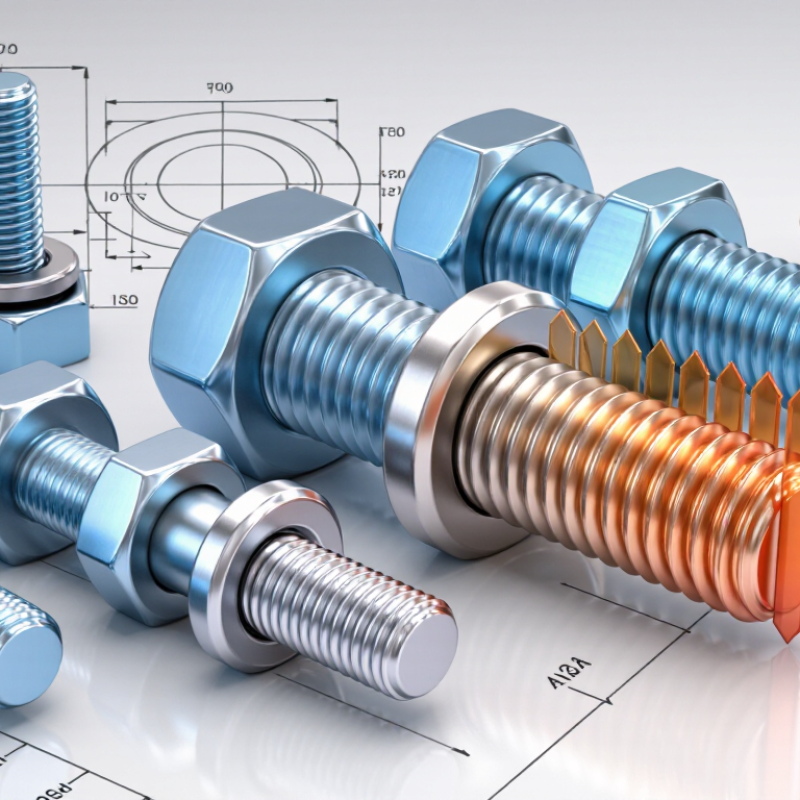
Choosing the Right Double End Bolt: Define the Application and Load Requirements
A double end bolt should match the joint, not merely the hole size. Start by identifying how the connection will be loaded. Is the force axial, lateral, or both? A support carrying a suspended frame may face steady tension, while a machine cover may experience vibration and repeated stress. These details influence bolt diameter, thread engagement, material, and required strength.
Measure the clamped materials carefully. A bolt installed in thin steel needs different engagement than one fixed into a thick tapped block. Check the available thread depth, washer space, tightening access, and expected temperature. Then estimate the working load and apply a suitable safety factor. A clean calculation helps, but it may still miss shock loads or uneven assembly. I have seen joints fail because the design considered weight but ignored movement. Corrosion, heat, and frequent maintenance also deserve attention.
Tips: Record the load direction, peak force, vibration level, and service environment before selecting the bolt. Match the bolt material with the base material to reduce corrosion risk. Confirm that the threaded ends are fully engaged without bottoming out. Use controlled tightening when the joint carries significant force. Inspect the threads for damage, burrs, or contamination. Small mistakes matter. Test the assembled joint when practical, because real conditions can challenge an otherwise sound design.
| Application and Load Condition | Primary Load Requirement | Recommended Bolt Material and Property Class | Typical Thread and Size Starting Point | Reference Strength Data | Important Selection Checks |
|---|---|---|---|---|---|
| General machinery assembly Indoor, moderate temperature, mainly axial clamping | Preload must remain stable under normal vibration and service loads. | Carbon or alloy steel, property class 8.8 | M8 × 1.25 to M16 × 2.0, selected after calculating the required preload. | Minimum tensile strength: approximately 800 MPa. Nominal yield strength: approximately 640 MPa. Proof stress: approximately 580 MPa or higher, depending on the applicable standard. | Use a compatible nut with a suitable strength class. Check thread engagement, washer seating, tightening method, and access for installation. |
| High-load structural or industrial equipment Repeated axial loading or higher clamping force | High tensile capacity with controlled preload and resistance to fatigue. | Alloy steel, property class 10.9 | M10 × 1.5 to M20 × 2.5, subject to the calculated tensile-stress area. | Minimum tensile strength: approximately 1,000 MPa. Nominal yield strength: approximately 900 MPa. Proof stress: approximately 830 MPa. | Avoid over-tightening. Verify joint stiffness, fatigue loading, thread run-out, nut compatibility, and whether the mating component can withstand the higher clamp load. |
| Outdoor equipment in normal atmospheric exposure Moisture, rain, and intermittent corrosion risk | Adequate tensile strength combined with improved corrosion resistance. | Austenitic stainless steel, A2-70 | M8 × 1.25 to M16 × 2.0 for general equipment; use larger sizes when required by the calculated load. | Minimum tensile strength: approximately 700 MPa. Minimum proof stress: approximately 450 MPa. | Stainless steel can gall during tightening. Use suitable assembly practice, avoid mixing incompatible metals where galvanic corrosion is possible, and account for lower proof strength than class 8.8 steel. |
| Marine, chemical, or high-corrosion environment Salt spray, chlorides, or frequent chemical exposure | Corrosion resistance is the primary requirement, but preload must still be maintained. | Austenitic stainless steel, A4-80, where suitable for the environment | M10 × 1.5 to M20 × 2.5, with size confirmed by load and corrosion calculations. | Minimum tensile strength: approximately 800 MPa. Minimum proof stress: approximately 600 MPa. | Confirm resistance to the specific chemicals and chloride concentration. Check crevice corrosion, galling, temperature limits, and compatibility with the mating material. |
| Elevated-temperature service Engines, exhaust systems, boilers, or heated tooling | Retention of strength and preload at the actual operating temperature. | Heat-resistant alloy steel or a material specifically qualified for the service temperature | Commonly M8 × 1.25 to M20 × 2.5, but thread size alone does not establish temperature suitability. | Room-temperature strength values are not sufficient for design. Use certified elevated-temperature yield, creep, and relaxation data. | Check thermal expansion, relaxation, oxidation, thread lubrication, thermal cycling, and the temperature rating of the nut and washer materials. |
| Vibration-prone machinery Rotating equipment, pumps, motors, or cyclic operation | Fatigue resistance and resistance to loosening are more important than static tensile strength alone. | Alloy steel, commonly property class 8.8 or 10.9, selected for fatigue requirements | M10 × 1.5 or larger may be preferred when space permits, because larger thread areas reduce tensile stress. | Static proof and tensile values do not define fatigue life. Fatigue performance depends on preload, stress amplitude, surface condition, and joint geometry. | Use positive locking or a qualified prevailing-torque solution when appropriate. Check joint separation, bending, transverse slip, thread fit, and tightening consistency. |
| Flange, pipe, or pressure-containing joint Axial clamping with sealing-gasket requirements | The bolt set must provide the required gasket seating load without exceeding bolt or flange limits. | Material and property class selected from the equipment design code and service temperature | Size and quantity must be determined from required gasket load, flange geometry, and allowable stresses. | Do not select solely from nominal tensile strength. The design must consider allowable stress, preload scatter, relaxation, and pressure-temperature conditions. | Verify bolt circle, grip length, flange stiffness, gasket type, tightening sequence, hydraulic or thermal effects, and applicable pressure-equipment requirements. |
| Limited installation space or blind assembly Studded connection with one end permanently installed | Correct engagement at both ends and sufficient usable length for the nut and washer. | Match the material and strength class to the connected components and service environment. | Specify both thread lengths separately, for example: M12 × 1.75 on one end and M12 × 1.75 on the other, with a defined overall length. | Strength is governed by the smallest effective tensile area and the weakest engaged thread or component. | Check installation-end and nut-end engagement, unthreaded grip length, thread run-out, insertion depth, protrusion, and the possibility of bottoming in a blind hole. |
| Lightweight or non-metallic mating component Aluminum, polymer, or thin-wall housing | Prevent pull-out, crushing, thread stripping, and excessive local deformation. | Bolt material may be carbon steel, alloy steel, or stainless steel; the mating component usually controls the design. | Use a larger diameter, longer engagement, insert, sleeve, or through-bolt arrangement when needed. | Bolt tensile strength alone is not enough. Check internal-thread shear area, bearing stress, pull-out strength, and local component stiffness. | Use a controlled tightening torque and suitable washers or load-spreading features. Avoid selecting a high-strength bolt that can damage the weaker component. |
| Basic sizing reference: Required tensile-stress area can be estimated as As ≥ F × S / σallow, where F is the maximum service tensile load, S is the design safety factor, and σallow is the permitted tensile stress. Final selection must also check shear, bending, fatigue, thread stripping, preload loss, temperature, corrosion, and the strength of the connected parts. | |||||
How to Choose the Right Double End Bolt?
Choosing the correct bolt type and thread configuration starts with the joint design. A double-end bolt may use equal threads, unequal threads, or a short tap end with a longer exposed end. The tap end must match the tapped hole, while the projecting end must fit the nut, washer, and required adjustment space. ASME B1.1 identifies 1/2-13 UNC as 13 threads per inch and 1/2-20 UNF as 20 threads per inch. Coarse threads usually install faster and tolerate minor contamination better. Fine threads offer better adjustment and a larger stress area, but they need cleaner handling.
Material strength also matters. ISO 898-1 lists property class 8.8 fasteners with 800 MPa minimum tensile strength and 640 MPa minimum yield strength. That figure is useful, but it does not replace checking temperature, corrosion, or fatigue exposure. NASA-RP-1228 explains that friction strongly affects torque-based preload. In practice, identical bolts can develop different clamping forces. I still recheck this step.
Tips: Measure the existing thread before ordering. Confirm diameter, pitch, engagement length, exposed length, and thread direction. Keep at least several full threads engaged, following the applicable engineering standard. A coarse thread is not automatically safer. For metric assemblies, verify the nut and bolt property classes together. Mark the installed depth, then inspect for bottoming before final tightening.
Material selection should follow the joint environment, not habit. Carbon steel suits dry indoor assemblies and general structural work. Alloy steel performs better under higher loads. Stainless steel resists corrosion, but its lower strength can surprise inexperienced buyers.
Check the service temperature and moisture first. Salt spray, condensation, and chemical exposure may require corrosion-resistant materials. ASTM F1554 lists minimum yield strengths of 36, 55, and 105 ksi for its principal anchor bolt grades. Those figures are useful benchmarks, not decoration.
Size affects both load capacity and thread engagement. Measure the diameter, thread pitch, exposed length, and installation depth. A bolt that looks substantial may still have insufficient engagement.
For metric fasteners, ISO 898-1 identifies property class 8.8 with a nominal tensile strength of 800 MPa. Class 10.9 reaches 1,000 MPa. Higher strength is not automatically safer.
The nut and washer must match the bolt grade. Mixing grades creates a weak link. Keep the threads clean. Tighten according to the engineered torque or preload requirement, not instinct.
In field checks, damaged first threads often reveal poor alignment. That detail is easy to miss. It deserves another inspection. Standards guide selection, but the joint design, fatigue load, and installation method still require qualified engineering review.
A double end bolt, often used as a stud, must match both mating threads. Check the diameter, pitch, thread form, and tolerance class before ordering. ISO 965-1 defines metric thread tolerance classes, while ASME B1.1 covers Unified inch threads. These standards prevent a loose fit or forced assembly. It should turn smoothly by hand.
Test the bolt with the actual nut or tapped hole. A thread gauge can confirm pitch, but it cannot reveal damaged threads or poor alignment. Inspect the first thread, chamfer, and unthreaded length. Engagement should provide enough thread contact without allowing the bolt to bottom out. A practical check is to mark the installed depth and verify it against the drawing. I have seen dimension sheets omit the chamfer, causing interference during assembly.
Space matters as much as thread fit.
Measure the gap around the nut, washer, and tightening tool. Leave room for a socket, wrench swing, and future removal. NASA’s Fastener Design Manual, NASA-RP-1228, warns that torque-based preload can vary by roughly 25% because of friction. That variation makes correct dimensions and controlled installation important. Do not rely on torque alone when access is restricted. A short bolt may lose engagement; an overly long one may strike nearby parts. Recheck the final protrusion after tightening.
Seems minor. It is not.
Corrosion resistance should match the installation environment, not just the catalog description. The NACE IMPACT study estimated global corrosion costs at US$2.5 trillion annually, equal to 3.4% of global GDP. That figure explains why coating selection deserves careful attention. Zinc-plated carbon steel may suit dry indoor equipment. Hot-dip galvanizing offers stronger outdoor protection. Stainless steel performs better in many wet or chloride-exposed areas, although grades differ significantly. A coastal application can expose threads to salt deposits, trapped moisture, and hidden crevice corrosion.
Standards help separate suitable products from attractive claims. ISO 898-1 defines mechanical properties for many carbon and alloy steel fasteners. ISO 3506 covers corrosion-resistant stainless fasteners. For continuous-thread or double-end studs, the applicable ASME dimensional standard should also match the drawing. Check the material grade, tensile class, thread tolerance, and test temperature. ASTM B117 salt-spray results can support comparison, but they do not predict real service life perfectly. That limitation matters.
Product quality appears in small details. Inspect thread runout, end chamfering, surface damage, and coating uniformity. Request heat numbers, inspection records, and mechanical test certificates. Traceability is essential. A bolt may look flawless and still fail specification. I would question any supplier offering only a generic certificate. One practical mistake is selecting stainless steel without checking galvanic contact with the mating component. That choice can create a new corrosion path. The better decision combines environment data, standard compliance, verified dimensions, and documented batch control.
We use cookies on our website to give you an improved browser experience. View our Privacy Policy for more information. Please make your selection to opt in or out of ALL cookies here: Accept or Decline
Do you consent to the use of ALL cookies?
901 2nd Court West
Birmingham, AL 35204
Sales: 866.481.4036
Logistics/Ops: 866.481.4036
2101 Dralle Road
University Park, IL 60466
Sales: 708.813.9070
Logistics/Ops: 708.235.4200
400 E. 13th Street
Little Rock, AR 72114
Sales: 866.760.5344
Logistics/Ops: 866.760.5344
225 Collins Road
Elkhart, IN 46515
Sales: 574.295.0214
Logistics/Ops: 574.607.4611
601 Berryman Pike
Tipton, IN 46072
Sales: 800.897.7591
Logistics/Ops: 800.897.7591
3900 Uvalda Street
Denver, CO 80239
Sales: 303.706.8000
Ops/Logistics: 303.576.8398
510 3rd Street E
Milan, IL 61264
Sales: 800.322.1052
Logistics/Ops: 800.322.1052
1660 E. Aurora
Des Moines, IA 50313
Sales: 800.671.1660
Logistics: 800.671.1660
86554 Gene Lasserre Blvd.
Yulee, FL 32097
Sales: 904.253.3060
Logistics/Ops: 904.225.3000
694 S.E. County Road 245
Lake City, FL 32025
Sales: 800.727.6706
Logistics/Ops: 386.752.7412
210 Neptune Road
Auburndale, FL 33823
Sales: 863.967.1131
Logistics/Ops: 863.777.9814
4601 McCoy Drive
Pensacola, FL 32503
Sales: 850.308.7030
Logistics/Ops: 850.434.5502
815 South 56th Street
Tampa, FL 33619
Sales: 813.302.1940
Logistics/Ops: 813.621.1352
200 Hosea Road
Lawrenceville, GA 30046
Sales: 770.953.7575
Logistics/Ops: 770.513.6000
Branch Product Guide
Branch Line Card
Moulding Offering
Cedar Offering
Column Offering
8173 Hwy. 165 North
Monroe, LA 71211
Sales: 800.256.4165
Logistics/Ops: 800.256.4165
508 Warren Avenue
Portland, ME 04103
Sales: 207.888.2331
Logistics/Ops: 207.797.6565
4300 Georgia Pacific Blvd.
Frederick, MD 21704
Sales: 301.798.7474
Logistics/Ops: 301.874.8000
419 Maple Street
Bellingham, MA 02019
Sales: 508.449.0535
Logistics/Ops: 508.966.5500
825 Buchanan Ave SW
Grand Rapids, MI 49507
Sales: 877.800.1180
Logistics/Ops: 616.278.0909
995 Pacific St. NW
Aitkin, MN 56431
Sales: 800.432.3727
Logistics/Ops: 218.212.7770
1102 Port Terminal Drive
Duluth, MN 55802
Sales: 800.951.9899
Logistics/Ops: 800.851.9899
9110 83rd Ave. North
Brooklyn Park, MN 55445
Sales: 763.425.0204
Logistics/Ops: 763.425.0204
910 E. Railroad Street
Long Beach, MS 39560
Sales: 866.535.4135
Logistics/Ops: 228.205.2400
1727 Warren Street
North Kansas City, MO 64116
Sales: 800.621.2611
Logistics/Ops: 800.621.2611
2123 North Golden
Springfield, MO 65803
Sales: 800.375.7891
Logistics/Ops: 800.375.7891
13860 Corp. Woods Trail
Bridgeton, MO 63044
Sales: 314.209.0800
Logistics/Ops: 314.209.0800
1109 South 19th Street
Omaha, NE 68108
Sales: 800.489.6637
Logistics/Ops: 800.489.6637
1 Luger Road
Denville, NJ 07834
Sales: 973-339-3539
Logistics/Ops: 973.625.1461
3720 Jeffrey Blvd.
Blasdell, NY 14219
Sales: 716.235.5989
Logistics/Ops: 716.825.6557
319 Yaphank Ave.
Yaphank, NY 11980
Sales: 631.358.5714
Logistics/Ops: 631.924.7401
3300 Parkside Drive
Charlotte, NC 28208
Sales: 800.839.2588
Logistics/Ops: 704.394.3172
1712 East D Street
Butner, NC 27509
Sales: 984.389.8200
Logistics/Ops: 919.575.3700
128 Foothills Drive
Statesville, NC 28687
Sales: 800.222.1414
Logistics/Ops: 704.394.3172
550 Munroe Falls Rd.
Tallmadge, OH 44278
Sales: 330.357.4506
Logistics/Ops: 330.794.1141
10347 Toebben Dr.
Independence, KY 41051
Sales: 859.298.3926
Logistics/Ops: 859.746.2250
450 N. MacArthur
Oklahoma City, OK 73127
Sales: 800.375.6025
Logistics/Ops: 800.375.6025
1680 North Aspen
Broken Arrow, OK 74012
Sales: 918.272.2212
Logistics/Ops: 918.272.2212
522 Bridge Street
Hunker, PA 15639
Sales: 878.217.2001
Logistics/Ops: 724.925.7285
4290 Atlanta Street
Charleston, SC 29418
Sales: 843.371.1420
Logistics/Ops: 843.554.8192
1040 S. Industrial Dr.
Erwin, TN 37650
Sales: 423.641.1005
Logistics/Ops: 423.742.5911
4287 Pilot Drive
Memphis, TN 38118
Sales: 901.365.2101
Logistics/Ops: 901.365.2101
700 Myatt Drive
Madison, TN 37115
Sales: 615.327.9547
Logistics/Ops: 629.777.4949
4747 Mark IV Parkway
Fort Worth, TX 76106
Sales: 866.323.5117
Logistics/Ops: 817.625.9091
6990 Market Avenue
El Paso, TX 79915
Sales: 915.778.6356
Logistics/Ops: 915.265.7200
2502 Wilson Road
Harlingen, TX 78552
Sales: 800.580.6711
Logistics/Ops: 800.580.6711
10,000 North Loop East
Houston, TX 77029
Sales: 713.921.1977
Logistics/Ops: 713.675.3544
702 East 44th St.
Lubbock, TX 79404
Sales: 866.454.6010
Logistics/Ops: 866.454.6010
535 N. WW White Road
San Antonio, TX 78219
Sales: 800.284.0488
Logistics/Ops: 210.333.8112
142 Pine Haven Shores Rd.
Shelburne, VT 05482
Sales: 802.800.2540
Logistics/Ops: 802.985.2512
4700 Bethlehem Road,
Richmond, VA 23230
Sales: 804.201.2400
Logistics/Ops: 804.342.1161
4516 N Barker Road
Spokane Valley, WA 99027
Phone: 509.892.9420
Toll free: 800.728.6157
8365 N. 76th Street
Milwaukee, WI 53223
Sales: 800.356.9245
Logistics/Ops: 800.356.9245
312 S. Chester Street
Sparta, WI 54656
Sales: 800.362.5864
Logistics/Ops: 800.362.5864
899 Grossman Drive
Schofield, WI 54476
Sales: 800.472.0017
Logistics/Ops: 800.472.0017
