
We use cookies on our website to give you an improved browser experience. View our Privacy Policy for more information. Please make your selection to opt in or out of ALL cookies here: Accept or Decline
Choosing a Flex Neon Strip in 2026 requires more than comparing brightness and price. The market is expanding, but product quality remains uneven. Grand View Research reports that the global LED lighting market reached approximately USD 81 billion in 2023, with continued growth expected through 2030. However, this broader figure does not represent every neon-style strip equally. Buyers still need to inspect construction, certification, and real operating performance.
Energy efficiency matters. The U.S. Department of Energy states that LED products can use at least 75% less energy than incandescent lighting and last considerably longer. Yet efficiency alone does not guarantee a reliable installation. Check the strip’s wattage per metre, operating voltage, heat dissipation, and expected lumen output. A bright sample on a showroom wall may perform differently inside a narrow aluminium channel. It may also show uneven colour after several months.
Look for a clear IP rating, especially around kitchens, storefronts, balconies, or covered outdoor signs. Review the bend direction and minimum bending radius before cutting. Confirm whether the power supply matches the total load, including voltage-drop losses on longer runs. UL, CE, RoHS, and relevant local approvals can strengthen confidence, but labels should be verified rather than assumed. A manufacturer’s technical sheet, testing report, warranty terms, and installation guidance reveal more than attractive product photography. Some choices remain subjective, too. Colour temperature, diffusion, and silicone finish should be judged under the actual viewing conditions, not only through online images.
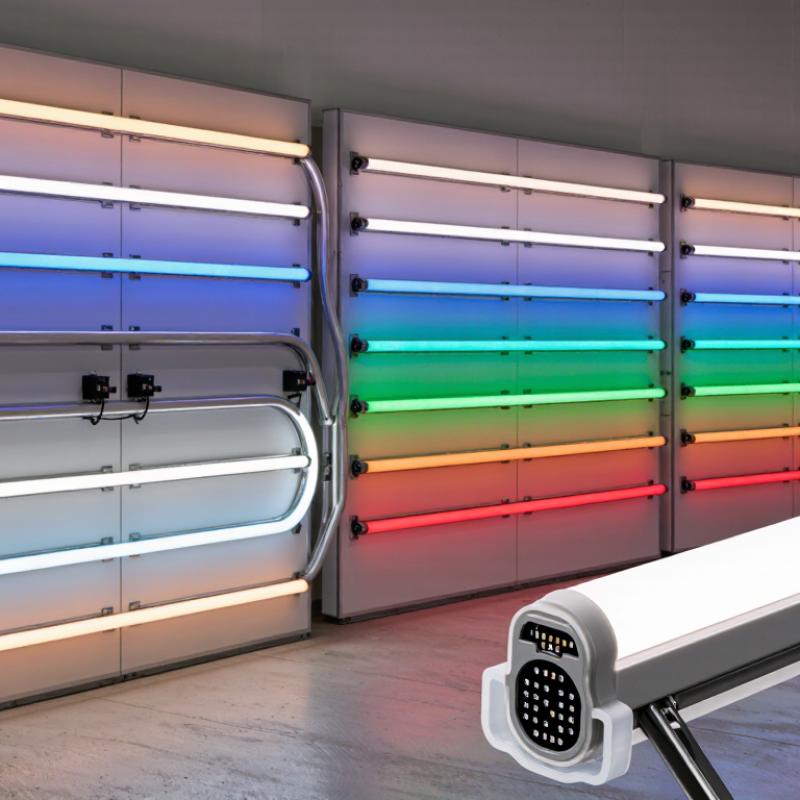
Flex neon strip lights are flexible LED assemblies sealed inside a silicone or similar diffuser. Unlike bare LED tape, they produce a continuous neon-like line with fewer visible light spots. Electricity reaches small LEDs mounted along a narrow circuit board. The diffuser spreads and softens their light. Some models bend vertically, while others bend sideways. This detail matters around signs, curves, and architectural edges.
The U.S. Department of Energy reports that LED products can use at least 75% less energy than incandescent lighting and last up to 25 times longer. That figure does not guarantee every neon strip will perform equally. Heat, poor power supplies, and incorrect installation can shorten its life. Check wattage per metre, voltage, colour rendering, and rated lifetime. For wet locations, use an enclosure with an appropriate IP rating. IEC 60529 defines the IP protection system, but the rating applies to the complete installation, not only the strip. This is often misunderstood.
Tips: Measure the route before buying. Confirm the bend direction and cutting intervals. Choose a power supply with spare capacity, rather than running it at its limit. For indoor displays, a high-CRI version usually shows colours more naturally. For outdoor use, inspect connectors, end caps, and seals carefully. A brighter strip is not always better; excessive brightness can create glare, waste energy, and expose weak heat management. My practical mistake was judging only the colour sample. The diffuser changed the result. Check it in the actual space.
Light type should follow the shape and purpose of your space. Top-bend neon suits straight shelves and signs, while side-bend versions follow curves more naturally. For general illumination, choose a single-color white strip. RGB or RGBW works better for visual accents, but colored light can distort food, skin, and material tones. The IES TM-30 method evaluates color fidelity more deeply than CRI alone, so review both when accurate appearance matters.
Brightness needs measurement, not guesswork. Compare lumens per meter, power consumption, and diffuser loss. A bright strip behind frosted acrylic may appear softer than its specification suggests. ENERGY STAR reports that certified LED lighting uses at least 75% less energy and can last up to 25 times longer than incandescent lighting. That is a useful efficiency benchmark, not a promise for every neon product. My first choice is rarely perfect.
Tips: Use 2200–2700K for intimate rooms, 3000–3500K for hospitality areas, and around 4000K for focused work. Test a one-meter sample before installation. Check color consistency at both ends. For damp locations, verify the complete system’s IP rating, including connectors and power supplies. The U.S. Department of Energy’s 2024 Solid-State Lighting report also stresses system performance, because drivers, heat, and installation can reduce real-world efficiency. Measure twice. Then question the specification.
Waterproofing should match the installation, not just the product description. For outdoor walls, balconies, or garden paths, check the IP rating carefully. A higher rating can resist dust and water, but it does not make poor installation safe. Inspect the silicone jacket for bubbles, thin spots, or open seams. I once ignored a small end gap, and moisture reached the copper conductors after heavy rain. That mistake was preventable. Confirm whether the strip is designed for temporary splashes, direct rain, or constant exposure. These conditions are different.
Tips: Bend the strip gently, never sharply. Seal every cut end with compatible materials. Keep connectors above standing water. Test a short section before installing the full length.
Material quality affects brightness, flexibility, and service life. Dense silicone usually protects better than brittle plastic, while copper conductors should feel consistent along the strip. Ask for the operating temperature range and confirm the power supply matches the required voltage. A correctly sized aluminum profile can reduce heat, especially in long indoor runs. However, profiles may not solve poor ventilation. I used to assume more cooling was always better; sometimes the profile simply added cost without improving performance.
Safety markings deserve careful checking. Look for documentation from a recognized testing body, clear electrical ratings, and installation instructions. Certification names and requirements vary by country, so verify local rules before purchase. Use a qualified electrician for mains connections. Low voltage is safer, but it still requires correct polarity, fusing, and strain relief. Never rely on attractive lighting alone.
How to Choose Flex Neon Strip Lights in 2026?
Choosing flex neon strip lights starts with the power supply, not the color. Check the strip’s voltage, wattage per meter, total length, and a safety margin of at least 20%. A five-meter, 12-watt-per-meter installation needs 60 watts; a 75-watt supply is more practical. The U.S. Department of Energy reports that LED systems can deliver major energy savings across their service life, but poor power conversion still creates waste and heat (DOE, Energy Savings Forecast of Solid-State Lighting, 2019). Use a regulated supply with suitable indoor or outdoor protection. Never hide it inside an unventilated cavity.
Controls should match the project’s daily use. A simple dimmer suits a fixed display, while addressable systems need compatible controllers, data wiring, and careful channel planning. The Zhaga Consortium’s interface guidance highlights the value of standardized control connections for future maintenance (Zhaga Book 18). That matters when one failed controller should not darken an entire facade. Keep signal cables short where possible. Test color consistency before sealing channels.
Installation quality decides whether the light looks professional. Provide aluminum profiles for cooling, clean the mounting surface, and respect the strip’s bend radius. Waterproof products still need sealed joins. I have seen beautiful lighting fail because installers trusted adhesive alone. It happens. Leave accessible service points, label every cable, and test the system for several hours before final closure. The IEA’s 2024 lighting analysis also stresses efficient equipment and better system design, not just efficient lamps.
How to Choose Flex Neon Strip Lights in 2026?
Lifespan should be checked beyond the advertised number. The U.S. Department of Energy’s Solid-State Lighting Technology Fact Sheet reports that LED systems can reach 50,000 hours under controlled conditions. Real installations often perform differently. Heat, moisture, tight bends, and poor drivers can shorten service life. At eight hours daily, 50,000 hours equals about 17 years. That calculation looks impressive. It is not a promise.
Energy use needs a simple measurement. A 10-meter strip rated at 12 watts per meter consumes 120 watts. Running eight hours daily uses about 350 kilowatt-hours annually. At $0.16 per kilowatt-hour, electricity costs roughly $56 each year. The International Energy Agency’s Energy Efficiency 2024 report identifies lighting as a major electricity-use category, making efficient conversion important. Check watts per meter, brightness, and operating hours together. Brightness alone can mislead.
Warranty terms reveal practical quality. Compare coverage length, driver inclusion, outdoor exclusions, color-fade rules, and proof-of-installation requirements. A five-year warranty may be weaker than a three-year warranty with clear replacement terms. Calculate total cost using purchase price, controllers, aluminum channels, labor, electricity, and likely replacement waste. One overlooked detail matters: a failed driver can disable an entire run. I would also question optimistic lifetime claims when thermal testing is missing. Industry data helps, but installation evidence matters more.
Compare lifespan, energy use, warranty, and estimated 10-year ownership cost using representative, brand-neutral specifications.
| Light Type | Rated Life | Power Use | Typical Warranty | 10-Year Cost per Meter |
|---|---|---|---|---|
| Standard Indoor LED Neon | 30,000 hours | 14 W/m | 2 years | $86.32 |
| High-Efficiency LED Neon | 50,000 hours | 8 W/m | 3 years | $87.56 |
| Outdoor-Rated LED Neon | 50,000 hours | 12 W/m | 5 years | $123.84 |
The chart uses a 0–100 comparison score, where higher is better. Scores are calculated from the listed specifications: lifespan is compared with the longest rated life, energy efficiency favors lower wattage, warranty favors longer coverage, and total cost favors lower spending. Ownership cost assumes 8 hours of operation per day for 10 years, electricity at $0.15 per kWh, and an estimated product cost of $25, $35, and $45 per meter respectively. Installation, controls, and maintenance are excluded.
We use cookies on our website to give you an improved browser experience. View our Privacy Policy for more information. Please make your selection to opt in or out of ALL cookies here: Accept or Decline
Do you consent to the use of ALL cookies?
901 2nd Court West
Birmingham, AL 35204
Sales: 866.481.4036
Logistics/Ops: 866.481.4036
2101 Dralle Road
University Park, IL 60466
Sales: 708.813.9070
Logistics/Ops: 708.235.4200
400 E. 13th Street
Little Rock, AR 72114
Sales: 866.760.5344
Logistics/Ops: 866.760.5344
225 Collins Road
Elkhart, IN 46515
Sales: 574.295.0214
Logistics/Ops: 574.607.4611
601 Berryman Pike
Tipton, IN 46072
Sales: 800.897.7591
Logistics/Ops: 800.897.7591
3900 Uvalda Street
Denver, CO 80239
Sales: 303.706.8000
Ops/Logistics: 303.576.8398
510 3rd Street E
Milan, IL 61264
Sales: 800.322.1052
Logistics/Ops: 800.322.1052
1660 E. Aurora
Des Moines, IA 50313
Sales: 800.671.1660
Logistics: 800.671.1660
86554 Gene Lasserre Blvd.
Yulee, FL 32097
Sales: 904.253.3060
Logistics/Ops: 904.225.3000
694 S.E. County Road 245
Lake City, FL 32025
Sales: 800.727.6706
Logistics/Ops: 386.752.7412
210 Neptune Road
Auburndale, FL 33823
Sales: 863.967.1131
Logistics/Ops: 863.777.9814
4601 McCoy Drive
Pensacola, FL 32503
Sales: 850.308.7030
Logistics/Ops: 850.434.5502
815 South 56th Street
Tampa, FL 33619
Sales: 813.302.1940
Logistics/Ops: 813.621.1352
200 Hosea Road
Lawrenceville, GA 30046
Sales: 770.953.7575
Logistics/Ops: 770.513.6000
Branch Product Guide
Branch Line Card
Moulding Offering
Cedar Offering
Column Offering
8173 Hwy. 165 North
Monroe, LA 71211
Sales: 800.256.4165
Logistics/Ops: 800.256.4165
508 Warren Avenue
Portland, ME 04103
Sales: 207.888.2331
Logistics/Ops: 207.797.6565
4300 Georgia Pacific Blvd.
Frederick, MD 21704
Sales: 301.798.7474
Logistics/Ops: 301.874.8000
419 Maple Street
Bellingham, MA 02019
Sales: 508.449.0535
Logistics/Ops: 508.966.5500
825 Buchanan Ave SW
Grand Rapids, MI 49507
Sales: 877.800.1180
Logistics/Ops: 616.278.0909
995 Pacific St. NW
Aitkin, MN 56431
Sales: 800.432.3727
Logistics/Ops: 218.212.7770
1102 Port Terminal Drive
Duluth, MN 55802
Sales: 800.951.9899
Logistics/Ops: 800.851.9899
9110 83rd Ave. North
Brooklyn Park, MN 55445
Sales: 763.425.0204
Logistics/Ops: 763.425.0204
910 E. Railroad Street
Long Beach, MS 39560
Sales: 866.535.4135
Logistics/Ops: 228.205.2400
1727 Warren Street
North Kansas City, MO 64116
Sales: 800.621.2611
Logistics/Ops: 800.621.2611
2123 North Golden
Springfield, MO 65803
Sales: 800.375.7891
Logistics/Ops: 800.375.7891
13860 Corp. Woods Trail
Bridgeton, MO 63044
Sales: 314.209.0800
Logistics/Ops: 314.209.0800
1109 South 19th Street
Omaha, NE 68108
Sales: 800.489.6637
Logistics/Ops: 800.489.6637
1 Luger Road
Denville, NJ 07834
Sales: 973-339-3539
Logistics/Ops: 973.625.1461
3720 Jeffrey Blvd.
Blasdell, NY 14219
Sales: 716.235.5989
Logistics/Ops: 716.825.6557
319 Yaphank Ave.
Yaphank, NY 11980
Sales: 631.358.5714
Logistics/Ops: 631.924.7401
3300 Parkside Drive
Charlotte, NC 28208
Sales: 800.839.2588
Logistics/Ops: 704.394.3172
1712 East D Street
Butner, NC 27509
Sales: 984.389.8200
Logistics/Ops: 919.575.3700
128 Foothills Drive
Statesville, NC 28687
Sales: 800.222.1414
Logistics/Ops: 704.394.3172
550 Munroe Falls Rd.
Tallmadge, OH 44278
Sales: 330.357.4506
Logistics/Ops: 330.794.1141
10347 Toebben Dr.
Independence, KY 41051
Sales: 859.298.3926
Logistics/Ops: 859.746.2250
450 N. MacArthur
Oklahoma City, OK 73127
Sales: 800.375.6025
Logistics/Ops: 800.375.6025
1680 North Aspen
Broken Arrow, OK 74012
Sales: 918.272.2212
Logistics/Ops: 918.272.2212
522 Bridge Street
Hunker, PA 15639
Sales: 878.217.2001
Logistics/Ops: 724.925.7285
4290 Atlanta Street
Charleston, SC 29418
Sales: 843.371.1420
Logistics/Ops: 843.554.8192
1040 S. Industrial Dr.
Erwin, TN 37650
Sales: 423.641.1005
Logistics/Ops: 423.742.5911
4287 Pilot Drive
Memphis, TN 38118
Sales: 901.365.2101
Logistics/Ops: 901.365.2101
700 Myatt Drive
Madison, TN 37115
Sales: 615.327.9547
Logistics/Ops: 629.777.4949
4747 Mark IV Parkway
Fort Worth, TX 76106
Sales: 866.323.5117
Logistics/Ops: 817.625.9091
6990 Market Avenue
El Paso, TX 79915
Sales: 915.778.6356
Logistics/Ops: 915.265.7200
2502 Wilson Road
Harlingen, TX 78552
Sales: 800.580.6711
Logistics/Ops: 800.580.6711
10,000 North Loop East
Houston, TX 77029
Sales: 713.921.1977
Logistics/Ops: 713.675.3544
702 East 44th St.
Lubbock, TX 79404
Sales: 866.454.6010
Logistics/Ops: 866.454.6010
535 N. WW White Road
San Antonio, TX 78219
Sales: 800.284.0488
Logistics/Ops: 210.333.8112
142 Pine Haven Shores Rd.
Shelburne, VT 05482
Sales: 802.800.2540
Logistics/Ops: 802.985.2512
4700 Bethlehem Road,
Richmond, VA 23230
Sales: 804.201.2400
Logistics/Ops: 804.342.1161
4516 N Barker Road
Spokane Valley, WA 99027
Phone: 509.892.9420
Toll free: 800.728.6157
8365 N. 76th Street
Milwaukee, WI 53223
Sales: 800.356.9245
Logistics/Ops: 800.356.9245
312 S. Chester Street
Sparta, WI 54656
Sales: 800.362.5864
Logistics/Ops: 800.362.5864
899 Grossman Drive
Schofield, WI 54476
Sales: 800.472.0017
Logistics/Ops: 800.472.0017
