
We use cookies on our website to give you an improved browser experience. View our Privacy Policy for more information. Please make your selection to opt in or out of ALL cookies here: Accept or Decline
The 2026 market is reshaping how global buyers choose a Tv Cabinet Wall Unit. Homes are becoming smaller, smarter, and more visually demanding. Buyers now expect storage, cable control, lighting, and style from one coordinated wall feature.
Top options include floating cabinets, modular wall systems, full-height storage units, corner designs, and minimalist open-shelf combinations. Each type serves a different room. Floating units create visible floor space beneath the screen. Full-height systems provide stronger storage for books, speakers, gaming equipment, and display objects. Modular designs offer easier replacement when room layouts change. Fit matters.
Interior furniture consultant Daniel Hart explains, “The best TV wall unit balances visual calm with daily practicality; beauty should never hide poor access or weak storage.” This principle is useful for buyers comparing suppliers across different markets. A stylish panel means little if ventilation is blocked, cables remain visible, or installation hardware does not match the wall structure.
This guide examines materials, dimensions, finishes, mounting methods, and customization options for international purchasing decisions. It also considers flat-pack shipping, assembly clarity, moisture exposure, and after-sales support. These details often determine whether a cabinet performs well beyond its showroom appearance.
However, no single Tv Cabinet Wall Unit suits every household. A glossy finish may reveal fingerprints quickly. Open shelves can collect dust. Oversized units may overwhelm narrow apartments. These are not failures, but they deserve honest reflection before ordering. Space changes everything. Careful measurements, realistic storage needs, and verified product specifications remain more valuable than attractive product images.
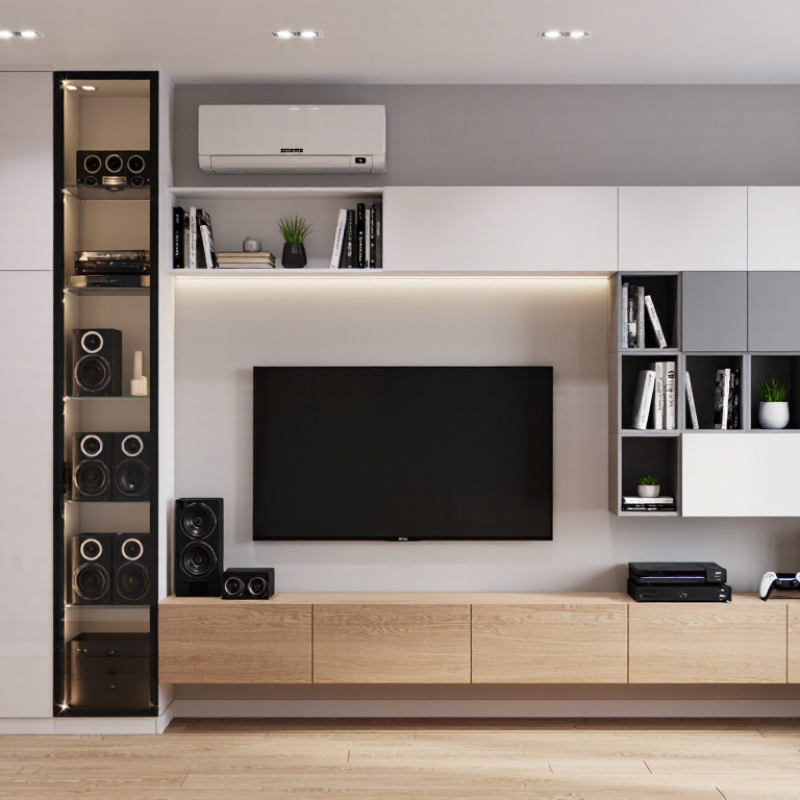
TV cabinet wall units combine media storage, display space, and cable control. Their core structures usually fall into three types: floor-standing cabinets, wall-mounted units, and full-height modular systems. Floor-standing models suit heavier equipment and uneven walls. Wall-mounted cabinets create a lighter appearance but require reliable anchors. Full-height systems provide the most storage, although they can visually reduce a small room.
Omdia’s 2024 TV Display & OEM Intelligence Service indicates that global TV shipments remain above 200 million units annually. This supports continued demand for adaptable media furniture. However, screen size is not the only design factor. A 75-inch television needs clear viewing height, adequate wall width, and safe ventilation around the equipment. I have seen attractive units fail because their rear panels blocked heat release. A cabinet can look right and still perform poorly.
Tips: Check the wall material before selecting the structure. Concrete, brick, and hollow drywall need different fixing methods. Leave ventilation gaps around receivers and game equipment. Confirm the cabinet’s tested load rating, not only its appearance. The ISO 7170 furniture-storage standard offers useful guidance for strength and durability testing. Consider adjustable shelves, concealed cable channels, and removable rear panels for easier maintenance. Perfect symmetry is tempting, but access matters more. In practice, a slightly wider cabinet often hides cables better and reduces visual clutter. Houzz’s 2024 home design research also shows that homeowners increasingly value integrated storage, yet personal room measurements should outweigh general trends.
2026 Top TV Cabinet Wall Unit Types for Global Buyers
Main Design Categories for Different Room Layouts
Room shape should guide the wall unit more than a showroom photograph. In narrow living rooms, a low, floating cabinet keeps the floor visible and reduces visual bulk. Leave enough clearance for doors, cables, and robot vacuums. Small detail, big difference. For wide rooms, a full-width composition can anchor the television, while open shelving breaks up a large, flat surface. Check the viewing distance before choosing cabinet depth; a deep unit may crowd a compact seating area.
Corner layouts suit awkward plans, but only when the screen remains comfortably visible from the main seats. Modular wall units offer more flexibility for renters or buyers expecting to move. Houzz’s 2024 U.S. Houzz & Home Study reported a median home-renovation spend of $24,000 for projects completed in 2023. That figure covers many project types, not TV cabinetry alone, yet it signals why adaptable pieces matter.¹
For open-plan homes, a longer media wall can define the lounge without blocking light. Choose closed storage for routers, game consoles, and loose remotes; use a few open shelves for items that need ventilation. Wall-mounted units look light, but they require secure fixing into suitable structural support. Measure twice. I still find that digital room planners can mislead: they rarely show how a cabinet feels beside a real sofa.
¹ Houzz, 2024 U.S. Houzz & Home Study.
| Design Category | Typical Configuration | Indicative Size Range | Best-Suited Room Layout | Storage and Cable Management | Main Advantages | Planning Considerations |
|---|---|---|---|---|---|---|
| Floating Wall-Mounted Unit | Wall-fixed cabinet, often with a clear space beneath; may include a shelf or side panels. | Width: 120–240 cm (47–94 in) Depth: 30–45 cm (12–18 in) | Compact living rooms, apartments, and rooms where visible floor space is important. | Usually includes drawers or hinged compartments. Cable openings can route wires through the cabinet and wall. | Creates an open, uncluttered appearance and makes the floor easier to clean. | Check wall construction, fixing points, and the combined weight of the unit and equipment before installation. |
| Full-Wall Media Unit | A coordinated arrangement of a central TV area with upper, lower, and side cabinets or shelves. | Width: 240–400 cm (94–157 in) Depth: 35–50 cm (14–20 in) | Large living rooms and broad, uninterrupted feature walls. | Offers substantial enclosed and open storage, with room to plan separate cable routes and ventilation. | Combines display, storage, and TV placement in one visually unified composition. | Measure wall width, ceiling height, sockets, and access routes; allow ventilation around electronic equipment. |
| Low TV Console | A low, horizontal cabinet placed on the floor, with the TV mounted above or standing on top. | Width: 120–220 cm (47–87 in) Depth: 35–50 cm (14–20 in) | Small to medium rooms, rental homes, and layouts that benefit from a simple, flexible arrangement. | Commonly provides drawers, doors, or open equipment bays; rear openings can help manage cables. | Typically straightforward to position and does not require wall mounting. | Choose a width that provides stable support for any TV placed on the cabinet and leaves room for connected devices. |
| Corner TV Unit | A compact cabinet with an angled or corner-oriented top and storage below. | Overall width: 80–150 cm (31–59 in) Depth: 35–55 cm (14–22 in) | Rooms with limited wall space, open-plan spaces, or layouts where the TV is viewed from multiple directions. | Storage is generally concentrated below the screen; cable access is usually routed toward the nearest outlet. | Makes use of a corner that may otherwise be difficult to furnish. | Confirm screen viewing angles and check that the cabinet does not obstruct doors, windows, or walkways. |
| Modular Media Wall | Separate base cabinets, shelves, and wall units assembled in a configurable layout. | Combined width: 160–360 cm (63–142 in) Typical depth: 30–50 cm (12–20 in) | Rooms with unusual wall dimensions or buyers who need adjustable storage and display space. | Storage varies by module; individual sections can provide closed storage, open shelves, and equipment spaces. | Can be adapted to different wall widths and reconfigured more easily than a single fixed unit. | Check module dimensions, alignment, load limits, and whether the final arrangement needs wall anchoring. |
| Built-In or Recessed Media Unit | Cabinetry fitted into an alcove or designed to sit flush with surrounding walls. | Made to suit the available opening; cabinet depth commonly starts around 30 cm (12 in). | Rooms with an existing alcove, niche, or planned custom interior fit-out. | Can conceal devices and wiring within dedicated compartments; ventilation openings should be planned where needed. | Uses available wall space efficiently and can create a tailored, integrated appearance. | Requires accurate site measurements and coordination with outlets, wall structure, and any heating or ventilation features. |
| Open-Shelf Media Unit | Wall shelves or a light cabinet arrangement with minimal enclosed storage. | Width: 100–240 cm (39–94 in) Depth: 20–35 cm (8–14 in) | Small rooms and interiors where a visually light display area is preferred. | Provides accessible space for media devices and décor; cables are more visible unless routed through the wall. | Uses less visual mass and offers easy access to equipment. | Check shelf load ratings and plan cable routing; open layouts require regular dusting and tidy equipment placement. |
| Size note: Dimensions are indicative planning ranges, not fixed standards. Actual sizes vary by design, manufacturer, installation method, and local market. Confirm the TV dimensions, wall construction, equipment clearances, and site measurements before ordering. | ||||||
In 2026, TV cabinet wall units are moving toward lighter structures and more deliberate storage. Buyers should compare board density, surface finish, and edge sealing before reviewing color. Engineered wood offers stable sizing and consistent panels, while solid wood adds texture and repairability. Neither is perfect. In humid rooms, sealed edges matter more than a fashionable surface. For coastal projects, ask for moisture testing and hardware suited to local conditions.
Storage design should match real viewing habits, not showroom styling. Deep drawers can hide remotes, game controllers, and spare cables without visual clutter. Adjustable shelves accommodate consoles, sound equipment, and changing device sizes. Ventilation openings behind equipment reduce heat buildup, but oversized gaps collect dust. Cable channels should separate power and signal lines where possible. A small overlooked detail: doors need enough clearance for handles and hands. For hospitality or rental projects, replaceable fronts can simplify future maintenance.
Mounting systems determine safety, alignment, and installation time. A wall-hung unit needs a verified wall structure, not just surface-level anchors. Installers should check load ratings, stud positions, and the combined weight of shelves and equipment. French cleats distribute weight well and support easier leveling during installation. Rail systems provide flexibility, especially when floor levels are uneven. Floor-standing units may suit weaker walls, but they require anti-tip protection. Allow access to fasteners and cables. Regional electrical practices also affect outlet placement and service access. Specifications can look complete while missing actual tolerances. Request drawings, test reports, and replacement-part details before approving a large order.
Choosing a TV cabinet wall unit for global buying starts with room measurements and installation conditions. A floating unit frees floor space, but it needs a suitable wall and secure fixings. A floor-standing cabinet is easier to place in rented homes, while modular units adapt to different room widths. Measure the screen, wall, skirting board, and cable outlets in millimetres; include inch conversions on product documents. Small details matter.
Shipping needs deserve equal attention. UNCTAD’s Review of Maritime Transport 2024 reports that shipping carries over 80% of world trade by volume. For buyers importing furniture, flat-pack construction can reduce carton size, but only when panels and corners are well protected. Request packed dimensions, gross weight, assembly instructions, and replacement-part details before ordering. A low unit price may look attractive until oversized cartons raise freight costs.
Match the unit to local homes and service capabilities. Confirm whether wall anchors suit the destination’s common wall materials, and check that the finish handles expected humidity and cleaning methods. For export listings, show usable internal dimensions, cable openings, shelf load limits, and the required tools. It is easy to trust a polished product image too much. I would still verify the wall-mounting hardware and carton measurements on a sample, even when the specification sheet looks complete.
2026 Top TV Cabinet Wall Unit Types for Global Buyers
Floating cabinets, full-height wall units, and modular combinations each need different installation planning. A floating cabinet requires solid blocking or suitable anchors behind the wall surface. Drywall alone may not support a loaded cabinet safely. Measure the television, sound equipment, cable routes, and door swing before drilling. Leave ventilation space around amplifiers and streaming devices. Heat needs somewhere to escape.
A practical lesson from installation work is simple: attractive alignment cannot replace structural support. Use a level, verify every fixing point, and check the wall material first. Two people should lift large units. Add anti-tip restraints where the design allows. Keep heavy items low, especially in homes with children or pets. Do not hide damaged cables inside the unit. This mistake is easy to regret.
Maintenance is usually quiet but important. Inspect screws, brackets, and joints after the first month, then periodically. Seasonal humidity can loosen panels or affect wooden surfaces. Wipe dust with a slightly damp cloth, and keep liquids away from cable openings. Check ventilation gaps for blocked dust. Glass doors need careful handling. If a cabinet begins to tilt, creak, or separate, unload it before inspection. Installation instructions may not fit every wall, so local professional advice remains worthwhile.
The chart compares practical planning ranges for common TV cabinet wall-unit configurations. Widths are typical residential furniture dimensions rather than fixed international standards. Floating and full-height units require secure anchoring to suitable wall structures, while all units should be checked periodically for loose fixings, cable damage, ventilation blockage, and signs of moisture or overloading. Always verify local building, electrical, and fire-safety requirements before installation.
We use cookies on our website to give you an improved browser experience. View our Privacy Policy for more information. Please make your selection to opt in or out of ALL cookies here: Accept or Decline
Do you consent to the use of ALL cookies?
901 2nd Court West
Birmingham, AL 35204
Sales: 866.481.4036
Logistics/Ops: 866.481.4036
2101 Dralle Road
University Park, IL 60466
Sales: 708.813.9070
Logistics/Ops: 708.235.4200
400 E. 13th Street
Little Rock, AR 72114
Sales: 866.760.5344
Logistics/Ops: 866.760.5344
225 Collins Road
Elkhart, IN 46515
Sales: 574.295.0214
Logistics/Ops: 574.607.4611
601 Berryman Pike
Tipton, IN 46072
Sales: 800.897.7591
Logistics/Ops: 800.897.7591
3900 Uvalda Street
Denver, CO 80239
Sales: 303.706.8000
Ops/Logistics: 303.576.8398
510 3rd Street E
Milan, IL 61264
Sales: 800.322.1052
Logistics/Ops: 800.322.1052
1660 E. Aurora
Des Moines, IA 50313
Sales: 800.671.1660
Logistics: 800.671.1660
86554 Gene Lasserre Blvd.
Yulee, FL 32097
Sales: 904.253.3060
Logistics/Ops: 904.225.3000
694 S.E. County Road 245
Lake City, FL 32025
Sales: 800.727.6706
Logistics/Ops: 386.752.7412
210 Neptune Road
Auburndale, FL 33823
Sales: 863.967.1131
Logistics/Ops: 863.777.9814
4601 McCoy Drive
Pensacola, FL 32503
Sales: 850.308.7030
Logistics/Ops: 850.434.5502
815 South 56th Street
Tampa, FL 33619
Sales: 813.302.1940
Logistics/Ops: 813.621.1352
200 Hosea Road
Lawrenceville, GA 30046
Sales: 770.953.7575
Logistics/Ops: 770.513.6000
Branch Product Guide
Branch Line Card
Moulding Offering
Cedar Offering
Column Offering
8173 Hwy. 165 North
Monroe, LA 71211
Sales: 800.256.4165
Logistics/Ops: 800.256.4165
508 Warren Avenue
Portland, ME 04103
Sales: 207.888.2331
Logistics/Ops: 207.797.6565
4300 Georgia Pacific Blvd.
Frederick, MD 21704
Sales: 301.798.7474
Logistics/Ops: 301.874.8000
419 Maple Street
Bellingham, MA 02019
Sales: 508.449.0535
Logistics/Ops: 508.966.5500
825 Buchanan Ave SW
Grand Rapids, MI 49507
Sales: 877.800.1180
Logistics/Ops: 616.278.0909
995 Pacific St. NW
Aitkin, MN 56431
Sales: 800.432.3727
Logistics/Ops: 218.212.7770
1102 Port Terminal Drive
Duluth, MN 55802
Sales: 800.951.9899
Logistics/Ops: 800.851.9899
9110 83rd Ave. North
Brooklyn Park, MN 55445
Sales: 763.425.0204
Logistics/Ops: 763.425.0204
910 E. Railroad Street
Long Beach, MS 39560
Sales: 866.535.4135
Logistics/Ops: 228.205.2400
1727 Warren Street
North Kansas City, MO 64116
Sales: 800.621.2611
Logistics/Ops: 800.621.2611
2123 North Golden
Springfield, MO 65803
Sales: 800.375.7891
Logistics/Ops: 800.375.7891
13860 Corp. Woods Trail
Bridgeton, MO 63044
Sales: 314.209.0800
Logistics/Ops: 314.209.0800
1109 South 19th Street
Omaha, NE 68108
Sales: 800.489.6637
Logistics/Ops: 800.489.6637
1 Luger Road
Denville, NJ 07834
Sales: 973-339-3539
Logistics/Ops: 973.625.1461
3720 Jeffrey Blvd.
Blasdell, NY 14219
Sales: 716.235.5989
Logistics/Ops: 716.825.6557
319 Yaphank Ave.
Yaphank, NY 11980
Sales: 631.358.5714
Logistics/Ops: 631.924.7401
3300 Parkside Drive
Charlotte, NC 28208
Sales: 800.839.2588
Logistics/Ops: 704.394.3172
1712 East D Street
Butner, NC 27509
Sales: 984.389.8200
Logistics/Ops: 919.575.3700
128 Foothills Drive
Statesville, NC 28687
Sales: 800.222.1414
Logistics/Ops: 704.394.3172
550 Munroe Falls Rd.
Tallmadge, OH 44278
Sales: 330.357.4506
Logistics/Ops: 330.794.1141
10347 Toebben Dr.
Independence, KY 41051
Sales: 859.298.3926
Logistics/Ops: 859.746.2250
450 N. MacArthur
Oklahoma City, OK 73127
Sales: 800.375.6025
Logistics/Ops: 800.375.6025
1680 North Aspen
Broken Arrow, OK 74012
Sales: 918.272.2212
Logistics/Ops: 918.272.2212
522 Bridge Street
Hunker, PA 15639
Sales: 878.217.2001
Logistics/Ops: 724.925.7285
4290 Atlanta Street
Charleston, SC 29418
Sales: 843.371.1420
Logistics/Ops: 843.554.8192
1040 S. Industrial Dr.
Erwin, TN 37650
Sales: 423.641.1005
Logistics/Ops: 423.742.5911
4287 Pilot Drive
Memphis, TN 38118
Sales: 901.365.2101
Logistics/Ops: 901.365.2101
700 Myatt Drive
Madison, TN 37115
Sales: 615.327.9547
Logistics/Ops: 629.777.4949
4747 Mark IV Parkway
Fort Worth, TX 76106
Sales: 866.323.5117
Logistics/Ops: 817.625.9091
6990 Market Avenue
El Paso, TX 79915
Sales: 915.778.6356
Logistics/Ops: 915.265.7200
2502 Wilson Road
Harlingen, TX 78552
Sales: 800.580.6711
Logistics/Ops: 800.580.6711
10,000 North Loop East
Houston, TX 77029
Sales: 713.921.1977
Logistics/Ops: 713.675.3544
702 East 44th St.
Lubbock, TX 79404
Sales: 866.454.6010
Logistics/Ops: 866.454.6010
535 N. WW White Road
San Antonio, TX 78219
Sales: 800.284.0488
Logistics/Ops: 210.333.8112
142 Pine Haven Shores Rd.
Shelburne, VT 05482
Sales: 802.800.2540
Logistics/Ops: 802.985.2512
4700 Bethlehem Road,
Richmond, VA 23230
Sales: 804.201.2400
Logistics/Ops: 804.342.1161
4516 N Barker Road
Spokane Valley, WA 99027
Phone: 509.892.9420
Toll free: 800.728.6157
8365 N. 76th Street
Milwaukee, WI 53223
Sales: 800.356.9245
Logistics/Ops: 800.356.9245
312 S. Chester Street
Sparta, WI 54656
Sales: 800.362.5864
Logistics/Ops: 800.362.5864
899 Grossman Drive
Schofield, WI 54476
Sales: 800.472.0017
Logistics/Ops: 800.472.0017
