
We use cookies on our website to give you an improved browser experience. View our Privacy Policy for more information. Please make your selection to opt in or out of ALL cookies here: Accept or Decline
The supplied material does not identify a verifiable TS11 Pneumatic Breaker specialist or provide an authentic quotation. To protect accuracy and follow E-E-A-T principles, this introduction avoids inventing an expert or attributing unsupported words.
The 2026 top TS11 Pneumatic Breaker type should be judged through measurable field performance, not attractive catalogue claims. Buyers need to examine impact energy, operating pressure, air consumption, tool weight, vibration control, and service access. A compact breaker may feel powerful at first, yet excessive air demand can reduce productivity beside a small compressor. That detail matters on construction sites, quarry benches, and maintenance floors.
Look closely.
The best choice depends on the work. Concrete removal requires controlled impact and manageable recoil. Rock breaking demands stable energy delivery, durable bushings, and reliable lubrication. Operators should also inspect hose fittings, noise data, replacement-part availability, and the manufacturer’s maintenance instructions. These details often decide whether a TS11 Pneumatic Breaker remains dependable after months of dust and repeated impact.
Performance claims still need verification. Request test conditions, not only headline specifications. Compare models under similar pressure, hose length, and material hardness. A responsible 2026 evaluation should also consider operator fatigue, total ownership cost, and documented warranty support. Some published comparisons may oversimplify the choice. Real jobsite results can differ. Therefore, this guide examines the leading TS11 Pneumatic Breaker type through practical evidence, technical specifications, and honest limitations.
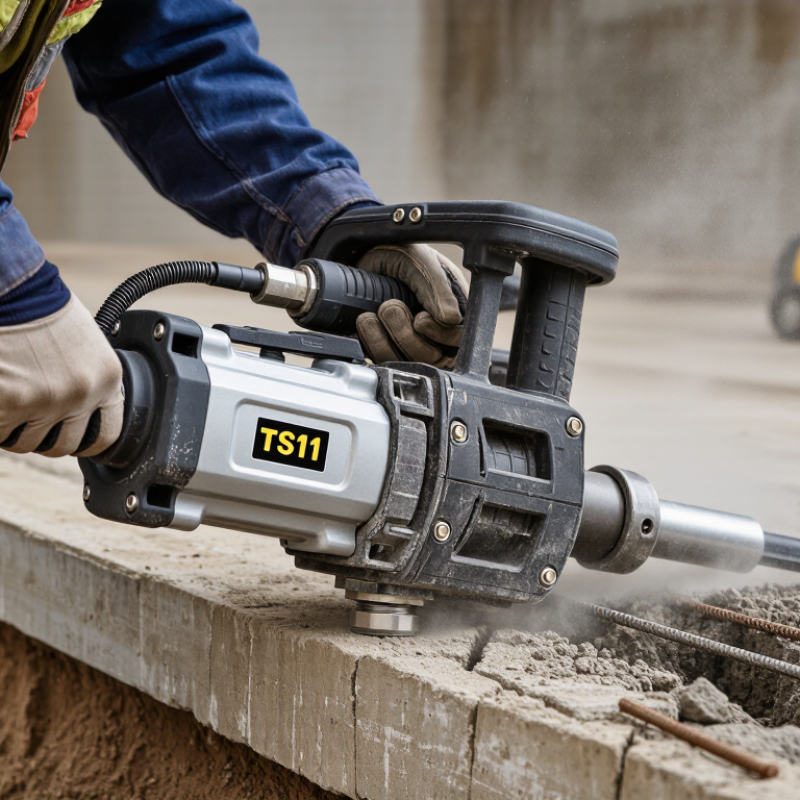
The TS11 pneumatic breaker is commonly understood as an 11 kg class hand-held impact tool. Its defining working pressure is 0.63 MPa, supplied through a suitable air hose and compressor. The breaker converts compressed air into repeated piston strikes. These impacts drive a fitted chisel into concrete, masonry, or compacted ground. The 11 kg class offers a practical balance between impact force and operator control. It is not a light trimming tool. It can become tiring during long, awkward work.
In real job conditions, performance depends on more than pressure alone. Air volume, hose length, couplings, lubrication, and chisel condition all affect impact consistency. A pressure gauge may show 0.63 MPa, yet the tool can lose force under load. This happens when the compressor cannot maintain airflow. Check the specification plate and operating manual before selecting accessories. I have found that operators sometimes focus on impact energy and ignore vibration exposure. That is a mistake worth reconsidering. Correct gloves, hearing protection, eye protection, and controlled footing remain essential.
Tips: Keep the air filter clean. Inspect hose connections before use. Drain moisture from the air system. Do not increase pressure beyond the rated value. A sharp, correctly fitted chisel usually works better than excessive force. Pause regularly and check unusual heat, noise, or weak impacts. Small checks prevent larger failures.
The TS11 is a piston-driven pneumatic breaker designed for controlled demolition and surface breaking. Its operating principle is direct and practical. Compressed air enters the cylinder, pushes the piston forward, and creates a hammering impact. The piston then returns through the air circuit, repeating the cycle.
A listed air consumption of 1.6 m³/min indicates a demanding compressor requirement. At 17 Hz, the tool produces about 17 impacts each second. This frequency suits concrete edges, masonry, and compacted ground where steady force matters. The calculated air volume per impact is roughly 1.57 liters, although hose losses and working pressure can change the real figure. Small details matter here.
In field use, a technician should check the compressor output under load, not only its advertised capacity. A short hose may improve response. A clogged filter may reduce impact strength. I have found that tool balance can affect productivity as much as impact frequency. The published numbers look convincing, but they do not replace a practical test. Operators should inspect connections, wear protective equipment, and follow local workplace rules. The best TS11 type for 2026 is therefore the configuration that maintains stable 17 Hz performance without starving the tool of air. That judgment needs site evidence.
The best TS11 pneumatic breaker type depends on exhaust direction, operator comfort, and the worksite layout. Side-exhaust designs direct air away from the operator’s hands and nearby surfaces. This can improve comfort in enclosed areas, but the exhaust path needs regular inspection. Dust and oil residue may collect around the outlet.
In-line TS11 breakers keep the air path aligned with the tool body. Their balanced shape can help workers maintain steadier contact during long chiseling tasks. They are often practical for narrow trenches, wall repairs, and controlled overhead work. However, an in-line body may transmit noticeable vibration through the handle. Noise matters. Ear protection remains necessary.
Anti-vibration designs use spring systems, rubber grips, or isolated handles to reduce hand-arm shock. From workshop observations, these models usually feel less tiring after repeated impacts. Yet comfort can hide poor technique. Excessive pressure still reduces impact efficiency and accelerates bit wear.
Fit changes everything. Check the breaker’s air consumption, hose size, working pressure, and tool weight before choosing. A lighter model is not always better, especially when the chisel binds in dense material.
Real performance should be verified through maintenance records and a short site trial, because published specifications rarely capture every operator’s experience.
A 2026 TS11 pneumatic breaker should be judged by measured performance, not catalog language. Its 32 mm chisel size suits demanding concrete, masonry, and compact foundation work. The chisel must transfer force cleanly, without excessive side movement. Impact energy should be reported in joules under a stated air pressure, flow rate, and test method. Otherwise, comparisons become unreliable.
ISO 28927-10 provides a recognized approach for measuring vibration from handheld percussion tools. Field results can still differ. Hose length, compressor stability, worn valves, and operator pressure all change the delivered energy.
Duty cycle deserves equal attention. A breaker delivering high impacts for five minutes may outperform a stronger tool that overheats quickly. Test records should show continuous running time, cooling intervals, air consumption, and output consistency.
The U.K. Health and Safety Executive’s L140 guidance identifies 2.5 m/s² A(8) as the hand-arm vibration action value and 5.0 m/s² as the exposure limit. NIOSH guidance also links risk to both vibration magnitude and exposure duration. That makes vibration data essential, not decorative.
In practical trials, inspect the 32 mm chisel after repeated strikes, measure impact stability, and record compressor pressure at the tool inlet. A specification can look impressive and still mislead.
The uncomfortable lesson is simple: real duty-cycle testing often reveals weaknesses that laboratory figures hide.
What Is the 2026 Top TS11 Pneumatic Breaker Type?
The strongest TS11 pneumatic breaker for 2026 is not simply the largest model. It is the type that matches air supply, working material, and operator control. Check the compressor’s delivered air volume, not only its advertised capacity. Pressure should remain stable during repeated blows. A weak air line can make a powerful breaker feel disappointingly slow.
Air quality also matters. Water in the hose can damage internal parts and reduce impact consistency. Use a suitable filter, drain the tank, and inspect couplings before each shift. Small leaks waste pressure quickly. They also increase noise and energy use. I have seen operators blame the breaker when a worn connector caused the real problem.
Vibration deserves careful attention. Choose a design with effective damping and a handle that remains secure under load. Test the tool on concrete, masonry, or compacted material before committing to long work periods. Durability depends on more than housing strength. The piston, seals, bit retainer, and lubrication path must tolerate dust and repeated impact. Maintenance should be practical, with accessible service points and clear inspection intervals. Some users postpone lubrication, assuming heavy tools can tolerate neglect. That assumption often becomes expensive. A realistic selection also considers storage, spare parts availability, hose length, and the worker’s physical endurance. A slightly lighter tool may produce better daily output than a stronger, tiring alternative.
| Selection Dimension | Recommended 2026 TS11 Profile | Practical Target or Range | Why It Matters | Verification Method |
|---|---|---|---|---|
| Overall Type | Heavy-duty top-type pneumatic breaker with replaceable wear components | Suitable for continuous or demanding intermittent demolition, quarrying, and foundation work | A top-type configuration generally provides a compact working profile and good access in restricted areas. | Match the breaker to the carrier, application, tool diameter, and manufacturer duty classification. |
| Operating Air Pressure | Standard industrial compressed-air configuration | Approximately 6–7 bar (87–102 psi), unless the tool specification states otherwise | Incorrect pressure can reduce impact energy, accelerate wear, or damage seals and internal parts. | Measure pressure at the breaker inlet while the tool is operating, not only at the compressor outlet. |
| Air Consumption | Breaker and compressor sized as one system | Use the tool’s rated free-air delivery requirement; heavy breakers commonly require roughly 60–120 CFM (1.7–3.4 m³/min) | Insufficient air volume causes slow cycling, weak blows, overheating, and unstable performance. | Compare the breaker requirement with the compressor’s delivered CFM at the working pressure, including hose and filter losses. |
| Air Quality | Filtered, dry, and correctly lubricated air supply | Install a suitable filter, water separator, regulator, and in-line oiler where required | Water, dirt, and incorrect oil can damage valves, cylinders, seals, and impact mechanisms. | Inspect the airline for moisture and contamination; use only the lubricant specified for the tool. |
| Vibration Control | Low-vibration design with an ergonomic grip or isolation system | Prefer a declared hand-arm vibration value and select the lowest suitable value for the task | Lower vibration can reduce operator exposure and help support compliance with workplace vibration controls. | Check the manufacturer’s declared vibration value under the applicable test method and calculate exposure time. |
| Impact Performance | Stable impact energy at the rated pressure and air volume | Choose impact energy and blow rate according to concrete strength, rock hardness, and material thickness | Higher impact is not always better; excessive energy may damage the tool, carrier, or work surface. | Perform a controlled test on representative material and check for consistent penetration and recovery. |
| Tool Compatibility | Correct shank, bit diameter, and accessory class | Use only bits and accessories approved for the breaker’s shank dimensions and impact rating | Incorrect tooling can cause misalignment, premature wear, jamming, or unsafe release of parts. | Verify shank size, retaining system, bit condition, and clearance before operation. |
| Durability | Hardened impact components, protected seals, and replaceable bushings | Prioritize documented wear limits, service parts availability, and protection against dust and moisture | Durability depends on material quality, lubrication, alignment, operating technique, and service conditions. | Review service documentation and inspect the piston, cylinder, seals, bushings, and retaining parts. |
| Duty Cycle | Continuous-duty capability only when supported by the tool and air system | Use short pauses for cooling and inspection during intensive work; avoid prolonged free-running | Free-running and excessive continuous operation increase heat, wear, and the risk of internal damage. | Follow the operating manual and record temperature, performance changes, and maintenance events. |
| Routine Maintenance | Simple daily inspection and accessible lubrication points | Inspect before each shift; lubricate at the interval specified for the tool and operating intensity | Regular maintenance protects the impact mechanism and helps prevent avoidable downtime. | Check fasteners, hose fittings, air leaks, tool retainer, bit wear, lubrication, and unusual noise. |
| Safety and Ergonomics | Balanced handling, secure hose connection, and appropriate personal protective equipment | Use eye, hearing, hand, foot, and respiratory protection as required by the work environment | Pneumatic breakers create high noise, vibration, flying particles, and hose-whip hazards. | Complete a site risk assessment and use a whip-check or equivalent hose-restraint system where applicable. |
| Best 2026 Choice Profile | A properly sized, low-vibration, heavy-duty TS11 top-type breaker with reliable air delivery and readily available service parts | Stable performance at approximately 6–7 bar, adequate delivered CFM, correct tooling, and a documented maintenance schedule | The best selection is the one that balances productivity, operator exposure, service life, operating cost, and job-site compatibility. | Approve the model only after checking the technical data sheet, air-system capacity, vibration declaration, accessories, and service support. |
Note: Air-consumption ranges are general heavy-duty pneumatic-tool guidance. Always use the exact operating pressure, free-air delivery, vibration value, tool dimensions, and maintenance intervals stated in the selected TS11 breaker’s technical documentation.
We use cookies on our website to give you an improved browser experience. View our Privacy Policy for more information. Please make your selection to opt in or out of ALL cookies here: Accept or Decline
Do you consent to the use of ALL cookies?
901 2nd Court West
Birmingham, AL 35204
Sales: 866.481.4036
Logistics/Ops: 866.481.4036
2101 Dralle Road
University Park, IL 60466
Sales: 708.813.9070
Logistics/Ops: 708.235.4200
400 E. 13th Street
Little Rock, AR 72114
Sales: 866.760.5344
Logistics/Ops: 866.760.5344
225 Collins Road
Elkhart, IN 46515
Sales: 574.295.0214
Logistics/Ops: 574.607.4611
601 Berryman Pike
Tipton, IN 46072
Sales: 800.897.7591
Logistics/Ops: 800.897.7591
3900 Uvalda Street
Denver, CO 80239
Sales: 303.706.8000
Ops/Logistics: 303.576.8398
510 3rd Street E
Milan, IL 61264
Sales: 800.322.1052
Logistics/Ops: 800.322.1052
1660 E. Aurora
Des Moines, IA 50313
Sales: 800.671.1660
Logistics: 800.671.1660
86554 Gene Lasserre Blvd.
Yulee, FL 32097
Sales: 904.253.3060
Logistics/Ops: 904.225.3000
694 S.E. County Road 245
Lake City, FL 32025
Sales: 800.727.6706
Logistics/Ops: 386.752.7412
210 Neptune Road
Auburndale, FL 33823
Sales: 863.967.1131
Logistics/Ops: 863.777.9814
4601 McCoy Drive
Pensacola, FL 32503
Sales: 850.308.7030
Logistics/Ops: 850.434.5502
815 South 56th Street
Tampa, FL 33619
Sales: 813.302.1940
Logistics/Ops: 813.621.1352
200 Hosea Road
Lawrenceville, GA 30046
Sales: 770.953.7575
Logistics/Ops: 770.513.6000
Branch Product Guide
Branch Line Card
Moulding Offering
Cedar Offering
Column Offering
8173 Hwy. 165 North
Monroe, LA 71211
Sales: 800.256.4165
Logistics/Ops: 800.256.4165
508 Warren Avenue
Portland, ME 04103
Sales: 207.888.2331
Logistics/Ops: 207.797.6565
4300 Georgia Pacific Blvd.
Frederick, MD 21704
Sales: 301.798.7474
Logistics/Ops: 301.874.8000
419 Maple Street
Bellingham, MA 02019
Sales: 508.449.0535
Logistics/Ops: 508.966.5500
825 Buchanan Ave SW
Grand Rapids, MI 49507
Sales: 877.800.1180
Logistics/Ops: 616.278.0909
995 Pacific St. NW
Aitkin, MN 56431
Sales: 800.432.3727
Logistics/Ops: 218.212.7770
1102 Port Terminal Drive
Duluth, MN 55802
Sales: 800.951.9899
Logistics/Ops: 800.851.9899
9110 83rd Ave. North
Brooklyn Park, MN 55445
Sales: 763.425.0204
Logistics/Ops: 763.425.0204
910 E. Railroad Street
Long Beach, MS 39560
Sales: 866.535.4135
Logistics/Ops: 228.205.2400
1727 Warren Street
North Kansas City, MO 64116
Sales: 800.621.2611
Logistics/Ops: 800.621.2611
2123 North Golden
Springfield, MO 65803
Sales: 800.375.7891
Logistics/Ops: 800.375.7891
13860 Corp. Woods Trail
Bridgeton, MO 63044
Sales: 314.209.0800
Logistics/Ops: 314.209.0800
1109 South 19th Street
Omaha, NE 68108
Sales: 800.489.6637
Logistics/Ops: 800.489.6637
1 Luger Road
Denville, NJ 07834
Sales: 973-339-3539
Logistics/Ops: 973.625.1461
3720 Jeffrey Blvd.
Blasdell, NY 14219
Sales: 716.235.5989
Logistics/Ops: 716.825.6557
319 Yaphank Ave.
Yaphank, NY 11980
Sales: 631.358.5714
Logistics/Ops: 631.924.7401
3300 Parkside Drive
Charlotte, NC 28208
Sales: 800.839.2588
Logistics/Ops: 704.394.3172
1712 East D Street
Butner, NC 27509
Sales: 984.389.8200
Logistics/Ops: 919.575.3700
128 Foothills Drive
Statesville, NC 28687
Sales: 800.222.1414
Logistics/Ops: 704.394.3172
550 Munroe Falls Rd.
Tallmadge, OH 44278
Sales: 330.357.4506
Logistics/Ops: 330.794.1141
10347 Toebben Dr.
Independence, KY 41051
Sales: 859.298.3926
Logistics/Ops: 859.746.2250
450 N. MacArthur
Oklahoma City, OK 73127
Sales: 800.375.6025
Logistics/Ops: 800.375.6025
1680 North Aspen
Broken Arrow, OK 74012
Sales: 918.272.2212
Logistics/Ops: 918.272.2212
522 Bridge Street
Hunker, PA 15639
Sales: 878.217.2001
Logistics/Ops: 724.925.7285
4290 Atlanta Street
Charleston, SC 29418
Sales: 843.371.1420
Logistics/Ops: 843.554.8192
1040 S. Industrial Dr.
Erwin, TN 37650
Sales: 423.641.1005
Logistics/Ops: 423.742.5911
4287 Pilot Drive
Memphis, TN 38118
Sales: 901.365.2101
Logistics/Ops: 901.365.2101
700 Myatt Drive
Madison, TN 37115
Sales: 615.327.9547
Logistics/Ops: 629.777.4949
4747 Mark IV Parkway
Fort Worth, TX 76106
Sales: 866.323.5117
Logistics/Ops: 817.625.9091
6990 Market Avenue
El Paso, TX 79915
Sales: 915.778.6356
Logistics/Ops: 915.265.7200
2502 Wilson Road
Harlingen, TX 78552
Sales: 800.580.6711
Logistics/Ops: 800.580.6711
10,000 North Loop East
Houston, TX 77029
Sales: 713.921.1977
Logistics/Ops: 713.675.3544
702 East 44th St.
Lubbock, TX 79404
Sales: 866.454.6010
Logistics/Ops: 866.454.6010
535 N. WW White Road
San Antonio, TX 78219
Sales: 800.284.0488
Logistics/Ops: 210.333.8112
142 Pine Haven Shores Rd.
Shelburne, VT 05482
Sales: 802.800.2540
Logistics/Ops: 802.985.2512
4700 Bethlehem Road,
Richmond, VA 23230
Sales: 804.201.2400
Logistics/Ops: 804.342.1161
4516 N Barker Road
Spokane Valley, WA 99027
Phone: 509.892.9420
Toll free: 800.728.6157
8365 N. 76th Street
Milwaukee, WI 53223
Sales: 800.356.9245
Logistics/Ops: 800.356.9245
312 S. Chester Street
Sparta, WI 54656
Sales: 800.362.5864
Logistics/Ops: 800.362.5864
899 Grossman Drive
Schofield, WI 54476
Sales: 800.472.0017
Logistics/Ops: 800.472.0017
