
We use cookies on our website to give you an improved browser experience. View our Privacy Policy for more information. Please make your selection to opt in or out of ALL cookies here: Accept or Decline
Choosing reliable Grade 304l Stainless Coils suppliers in 2026 requires more than comparing prices. Buyers must examine chemical composition, surface finish, coil tolerances, production records, and delivery consistency. A polished coil may look impressive under warehouse lighting, yet hidden thickness variation can affect forming, welding, and final product quality.
Dr. Harold M. Cobb, a recognized stainless-steel historian and metallurgist, has stated, “Stainless steel is not one material, but a family of materials.” This observation remains practical. Grade 304L is valued for its low carbon content, corrosion resistance, weldability, and broad industrial use. However, suppliers do not offer identical performance. Their melting controls, annealing methods, pickling practices, and inspection systems can differ significantly.
Look closely.
A dependable supplier should provide current mill test certificates, heat numbers, dimensional reports, and clear traceability. Site experience also matters. A supplier serving food-processing equipment may understand hygienic finishes better than a general metal trader. Meanwhile, a construction-focused distributor may offer stronger stock availability and faster regional delivery.
This guide evaluates leading suppliers through technical capability, quality assurance, export experience, customization options, and customer support. It also considers weaknesses. No supplier is perfect, and marketing claims deserve verification. Some companies communicate well but provide limited technical evidence. Others produce excellent coils but respond slowly when specifications change.
The strongest choice depends on your application, not reputation alone. By comparing measurable evidence, buyers can reduce waste, avoid mismatched material, and select Grade 304L Stainless Coils with greater confidence.
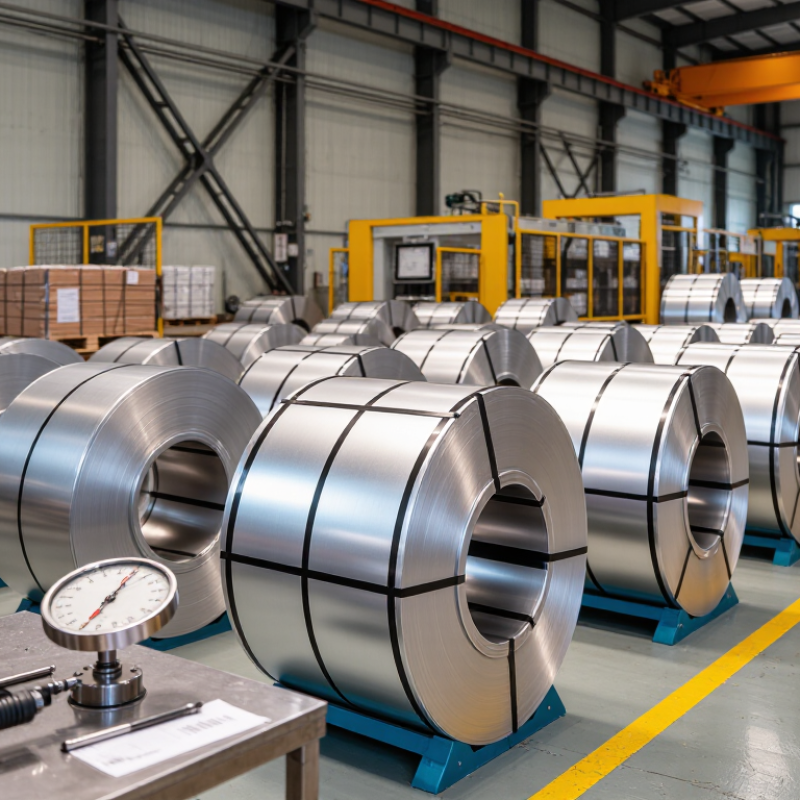
304L stainless steel is a low-carbon version of 304 stainless steel. It contains chromium and nickel, which help form a protective oxide layer. This layer supports corrosion resistance in kitchens, chemical equipment, and architectural interiors. That small carbon reduction matters. After welding, 304L is less likely to form chromium carbides along grain boundaries. This helps reduce the risk of weld-related corrosion. Fabrication is more forgiving.
The material is supplied in coils because continuous strip production improves consistency and handling. Coils can be slit into narrow widths or shaped through rollers. They also reduce repeated setup work during manufacturing. A typical coil may show a smooth, reflective surface, controlled thickness, and carefully rounded edges. These details affect stamping, bending, and surface finishing. In practical purchasing, I check the heat number, thickness tolerance, coil weight, and test certificate. A reliable supplier should also explain annealing, pickling, and surface grades clearly.
304L is not perfect for every environment. Strong chlorides can still cause pitting, especially near seawater or stagnant moisture. I have seen material selected by appearance alone, which is a costly mistake. Chemical exposure, forming requirements, and welding methods deserve equal attention. Supplier experience matters here. Clear inspection records and traceable production data often reveal more than a polished sales description. “Top grade” should mean verified performance, not merely a bright surface.
Technical reference and supplier-selection matrix for 304L stainless steel coils
| Evaluation Dimension | 304L Stainless Steel Reference | Why It Matters in Coil Applications | Supplier Documentation or Inspection Point |
|---|---|---|---|
| Material designation | AISI/SAE 304L; UNS S30403; commonly specified under ASTM A240/A240M for plate, sheet, and strip. | Provides a recognized material identity for purchasing, fabrication, and traceability. | Request the material test certificate showing grade, heat number, applicable standard, and product form. |
| Nominal chromium content | Typically 18.0–20.0% by mass under ASTM A240 chemical limits. | Chromium forms a passive oxide film that provides the basic corrosion resistance of the stainless steel. | Verify the heat-analysis result against the agreed standard and purchase specification. |
| Nominal nickel content | Typically 8.0–12.0% by mass under ASTM A240 chemical limits. | Nickel helps stabilize the austenitic structure and supports ductility, formability, and toughness. | Check the certified chemical analysis rather than relying only on the grade label. |
| Maximum carbon content | 0.030% maximum by mass for the “L” low-carbon grade. | The lower carbon level reduces the risk of chromium-carbide precipitation during welding and helps preserve corrosion resistance near welds. | Confirm the carbon result and specify 304L when welding or post-weld corrosion performance is important. |
| Material structure | Austenitic stainless steel; generally non-magnetic in the annealed condition, although cold working can increase magnetic response. | Supports excellent formability and toughness for stamped, rolled, and fabricated coil components. | Request mill documentation for condition and avoid using magnetism alone as a grade-identification test. |
| Density | Approximately 7.9–8.0 g/cm³, depending on reference and composition. | Useful for estimating coil weight, freight requirements, slitting yield, and material consumption. | Compare the calculated mass with the ordered dimensions, theoretical weight, and actual weighbridge record. |
| Typical tensile strength | At least about 515 MPa for annealed sheet and strip under ASTM A240 requirements; actual values vary with product and condition. | Indicates resistance to tensile loading and helps determine forming and processing limits. | Review the certified tensile test results for each heat or lot as required by the purchase order. |
| Typical yield strength | At least about 205 MPa at 0.2% offset for annealed material under ASTM A240 requirements. | Important for calculating forming loads and assessing permanent deformation during service. | Check yield strength, tensile strength, and elongation together; do not evaluate quality from one value alone. |
| Elongation | Commonly specified at approximately 40% minimum in 50 mm for annealed ASTM A240 sheet and strip, subject to the applicable product specification. | High elongation supports deep drawing, bending, spinning, and other cold-forming operations. | Match the test method, gauge length, thickness range, and minimum value to the contract requirements. |
| Surface finish options | Common finishes include 2B, BA, No. 4, and No. 8, depending on the product and processing route. | Surface condition affects appearance, cleanability, friction, reflectivity, and suitability for architectural or food-processing equipment. | Define finish, roughness target where applicable, protective film, inspection lighting, and acceptable surface defects. |
| Common thickness range | Available thickness depends on the mill, standard, rolling route, and order quantity; thin-gauge and heavier coil products are both commercially available. | Thickness tolerance directly affects part dimensions, weight, forming behavior, and downstream slitting performance. | Confirm nominal thickness, permitted tolerance, measurement method, and sampling frequency before order placement. |
| Width and edge condition | Coils may be supplied in mill edge or slit edge configurations, subject to the ordered width and tolerance. | Accurate width and clean edges reduce trimming waste, tooling issues, burrs, and line stoppages. | Specify width tolerance, camber, flatness, edge condition, burr limit, and coil inside/outside diameter. |
| Weldability | Generally suitable for common fusion-welding processes when appropriate procedures and filler metals are used. | Low carbon content helps reduce sensitization risk compared with standard 304 during welding, although heat input and service conditions still matter. | Ask for welding recommendations, heat-treatment condition, and any intergranular-corrosion test requirement relevant to the application. |
| Corrosion-resistance scope | Good general resistance in many atmospheric, food, architectural, and mildly corrosive environments. | Its balance of corrosion resistance, availability, and formability makes it a widely used coil grade. | Require application-specific review for chlorides, seawater, strong acids, high temperatures, or crevice conditions; 304L is not universally suitable. |
| Magnetic behavior after processing | Usually low magnetic permeability when annealed; rolling, bending, and forming can produce some magnetism. | Prevents incorrect rejection of otherwise conforming material when components have undergone significant cold work. | Use chemical analysis and mechanical testing for identification; define magnetic-permeability limits only when functionally necessary. |
| Traceability | Each production heat or lot should be identifiable through records linking the coil to its chemical and mechanical test results. | Supports quality control, recall management, project documentation, and regulatory compliance. | Check heat number marking, coil number, certificate consistency, packing list, and permanent or removable identification. |
| Recommended supplier qualification status | Evidence-based approval | A technically suitable supplier should demonstrate conformity, stable dimensional control, reliable delivery, and responsive corrective action. | Evaluate certificates, sample inspection, surface quality, dimensional capability, packaging, lead time, nonconformance history, and after-sales support. |
Key Standards and Quality Criteria for 304L Stainless Coils
Reliable 304L stainless coil suppliers should provide material meeting ASTM A240 or EN 10088 requirements. The grade normally contains no more than 0.03% carbon. This lower carbon level helps reduce carbide precipitation after welding. Buyers should verify chromium, nickel, manganese, and carbon values through a heat-specific mill test certificate. Tensile strength, yield strength, and elongation must also match the selected standard. A certificate can look complete, yet one unchecked detail may cause costly production problems.
Surface quality needs equal attention. Request the specified finish, such as 2B or BA, with clear thickness and width tolerances. Inspect coils for scratches, edge cracks, dents, rust stains, and uneven leveling. Useful controls include positive material identification, ultrasonic testing, dimensional checks, and corrosion testing when service conditions require it. Traceability should continue from the heat number to the packing label. This sounds basic. It is often missed.
Tips: Ask for a recent inspection report, not only a standard template. Confirm coil weight, inner diameter, packaging, and moisture protection before shipment. Compare test results with your forming and welding needs. A supplier may meet the chemistry range but still fail your surface or flatness expectations. Leave room for review. Specifications sometimes need adjustment after the first production trial.
The chart shows the ASTM A240/A240M chemical composition limits for 304L stainless steel, expressed as weight percentages. Chromium and nickel provide corrosion resistance, while the low carbon limit helps reduce carbide precipitation after welding. Actual coil certification should also verify mechanical properties, dimensions, surface condition, heat treatment, and traceability.
Evaluating 304L stainless coil suppliers in 2026 requires more than comparing prices. A credible supplier should provide clear mill certificates, heat numbers, and traceable production records. Check whether the certificate matches the ordered grade, thickness, width, and surface finish. 304L usually contains reduced carbon, supporting better weldability and resistance to sensitization. Still, do not accept vague claims.
Ask for recent test results covering chemical composition, tensile strength, elongation, hardness, and surface quality. Confirm which standards the supplier follows, such as ASTM or EN requirements. Packaging also matters. Coils should have secure straps, moisture protection, edge guards, and readable labels. Small details prevent costly damage.
Request samples before placing a large order. Measure thickness at several points, inspect the surface under strong light, and review coil weight against the packing list. A reliable supplier should explain tolerances without avoiding difficult questions. Production capacity, lead time, and after-sales response deserve equal attention. I have found that fast replies do not always mean strong technical control. That is worth remembering.
A remote audit can reveal more than a polished brochure. Look for calibrated instruments, documented inspections, and consistent identification from melting to shipment. Ask how nonconforming coils are isolated. Weak answers are warning signs. No checklist is perfect. Your application may require extra testing, especially for deep drawing, welding, or corrosive service. A supplier earns confidence through evidence, not confident language.
The 2026 market is regional, but supplier selection is increasingly technical. The International Stainless Steel Forum reported global crude stainless steel production of about 62 million tonnes in 2024. East Asia remains the largest production base, supported by integrated mills, strong melt capacity, and efficient coil processing. China, Indonesia, Japan, South Korea, and Taiwan continue serving large-volume demand.
Europe remains important for certified, lower-volume, and highly traceable supply. European service centers often provide slitting, leveling, surface finishing, and smaller batch delivery. North American distributors focus on local inventory, shorter lead times, and documentation for construction, food equipment, and chemical applications. It is not always cheaper.
Supplier types differ sharply. Integrated producers control melting, rolling, annealing, and testing. Independent processors buy master coils and customize widths, edges, and finishes. Stockists can respond quickly, but their heat-level traceability may require closer review. Trading companies offer broader sourcing, although inspection standards can vary.
A 2025 CRU stainless market analysis highlighted persistent pressure from excess capacity and uneven regional demand. Buyers should therefore verify 304L chemistry, tensile properties, surface finish, coil weight, and mill certificates before comparing prices. ASTM A240 alignment matters. So does real inspection evidence.
In practice, I would request sample certificates, recent third-party test records, and packing photographs. A polished certificate is not proof of consistent production. That assumption deserves scrutiny.
When sourcing 304L stainless steel coils in 2026, price should be judged against the complete delivery cost. Ask suppliers to separate material, slitting, packaging, insurance, and freight charges. A low quotation may exclude edge trimming or port fees. Request prices for the exact thickness, width, surface finish, coil weight, and quantity. Small specification changes can alter the final price considerably.
Certification checks protect both quality and project schedules. Reliable suppliers should provide a material test certificate, preferably EN 10204 3.1, with heat number traceability. Confirm compliance with the required ASTM or EN specification before placing an order. ISO 9001 supports process control, but it does not replace product testing. Review chemical composition, tensile results, dimensional tolerances, and surface inspection records. Documents matter. Yet paperwork alone cannot reveal every coil defect.
Delivery planning needs practical questions. Is the coil in stock, or will production start after payment? Request a written lead time, loading date, packaging method, and acceptable shipment tolerance. Moisture-resistant wrapping and strong steel bands help prevent damage during ocean transport. After-sales support should include prompt claim handling, photo evidence procedures, replacement options, and access to traceability records. In my experience, written agreements reduce confusion, though they cannot remove every delay. Forecasts are imperfect. A supplier who reports problems early is often safer than one promising an unrealistically short delivery.
We use cookies on our website to give you an improved browser experience. View our Privacy Policy for more information. Please make your selection to opt in or out of ALL cookies here: Accept or Decline
Do you consent to the use of ALL cookies?
901 2nd Court West
Birmingham, AL 35204
Sales: 866.481.4036
Logistics/Ops: 866.481.4036
2101 Dralle Road
University Park, IL 60466
Sales: 708.813.9070
Logistics/Ops: 708.235.4200
400 E. 13th Street
Little Rock, AR 72114
Sales: 866.760.5344
Logistics/Ops: 866.760.5344
225 Collins Road
Elkhart, IN 46515
Sales: 574.295.0214
Logistics/Ops: 574.607.4611
601 Berryman Pike
Tipton, IN 46072
Sales: 800.897.7591
Logistics/Ops: 800.897.7591
3900 Uvalda Street
Denver, CO 80239
Sales: 303.706.8000
Ops/Logistics: 303.576.8398
510 3rd Street E
Milan, IL 61264
Sales: 800.322.1052
Logistics/Ops: 800.322.1052
1660 E. Aurora
Des Moines, IA 50313
Sales: 800.671.1660
Logistics: 800.671.1660
86554 Gene Lasserre Blvd.
Yulee, FL 32097
Sales: 904.253.3060
Logistics/Ops: 904.225.3000
694 S.E. County Road 245
Lake City, FL 32025
Sales: 800.727.6706
Logistics/Ops: 386.752.7412
210 Neptune Road
Auburndale, FL 33823
Sales: 863.967.1131
Logistics/Ops: 863.777.9814
4601 McCoy Drive
Pensacola, FL 32503
Sales: 850.308.7030
Logistics/Ops: 850.434.5502
815 South 56th Street
Tampa, FL 33619
Sales: 813.302.1940
Logistics/Ops: 813.621.1352
200 Hosea Road
Lawrenceville, GA 30046
Sales: 770.953.7575
Logistics/Ops: 770.513.6000
Branch Product Guide
Branch Line Card
Moulding Offering
Cedar Offering
Column Offering
8173 Hwy. 165 North
Monroe, LA 71211
Sales: 800.256.4165
Logistics/Ops: 800.256.4165
508 Warren Avenue
Portland, ME 04103
Sales: 207.888.2331
Logistics/Ops: 207.797.6565
4300 Georgia Pacific Blvd.
Frederick, MD 21704
Sales: 301.798.7474
Logistics/Ops: 301.874.8000
419 Maple Street
Bellingham, MA 02019
Sales: 508.449.0535
Logistics/Ops: 508.966.5500
825 Buchanan Ave SW
Grand Rapids, MI 49507
Sales: 877.800.1180
Logistics/Ops: 616.278.0909
995 Pacific St. NW
Aitkin, MN 56431
Sales: 800.432.3727
Logistics/Ops: 218.212.7770
1102 Port Terminal Drive
Duluth, MN 55802
Sales: 800.951.9899
Logistics/Ops: 800.851.9899
9110 83rd Ave. North
Brooklyn Park, MN 55445
Sales: 763.425.0204
Logistics/Ops: 763.425.0204
910 E. Railroad Street
Long Beach, MS 39560
Sales: 866.535.4135
Logistics/Ops: 228.205.2400
1727 Warren Street
North Kansas City, MO 64116
Sales: 800.621.2611
Logistics/Ops: 800.621.2611
2123 North Golden
Springfield, MO 65803
Sales: 800.375.7891
Logistics/Ops: 800.375.7891
13860 Corp. Woods Trail
Bridgeton, MO 63044
Sales: 314.209.0800
Logistics/Ops: 314.209.0800
1109 South 19th Street
Omaha, NE 68108
Sales: 800.489.6637
Logistics/Ops: 800.489.6637
1 Luger Road
Denville, NJ 07834
Sales: 973-339-3539
Logistics/Ops: 973.625.1461
3720 Jeffrey Blvd.
Blasdell, NY 14219
Sales: 716.235.5989
Logistics/Ops: 716.825.6557
319 Yaphank Ave.
Yaphank, NY 11980
Sales: 631.358.5714
Logistics/Ops: 631.924.7401
3300 Parkside Drive
Charlotte, NC 28208
Sales: 800.839.2588
Logistics/Ops: 704.394.3172
1712 East D Street
Butner, NC 27509
Sales: 984.389.8200
Logistics/Ops: 919.575.3700
128 Foothills Drive
Statesville, NC 28687
Sales: 800.222.1414
Logistics/Ops: 704.394.3172
550 Munroe Falls Rd.
Tallmadge, OH 44278
Sales: 330.357.4506
Logistics/Ops: 330.794.1141
10347 Toebben Dr.
Independence, KY 41051
Sales: 859.298.3926
Logistics/Ops: 859.746.2250
450 N. MacArthur
Oklahoma City, OK 73127
Sales: 800.375.6025
Logistics/Ops: 800.375.6025
1680 North Aspen
Broken Arrow, OK 74012
Sales: 918.272.2212
Logistics/Ops: 918.272.2212
522 Bridge Street
Hunker, PA 15639
Sales: 878.217.2001
Logistics/Ops: 724.925.7285
4290 Atlanta Street
Charleston, SC 29418
Sales: 843.371.1420
Logistics/Ops: 843.554.8192
1040 S. Industrial Dr.
Erwin, TN 37650
Sales: 423.641.1005
Logistics/Ops: 423.742.5911
4287 Pilot Drive
Memphis, TN 38118
Sales: 901.365.2101
Logistics/Ops: 901.365.2101
700 Myatt Drive
Madison, TN 37115
Sales: 615.327.9547
Logistics/Ops: 629.777.4949
4747 Mark IV Parkway
Fort Worth, TX 76106
Sales: 866.323.5117
Logistics/Ops: 817.625.9091
6990 Market Avenue
El Paso, TX 79915
Sales: 915.778.6356
Logistics/Ops: 915.265.7200
2502 Wilson Road
Harlingen, TX 78552
Sales: 800.580.6711
Logistics/Ops: 800.580.6711
10,000 North Loop East
Houston, TX 77029
Sales: 713.921.1977
Logistics/Ops: 713.675.3544
702 East 44th St.
Lubbock, TX 79404
Sales: 866.454.6010
Logistics/Ops: 866.454.6010
535 N. WW White Road
San Antonio, TX 78219
Sales: 800.284.0488
Logistics/Ops: 210.333.8112
142 Pine Haven Shores Rd.
Shelburne, VT 05482
Sales: 802.800.2540
Logistics/Ops: 802.985.2512
4700 Bethlehem Road,
Richmond, VA 23230
Sales: 804.201.2400
Logistics/Ops: 804.342.1161
4516 N Barker Road
Spokane Valley, WA 99027
Phone: 509.892.9420
Toll free: 800.728.6157
8365 N. 76th Street
Milwaukee, WI 53223
Sales: 800.356.9245
Logistics/Ops: 800.356.9245
312 S. Chester Street
Sparta, WI 54656
Sales: 800.362.5864
Logistics/Ops: 800.362.5864
899 Grossman Drive
Schofield, WI 54476
Sales: 800.472.0017
Logistics/Ops: 800.472.0017
