
We use cookies on our website to give you an improved browser experience. View our Privacy Policy for more information. Please make your selection to opt in or out of ALL cookies here: Accept or Decline
Choosing reliable Metal Scaffolding Planks requires more than comparing online prices. In 2026, contractors and distributors will examine load capacity, surface treatment, dimensions, and supply consistency. A plank may look identical in a product photo, yet differ greatly in steel thickness, welding quality, and edge protection. Small differences matter on a busy construction site.
This guide explores leading Metal Scaffolding Planks suppliers worldwide. It considers manufacturing experience, quality systems, export capability, customization, and customer support. Practical details receive attention, including slip-resistant surfaces, drainage holes, galvanized finishes, and packaging for long-distance shipping. Supplier reputation also matters. Verified test reports and traceable production records offer stronger evidence than broad marketing claims. Trust needs proof.
The market is not perfectly uniform. Some suppliers publish detailed technical data, while others provide limited information. That gap deserves careful reflection. A low quotation may exclude inspection, inland transport, or replacement support. Delivery promises can also change during peak construction seasons. Buyers should request current specifications, sample evaluations, and clear commercial terms before placing large orders. This introduction sets a realistic framework for comparing global manufacturers and trading companies. It does not treat any supplier as suitable for every project. Site conditions, regional standards, working loads, and installation practices can change the final decision. Experienced buyers know that dependable performance is built through repeated checks, not attractive brochures. Safety remains the central measure. A strong supplier helps make that measure visible.
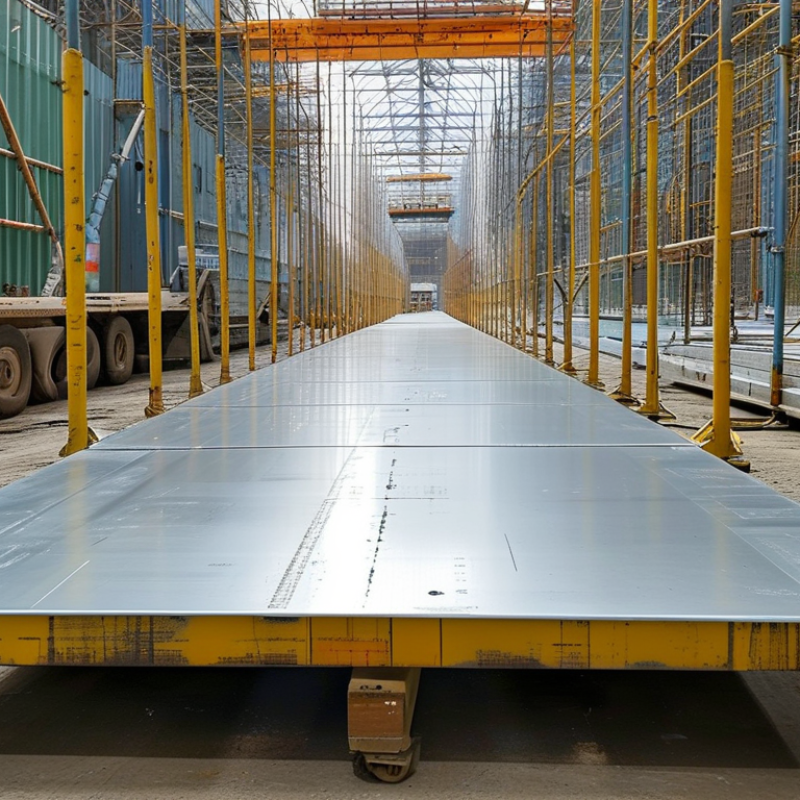
The 2026 global metal scaffold plank market is shifting toward safer, lighter, and more durable access platforms. Steel remains popular because it offers high load capacity and strong resistance to rough jobsite handling. Galvanized surfaces help reduce rust when planks face rain, dust, and repeated transport. Aluminum is gaining demand where crews value lower weight and faster installation. It also suits maintenance work in crowded urban buildings.
Construction growth is not the only demand driver. Infrastructure repairs, industrial shutdowns, warehouse expansion, and rental fleet replacement are influencing purchasing decisions. Suppliers worldwide are improving plank geometry, anti-slip surfaces, end hooks, and drainage details. Buyers should check working-load ratings, deflection limits, weld quality, and compatibility with existing scaffold systems. A clean product label matters. So does traceable factory testing.
Field experience still exposes gaps in market claims. Some lightweight planks are easier to carry but may feel less rigid under concentrated loads. Steel can endure abuse, yet its weight increases handling effort and transport costs. Forecasts may also overstate demand when construction cycles weaken. Procurement teams should compare total service life, not only the initial price. Regular inspections remain necessary, even for corrosion-resistant products. Small cracks, bent hooks, or damaged decking can change a safe platform into a serious risk.
For scaffolding planks, EN 12811 load classes describe the platform’s intended uniformly distributed load. Class 1 supports 0.75 kN/m², while Class 6 supports 6.0 kN/m². The intermediate levels are 1.5, 2.0, 3.0, and 4.5 kN/m². These figures help contractors match platforms with plastering, masonry, storage, or heavy construction work.
A reliable supplier should provide test reports, material specifications, and traceable production records. However, the load class does not describe every installation condition. Span length, plank thickness, support spacing, connection details, and local exposure can change actual performance. An engineer should verify the complete scaffold arrangement before use.
On active sites, uneven loading is common. Workers may place mortar tubs near one edge, creating concentrated stress instead of an even load. Wet surfaces, damaged hooks, and bent edges also reduce confidence. I have found that simple pre-use inspections often reveal problems missed during procurement. Still, inspection alone cannot replace structural calculations or competent supervision. Suppliers serving international projects should explain testing methods clearly, not rely on vague capacity claims. The documentation may look complete, yet one missing dimensional tolerance can make comparison difficult. Clear labeling on each plank helps crews identify the correct class quickly.
2026 Top Metal Scaffolding Planks Suppliers Worldwide
Steel and aluminum planks serve different access needs. Steel has a density near 7.85 g/cm³. Aluminum measures about 2.70 g/cm³. For identical dimensions, aluminum weighs roughly one-third as much. That difference matters during repeated lifting, transport, and platform assembly. Workers notice it quickly.
Steel usually offers higher stiffness and impact resistance. Common structural steels provide yield strengths around 250–355 MPa. Aluminum alloys may offer approximately 200–300 MPa, depending on temper and design. These figures do not tell the whole story. Plank shape, rib spacing, span, weld quality, and deflection limits also control safe performance. A lighter plank is not automatically weaker.
Corrosion data requires careful interpretation. Unprotected steel develops red rust when moisture and oxygen remain present. Galvanizing can add a durable zinc barrier, but scratches still need inspection. Aluminum forms a thin oxide layer naturally. It usually resists atmospheric corrosion better, yet saltwater and trapped chlorides can cause pitting. That risk is easy to underestimate. Suppliers should provide alloy details, coating thickness, load-test records, and traceable inspection documents. Check the actual working environment, not just a catalog chart. Weight savings can reduce handling strain, but excessive flexibility may affect user confidence and platform stability. Some comparisons also ignore end fittings and reinforcement. That is a useful warning.
Density, strength, weight, and corrosion comparison using representative engineering values
The chart indexes each property to steel = 100. Aluminum is approximately 65.6% as dense and 34.4% as heavy for the stated equal cross-section, while its representative yield strength is approximately 110.4% of the steel reference. Actual scaffold plank performance depends on alloy or steel grade, profile geometry, span, connections, surface treatment, and applicable safety standards. Corrosion rates are not universal and require site-specific exposure and coating data.
2026 Top Metal Scaffolding Planks Suppliers Worldwide
OSHA 1926.451 requires scaffold platforms to provide safe, usable working space. In most situations, that means at least 18 inches, or about 46 centimeters, of platform width. A metal plank may look strong, yet a narrow gap can still create a serious foot-placement hazard. Check the plank’s clear width after installation, not only its labeled size. Brackets, guardrails, and overlapping members can reduce usable space.
Stability also depends on height and base dimensions. When a supported scaffold rises above four times its minimum base width, it must be restrained against tipping. This 4:1 limit is not a visual estimate. Measure from the supporting surface to the platform or relevant height point, then compare it with the smallest base dimension. Use approved ties, braces, or equivalent restraint as required by the design. Suppliers should provide load data, material specifications, connection details, and inspection guidance. Ask how planks resist bending, slipping, corrosion, and damaged end hooks. A scratched coating is not always cosmetic.
A practical site check includes a tape measure, level, and written inspection record. Look for warped planks, blocked access, loose connections, and uneven support. Do not assume a heavier plank solves every problem. That assumption needs review. Regional rules may add requirements, so a competent person should verify the final setup before use.
| Supplier Evaluation Dimension | Procurement Category | Verified Technical Requirement | Relevant Standard or Reference | Evidence to Request from a Supplier | Acceptance Status |
|---|---|---|---|---|---|
| Platform width | OSHA-compliant metal scaffold plank | Minimum 18 in (46 cm) wide | OSHA 29 CFR 1926.451(b)(1) | Dimensioned drawing, product data sheet, and incoming-goods measurement record | Mandatory |
| Platform support | Plank-to-support interface | Each platform unit must be fully planked or decked within the scaffold width | OSHA 29 CFR 1926.451(b)(1) | Installation instructions showing bearing, spacing, overlap, and allowable support arrangement | Mandatory |
| Plank condition | Inspection and serviceability | No visible damage, bending, corrosion-related section loss, or other defects that could affect strength | OSHA 29 CFR 1926.451(f)(7) | Inspection checklist, rejection criteria, repair policy, and traceable lot records | Mandatory |
| Load capacity | Light-, medium-, or heavy-duty platform selection | Rated load must be established by the manufacturer or a qualified person for the specific span and support condition | OSHA 29 CFR 1926.451(a)(1), (a)(4) | Stamped safe-working-load table, span limits, test basis, and engineering calculations | Mandatory |
| Uniform loading | Distributed platform loading | Scaffold and components must support their own weight plus at least 4 times the maximum intended load | OSHA 29 CFR 1926.451(a)(1) | Design calculation identifying dead load, live load, impact assumptions, and safety factor | Mandatory |
| Stability ratio | Free-standing scaffold stability | A scaffold exceeding 4 times the minimum base dimension in height must be restrained against tipping | OSHA 29 CFR 1926.451(d)(3) | Base-dimension calculation, tie or brace layout, and competent-person inspection record | Mandatory |
| Tie and brace design | Stability accessories supplied with the system | Ties, guys, braces, or equivalent stabilizing measures must be installed according to the scaffold design and site conditions | OSHA 29 CFR 1926.451(c)(1), (d)(3) | System assembly manual, tie pattern, anchorage requirements, and field verification procedure | Mandatory |
| Slip resistance | Deck surface and walking safety | Platform surfaces must be free of slippery conditions and hazards that could cause falls | OSHA 29 CFR 1926.451(f)(8) | Surface-finish specification, wet-condition guidance, and anti-slip test or inspection method | Mandatory |
| End restraint | Plank retention and uplift control | Platform units must be secured against displacement when required by the scaffold configuration or work conditions | OSHA 29 CFR 1926.451(b)(4), (f)(5) | Approved locking, cleating, hook, or restraint details and installation instructions | Mandatory |
| Material traceability | Steel or aluminum plank production | Material grade, heat or batch identification, and production lot must be traceable to inspection records | Quality-control best practice; verify against the project specification | Mill certificate, batch number, inspection report, and marking or labeling scheme | Recommended |
| Corrosion protection | Outdoor and repeated-use applications | Protective coating or corrosion-resistant material must be suitable for the intended environment and service life | Project specification and manufacturer’s corrosion guidance | Coating type, coating-thickness record, salt-spray or durability data where specified | Recommended |
| Dimensional consistency | Interchangeable modular planks | Length, width, thickness, end profile, and bearing details must remain within documented production tolerances | Manufacturer’s approved drawing and applicable regional specification | Inspection plan, tolerance table, calibration records, and sample measurement report | Recommended |
| Regional compliance | Worldwide project suitability | Supplier should identify the governing local scaffold rules in addition to OSHA requirements when products are exported | United States: OSHA 29 CFR 1926.451; Europe: EN 12811-1; Australia/New Zealand: AS/NZS 1577.1 where applicable | Country-specific declaration, engineering documentation, user instructions, and conformity records | Mandatory |
| Documentation quality | Supplier qualification | Technical documents must state intended use, allowable span, load rating, support conditions, inspection requirements, and limitations | OSHA 29 CFR 1926.451; project-specific engineering requirements | Controlled product manual, drawings, load tables, inspection forms, and revision history | Mandatory |
| Training support | Installation and user guidance | Employees using or erecting scaffolds must receive training appropriate to the hazards and procedures involved | OSHA 29 CFR 1926.454 | Assembly training materials, competent-person guidance, toolbox-talk documents, and inspection forms | Recommended |
Note: OSHA’s minimum platform width is 18 inches, commonly rounded to 46 cm. The 4:1 rule concerns scaffold height relative to the minimum base dimension and does not replace project-specific structural design, tie-in requirements, or competent-person inspection.
Choosing metal scaffolding planks requires more than comparing prices. On active construction sites, I inspect plank edges, weld consistency, surface finish, and locking details. Small defects become serious when workers carry materials at height.
Reliable suppliers provide traceable certifications, not vague compliance statements. Check whether ISO 9001 covers the manufacturing facility. Review applicable EN 12811 or equivalent technical requirements. Ask for certificates with issuing bodies, dates, product codes, and testing scope. A certificate alone proves little.
Load-test evidence deserves close attention. Request reports showing test span, applied load, deflection, slip resistance, and failure behavior. The tested plank should match the delivered thickness and alloy. Samples from different batches can reveal variation. That step costs time.
Written warranty terms should define coating failure, deformation, replacement procedures, and response times. Exclusions need careful reading, especially for storage damage or improper support. A five-year warranty sounds strong, but vague wording weakens its value.
Lead time must include production, independent inspection, packing, and transport. Ask for a realistic schedule, not an optimistic promise. For urgent projects, suppliers should disclose available stock and batch numbers. I have seen short quotations hide long inspection queues.
Our evaluations are not flawless. Local weather, handling habits, and changing project loads can alter performance. A second technical review is often worthwhile. Reliability grows through documented evidence, site experience, and honest communication.
We use cookies on our website to give you an improved browser experience. View our Privacy Policy for more information. Please make your selection to opt in or out of ALL cookies here: Accept or Decline
Do you consent to the use of ALL cookies?
901 2nd Court West
Birmingham, AL 35204
Sales: 866.481.4036
Logistics/Ops: 866.481.4036
2101 Dralle Road
University Park, IL 60466
Sales: 708.813.9070
Logistics/Ops: 708.235.4200
400 E. 13th Street
Little Rock, AR 72114
Sales: 866.760.5344
Logistics/Ops: 866.760.5344
225 Collins Road
Elkhart, IN 46515
Sales: 574.295.0214
Logistics/Ops: 574.607.4611
601 Berryman Pike
Tipton, IN 46072
Sales: 800.897.7591
Logistics/Ops: 800.897.7591
3900 Uvalda Street
Denver, CO 80239
Sales: 303.706.8000
Ops/Logistics: 303.576.8398
510 3rd Street E
Milan, IL 61264
Sales: 800.322.1052
Logistics/Ops: 800.322.1052
1660 E. Aurora
Des Moines, IA 50313
Sales: 800.671.1660
Logistics: 800.671.1660
86554 Gene Lasserre Blvd.
Yulee, FL 32097
Sales: 904.253.3060
Logistics/Ops: 904.225.3000
694 S.E. County Road 245
Lake City, FL 32025
Sales: 800.727.6706
Logistics/Ops: 386.752.7412
210 Neptune Road
Auburndale, FL 33823
Sales: 863.967.1131
Logistics/Ops: 863.777.9814
4601 McCoy Drive
Pensacola, FL 32503
Sales: 850.308.7030
Logistics/Ops: 850.434.5502
815 South 56th Street
Tampa, FL 33619
Sales: 813.302.1940
Logistics/Ops: 813.621.1352
200 Hosea Road
Lawrenceville, GA 30046
Sales: 770.953.7575
Logistics/Ops: 770.513.6000
Branch Product Guide
Branch Line Card
Moulding Offering
Cedar Offering
Column Offering
8173 Hwy. 165 North
Monroe, LA 71211
Sales: 800.256.4165
Logistics/Ops: 800.256.4165
508 Warren Avenue
Portland, ME 04103
Sales: 207.888.2331
Logistics/Ops: 207.797.6565
4300 Georgia Pacific Blvd.
Frederick, MD 21704
Sales: 301.798.7474
Logistics/Ops: 301.874.8000
419 Maple Street
Bellingham, MA 02019
Sales: 508.449.0535
Logistics/Ops: 508.966.5500
825 Buchanan Ave SW
Grand Rapids, MI 49507
Sales: 877.800.1180
Logistics/Ops: 616.278.0909
995 Pacific St. NW
Aitkin, MN 56431
Sales: 800.432.3727
Logistics/Ops: 218.212.7770
1102 Port Terminal Drive
Duluth, MN 55802
Sales: 800.951.9899
Logistics/Ops: 800.851.9899
9110 83rd Ave. North
Brooklyn Park, MN 55445
Sales: 763.425.0204
Logistics/Ops: 763.425.0204
910 E. Railroad Street
Long Beach, MS 39560
Sales: 866.535.4135
Logistics/Ops: 228.205.2400
1727 Warren Street
North Kansas City, MO 64116
Sales: 800.621.2611
Logistics/Ops: 800.621.2611
2123 North Golden
Springfield, MO 65803
Sales: 800.375.7891
Logistics/Ops: 800.375.7891
13860 Corp. Woods Trail
Bridgeton, MO 63044
Sales: 314.209.0800
Logistics/Ops: 314.209.0800
1109 South 19th Street
Omaha, NE 68108
Sales: 800.489.6637
Logistics/Ops: 800.489.6637
1 Luger Road
Denville, NJ 07834
Sales: 973-339-3539
Logistics/Ops: 973.625.1461
3720 Jeffrey Blvd.
Blasdell, NY 14219
Sales: 716.235.5989
Logistics/Ops: 716.825.6557
319 Yaphank Ave.
Yaphank, NY 11980
Sales: 631.358.5714
Logistics/Ops: 631.924.7401
3300 Parkside Drive
Charlotte, NC 28208
Sales: 800.839.2588
Logistics/Ops: 704.394.3172
1712 East D Street
Butner, NC 27509
Sales: 984.389.8200
Logistics/Ops: 919.575.3700
128 Foothills Drive
Statesville, NC 28687
Sales: 800.222.1414
Logistics/Ops: 704.394.3172
550 Munroe Falls Rd.
Tallmadge, OH 44278
Sales: 330.357.4506
Logistics/Ops: 330.794.1141
10347 Toebben Dr.
Independence, KY 41051
Sales: 859.298.3926
Logistics/Ops: 859.746.2250
450 N. MacArthur
Oklahoma City, OK 73127
Sales: 800.375.6025
Logistics/Ops: 800.375.6025
1680 North Aspen
Broken Arrow, OK 74012
Sales: 918.272.2212
Logistics/Ops: 918.272.2212
522 Bridge Street
Hunker, PA 15639
Sales: 878.217.2001
Logistics/Ops: 724.925.7285
4290 Atlanta Street
Charleston, SC 29418
Sales: 843.371.1420
Logistics/Ops: 843.554.8192
1040 S. Industrial Dr.
Erwin, TN 37650
Sales: 423.641.1005
Logistics/Ops: 423.742.5911
4287 Pilot Drive
Memphis, TN 38118
Sales: 901.365.2101
Logistics/Ops: 901.365.2101
700 Myatt Drive
Madison, TN 37115
Sales: 615.327.9547
Logistics/Ops: 629.777.4949
4747 Mark IV Parkway
Fort Worth, TX 76106
Sales: 866.323.5117
Logistics/Ops: 817.625.9091
6990 Market Avenue
El Paso, TX 79915
Sales: 915.778.6356
Logistics/Ops: 915.265.7200
2502 Wilson Road
Harlingen, TX 78552
Sales: 800.580.6711
Logistics/Ops: 800.580.6711
10,000 North Loop East
Houston, TX 77029
Sales: 713.921.1977
Logistics/Ops: 713.675.3544
702 East 44th St.
Lubbock, TX 79404
Sales: 866.454.6010
Logistics/Ops: 866.454.6010
535 N. WW White Road
San Antonio, TX 78219
Sales: 800.284.0488
Logistics/Ops: 210.333.8112
142 Pine Haven Shores Rd.
Shelburne, VT 05482
Sales: 802.800.2540
Logistics/Ops: 802.985.2512
4700 Bethlehem Road,
Richmond, VA 23230
Sales: 804.201.2400
Logistics/Ops: 804.342.1161
4516 N Barker Road
Spokane Valley, WA 99027
Phone: 509.892.9420
Toll free: 800.728.6157
8365 N. 76th Street
Milwaukee, WI 53223
Sales: 800.356.9245
Logistics/Ops: 800.356.9245
312 S. Chester Street
Sparta, WI 54656
Sales: 800.362.5864
Logistics/Ops: 800.362.5864
899 Grossman Drive
Schofield, WI 54476
Sales: 800.472.0017
Logistics/Ops: 800.472.0017
